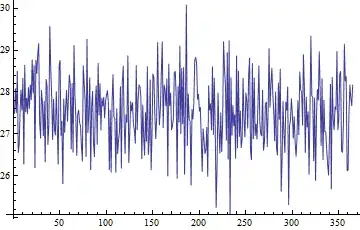
I'm trying to find mean of temperature data list. The temperature data list has 3 hours steps which means I have 365*8=2920 temperature measurements per year. My data are temperatures of 13 years. First I found mean temperature of 13 years "t" one by one list by the following:
 MeanTemp={Mean[Transpose[Partition[t[[1 ;; 365*8]], 8], {2, 1}]],
 Mean[Transpose[Partition[t[[365*8 + 1 ;; 365*8*2]], 8], {2, 1}]],
 Mean[Transpose[Partition[t[[365*8*2 + 1 ;; 365*8*3]], 8], {2, 1}]],
 Mean[Transpose[Partition[t[[365*8*3 + 1 ;; 365*8*4]], 8], {2, 1}]],
 Mean[Transpose[Partition[t[[365*8*4 + 1 ;; 365*8*5]], 8], {2, 1}]],
 Mean[Transpose[Partition[t[[365*8*5 + 1 ;; 365*8*6]], 8], {2, 1}]],
 Mean[Transpose[Partition[t[[365*8*6 + 1 ;; 365*8*7]], 8], {2, 1}]],
 Mean[Transpose[Partition[t[[365*8*7 + 1 ;; 365*8*8]], 8], {2, 1}]],
 Mean[Transpose[Partition[t[[365*8*8 + 1 ;; 365*8*9]], 8], {2, 1}]],
 Mean[Transpose[Partition[t[[365*8*9 + 1 ;; 365*8*10]], 8], {2, 1}]],
 Mean[Transpose[Partition[t[[365*8*10 + 1 ;; 365*8*11]], 8], {2, 1}]],
  Mean[Transpose[
   Partition[n[[365*8*11 + 1 ;; 365*8*12]], 8], {2, 1}]],
 Mean[Transpose[Partition[n[[365*8*12 + 1 ;; 365*8*13]], 8], {2, 1}]]};
Then I subtract mean temperature of all years from it. Which means I found variance of temperature:
TempVariance={Mean[Transpose[Partition[t[[1 ;; 365*8]], 8], {2, 1}]] -
  meanofyear,
 Mean[Transpose[Partition[t[[365*8 + 1 ;; 365*8*2]], 8], {2, 1}]] -
  meanofyear,
 Mean[Transpose[Partition[t[[365*8*2 + 1 ;; 365*8*3]], 8], {2, 1}]] -
  meanofyear,
 Mean[Transpose[Partition[t[[365*8*3 + 1 ;; 365*8*4]], 8], {2, 1}]] -
  meanofyear,
 Mean[Transpose[Partition[t[[365*8*4 + 1 ;; 365*8*5]], 8], {2, 1}]] -
  meanofyear,
 Mean[Transpose[Partition[t[[365*8*5 + 1 ;; 365*8*6]], 8], {2, 1}]] -
  meanofyear,
 Mean[Transpose[Partition[t[[365*8*6 + 1 ;; 365*8*7]], 8], {2, 1}]] -
  meanofyear,
 Mean[Transpose[Partition[t[[365*8*7 + 1 ;; 365*8*8]], 8], {2, 1}]] -
  meanofyear,
 Mean[Transpose[Partition[t[[365*8*8 + 1 ;; 365*8*9]], 8], {2, 1}]] -
  meanofyear,
 Mean[Transpose[Partition[t[[365*8*9 + 1 ;; 365*8*10]], 8], {2, 1}]] -
   meanofyear,
 Mean[Transpose[
    Partition[t[[365*8*10 + 1 ;; 365*8*11]], 8], {2, 1}]] -
  meanofyear,
 Mean[Transpose[
    Partition[t[[365*8*11 + 1 ;; 365*8*12]], 8], {2, 1}]] -
  meanofyear,
 Mean[Transpose[
    Partition[t[[365*8*12 + 1 ;; 365*8*13]], 8], {2, 1}]] -
  meanofyear}
I think this manuscript would be so long if the data increases.How to decrease the manuscript and increase flexibility?




Partition...among other things. – ciao Apr 12 '14 at 07:13