Given a list
list = {1,2,2,2,2,5,1,3,2,6,6,6,6,6,6,6,6,6,6,6,10,-3};
how to find the longest constant sublist (or equivalently the element and the number of times it is repeated)?
(in this example, {6,6,6,6,6,6,6,6,6,6,6} or {6,11})
Given a list
list = {1,2,2,2,2,5,1,3,2,6,6,6,6,6,6,6,6,6,6,6,10,-3};
how to find the longest constant sublist (or equivalently the element and the number of times it is repeated)?
(in this example, {6,6,6,6,6,6,6,6,6,6,6} or {6,11})

Concisely and reasonably efficiently:
Last @ Sort @ Split @ list
{6, 6, 6, 6, 6, 6, 6, 6, 6, 6, 6}
More efficiently:
# ~Extract~ Ordering[#, -1] & @ Split @ list
{6, 6, 6, 6, 6, 6, 6, 6, 6, 6, 6}
Multiple longest runs:
longestRuns[x_List] :=
  With[{sp = Split[x]},
    sp ~Extract~ Position[#, Max@#] &[Length /@ sp] & @ x
  ]

{1, 2, 2, 3, 4, 4, 5, 6} // longestRuns
{{2, 2}, {4, 4}}
Less efficiently but having fun with patterns:
list /. {___, seq : Longest[x_ ..], ___} :> {seq}
{6, 6, 6, 6, 6, 6, 6, 6, 6, 6, 6}

I post this somewhat ridiculous answer for 'fun', acknowledging all the given answers directly answer the question, esp Mr. Wizard. I post just ways of 'visualizing' longest run:
list = {1, 2, 2, 2, 2, 5, 1, 3, 2, 6, 6, 6, 6, 6, 6, 6, 6, 6, 6, 6,
   10, -3};
With[{w = Union@list},
 ArrayPlot[Map[Function[x, Unitize[# - x] & /@ list], w],
  FrameTicks -> {{Thread[{Range[Length@w], w}],
     None}, {Range[Length@list], None}}]]

Of course you could ArrayPlot with your own color scheme.
Increasing the overkill:
ind = Range[Length@list];
gg = With[{pt = Partition[ind, 2, 1]},
   UndirectedEdge @@@ Pick[pt, Length@Union[list[[#]]] == 1 & /@ pt]];
gp = Graph[ind, gg,
  VertexLabels ->
   Thread[ind -> (Placed[
         Framed[#, Background -> Yellow, RoundingRadius -> 4],
         Center] & /@ list)],
  GraphLayout -> "HighDimensionalEmbedding", VertexSize -> 0,
  PlotRangePadding -> {1, 2}, EdgeStyle -> Directive[Thick, Red]]
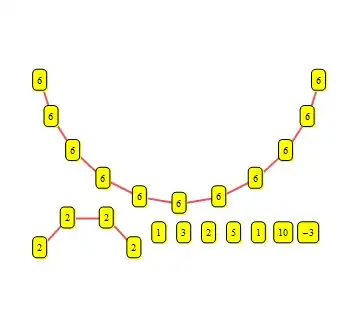
Note:
comp = ConnectedComponents[gp] /. Thread[ind -> list]
yields:
{{6, 6, 6, 6, 6, 6, 6, 6, 6, 6, 6}, {2, 2, 2,
  2}, {5}, {3}, {1}, {10}, {1}, {2}, {-3}}
or increasing the overkill using CommunityGraphPlot:
CommunityGraphPlot[
 Graph[ind, gg,
  VertexLabels ->
   Thread[ind -> (Placed[
         Style[#, White, Bold, FontFamily -> "Kartika", 12],
         Center] & /@ list)], VertexSize -> 1.5,
  EdgeStyle -> Directive[Thick, Red]], ConnectedComponents[gp],
 Method -> "Hierarchical", CommunityRegionStyle -> Green]
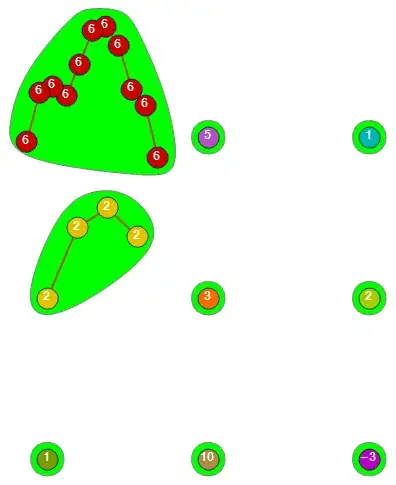
or showing the 'chain':
CommunityGraphPlot[
 Graph[UndirectedEdge @@@ Partition[ind, 2, 1],
  VertexLabels ->
   Thread[ind -> (Placed[
         Style[#, White, Bold, FontFamily -> "Kartika", 10],
         Center] & /@ list)], VertexSize -> 1, EdgeStyle -> Thick],
 ConnectedComponents[gp], CommunityRegionStyle -> Green,
 ImageSize -> 800]


In Version 10 you can use the new function MaximalBy:
Split@list~MaximalBy~Length
{{6, 6, 6, 6, 6, 6, 6, 6, 6, 6, 6}}
You can also use it in the operator form:
MaximalBy[Length]@Split@list

Faster, properly returns multiple sublists if there are more than one sequence with maximal length:
Module[{l = #,
        sa = Append[SparseArray[Differences@#]["AdjacencyLists"], Length@#],
        sap, p},

   sap = Prepend[Most@sa + 1, 1];
   p = Pick[Transpose[{sap, sa}], sa - sap, Max[sa - sap]];
   l[[Span @@ #]] & /@ p] &[targetListHere]

Another way, maybe not so efficient:
With[{list = {1, 2, 3, 2, 3, 3, 3, 3}},
LongestCommonSubsequence[list,
ConstantArray[#, Length@list]] & /@ (DeleteDuplicates@list)]

