Here is how you do this analytically: (using user2790167's pull in pure function form)
 nFibers = 50;
 mean = 100;
 stdev = 20;
 fibers = Sort@RandomVariate[NormalDistribution[mean, stdev], nFibers];
 Show[{
      Plot[  InverseCDF[ NormalDistribution[ mean, stdev] , nweak/nFibers]
         (nFibers - nweak + 1 ), {nweak, 1, nFibers - 1}, PlotStyle -> {Red, Dashed}],
      ListPlot[
         Rest@First@
            Transpose@
              NestList[{First@#[[2]] Length@#[[2]], Rest@#[[2]]} &,
                  {0, fibers}, nFibers], Joined -> True,
          AxesLabel -> {"Broken Fibers", "Net Load"}]}, PlotRange -> All,
          AxesOrigin -> {0, 0}]
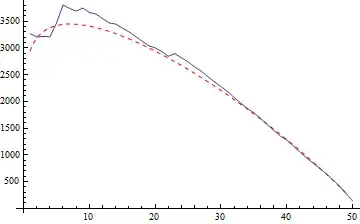
Also it is useful to plot against the strength of the fiber that is about to fail:
(which correlates to strain assuming equal stiffness of the fibers )
 nFibers = 50;
 mean = 100;
 stdev = 20;
 fibers = Sort@RandomVariate[NormalDistribution[mean, stdev], nFibers];
 Show[{
   Plot[  s  (nFibers (1 - CDF[ NormalDistribution[ mean, stdev] , s]) ) ,
       {s, 0, 200}, PlotStyle -> {Red, Dashed}],
   ListPlot[
     First@
        Transpose@
           NestList[{{First@#[[2]] {1, Length@#[[2]]}, Rest@#[[2]]} &,
             {{0, 0}, fibers}, nFibers], Joined -> True,
           AxesLabel -> {"min surviving strength", "Net Load"}]}, PlotRange -> All,
           AxesOrigin -> {0, 0}, AspectRatio -> 1/GoldenRatio]

for large nFibers the simulations converge to the analytic form..


Select. (You can do this analytically as well usingCDFclarify if thats what you mean. ) – george2079 Apr 25 '14 at 14:30listfrom theselectcommand? – user10600 Apr 25 '14 at 14:37RandomVariate.. – george2079 Apr 25 '14 at 14:45