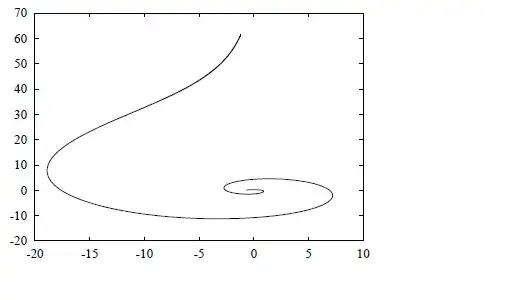
Generically there are 10 branches to choose for the value of x'[t] at a value for x[t] in the OP's differential equation
deOP = x'[t] == (1 + (I x[t])^(9/5))^(1/2)
In this form, however, there will be discontinuous jumps in the value of x'[t] whenever x[t] crosses a branch cut of the differential equation deOP. We can rationalize the equation to get the differential equation
deRat = (x'[t]^2 - 1)^5 == (I x[t])^9
This form still has the intrinsic problem that there are generically 10 solutions for x'[t] for a given value of x[t]; however, there are not discontinuous jumps from crossing branch cuts in Mathematica functions.
Because of the square root (or equivalently, x'[t]^2), the roots come in pairs with opposite signs. The pair of integral curves corresponding to such a pair of roots in fact trace the same path in the complex plane, but in opposite directions. So generically through each value for x[0] pass five integral curves.
Theoretically the solutions may be computed with
NDSolve[{deRat, x[0] == x0}, x, {t, -8, 8}]
and indeed Mathematica tries to find all ten. It is slow and it seems to have trouble staying on the right branch (there are corners in the plots, indicating a discontinuity in the derivative).
Another approach is to differentiate deRat to get a second order equation that is linear in x''[t]; then x'[t] will be integrated from the initial value and Mathematica never has to choose a branch. The branch will be chosen by the choice of the initial value. If the initial value for x'[0] is dx0, then the following code will find the solution:
NDSolveValue[{
   x''[t] == (x''[t] /. First@Solve[D[deRat, t], x''[t]]),
   x'[0]  == dx0,
   x[0]   == x0},
  x, {t, -100, 100}] &,
The five initial values for x'[0] that yield the distinct integral curves may be found with
Select[
 x'[0] /. Solve[{deRat /. t -> 0, x[0] == x0}, {x[0], x'[0]}],
 Re[#] > 0 &]
Below I'll get all the solutions by mapping NDSolve over the initial values for x'[0]. I'll integrate each solution until it exceeds a specified distance from the initial point x[0], using WhenEvent. To plot the solutions, it will be convenient to change how the interpolating functions extrapolate, since each solution will have a different domain.
The accepted answer to
What's inside InterpolatingFunction[{{1., 4.}}, <>]?
shows what parts of an InterpolatingFunction to modify to change the default extrapolation behavior. We can change the value returned by the InterpolatingFunction to Indeterminate; then ParametricPlot simply does not plot a point when the input t is outside of the domain. The function doNotExtrapolate alters an InterpolatingFunction in this way.
Here is the complete code:
ClearAll[x, t, doNotExtrapolate];
doNotExtrapolate[if_InterpolatingFunction] :=
  ReplacePart[if, {
    {2, 10} -> (Indeterminate &),      (* Extrapolation Handler *)
    {2, 2} -> 6                        (* Warning -> False *)
    }];


deOP = x'[t] == (1 + (I x[t])^(9/5))^(1/2);
deRat = (x'[t]^2 - 1)^5 == (I x[t])^9;

x0 = -9877/10000 + I  1563/10000;
plotradius = 10;
dx0All = SortBy[
   Select[
    x'[0] /. Solve[{deRat /. t -> 0, x[0] == x0}, {x[0], x'[0]}],
    Re[#] > 0 &],
   Arg[N[#]] &];

xAll = Map[
    NDSolveValue[{
       x''[t] == (x''[t] /. First@Solve[D[deRat, t], x''[t]]),
       x'[0]  == #,
       x[0]   == x0,
       WhenEvent[Abs[x[t] - x0] > plotradius, "StopIntegration"]},
      x, {t, -100, 100}] &,
    dx0All
    ] /. if_InterpolatingFunction :> doNotExtrapolate[if];
Output:
GraphicsRow @ Table[
  With[{dx = plotradius/n, plotctr = {-0.9877, 0.1563}},
   ParametricPlot[Evaluate[{Re[#[t]], Im[#[t]]} & /@ xAll],
    Evaluate[{t}~Join~Through[{Min, Max}[Through[xAll["Domain"]]]]],
    PlotRange -> (plotctr + {{-dx, dx}, {-dx, dx}}),
    AspectRatio -> 1]
   ],
  {n, {1, 4, 50}}]