As per rasher's suggestions:
Finding critical points:
f[x_, y_] := (y/2) (2 Cos[2 x] + 2 Cos[x] + 1)/
    5 + ((1 - y)/2) (2 Cos[x] + 1)/3.
Solve[{D[f[x, y], x] == 0, D[f[x, y], y] == 0}, {x, y}]
yields:
{{x -> 0.}, {x -> -2.30052, y -> 0.5}, {x -> 2.30052, y -> 0.5}}
Note
(i) this does not find all solutions (note symmetries of surface)
(ii) the third (and symmetrical solution around Pi) are in the domain of interest
(iii) the third solution is a saddle point (see following):
g[a_, b_] :=
 D[f[x, y], {x, 2}] D[f[x, y], {y, 2}] -
   D[f[x, y], x, y]^2 /. {x -> a, y -> b}
g[2.300523983021863`, 0.5]
g[2Pi-2.300523983021863`, 0.5]
both yield: -0.246914 <0 -> saddle point
Displaying surface at y=1/2 shows symmetry (with some cheating with Mesh):
Plot[f[x, 1/2], {x, 0, 2 Pi}, MeshFunctions -> {#2 + 1./18.01 &},
 Mesh -> {{0}}, PlotRange -> {-0.2, 0.5},
 MeshStyle -> PointSize[0.03], PlotPoints -> 200]

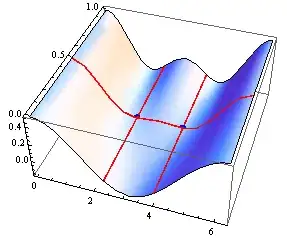
The intersection shows the saddle points:
Show[Plot3D[Evaluate@f[x, y], {x, 0, 2 Pi}, {y, 0, 1},
  MeshFunctions -> {#1 &, #2 &},
  Mesh -> {{2 Pi - 2.300523983021863`, 2.300523983021863`}, {0.5}},
  MeshStyle -> {{Red, Thickness[0.006]}}],
 Graphics3D[{Blue, PointSize[0.03],
   Point[{##, f[##]} & @@@ {{2 Pi - 2.300523983021863`,
       0.5}, {2.300523983021863`, 0.5}}]}]]


FindMinimumet al. probably not useful to you for this: They are for finding local min/max. You could try solving for critical points, then sieve them, or get sneaky and abuse plot/mesh functions to extract them. See e.g. here (and other tricks in other answers there). – ciao Jun 17 '14 at 06:39