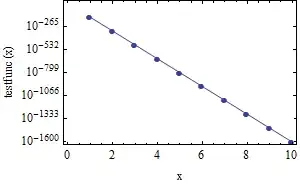
At some point, the plot functions make the coordinates machine-sized numbers. At that point, numbers smaller than [$MinMachineNumber](http://reference.wolfram.com/mathematica/ref/$MinMachineNumber.html) (`2.22507*10^-308` on my MacBook Pro) probably get converted to zero. `LogPlot` and `ListLogPlot` behave differently. It appears as if numbers less than `$MinMachineNumberare converted to zero byLogPlot**before** being plugged intoLog, whereasListLogPlottakes theLog` first.
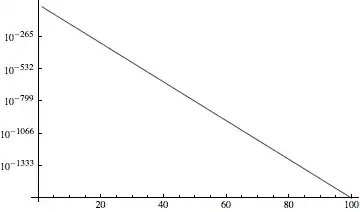
Here's a workaround that allows one to use the sampling of Plot. Apparently, the underflow does not interfere with Plot's adaptive sampling.
ListLogPlot[
 Transpose[{#[[1]], Exp[#[[2]]]} &@Transpose[#]] & /@
  Cases[Plot[Log@testfunc[x], {x, 1, 100}], Line[pts_] :> pts, Infinity],
 Joined -> True]
A general purpose function:
Options[listLogPlotFromPlot] =
  DeleteDuplicates@Join[Options[ListLogPlot], Options[Plot]];
SetAttributes[listLogPlotFromPlot, HoldAll];

listLogPlotFromPlot[f_, domain_, opts : OptionsPattern[]] :=
 With[{plotopts = FilterRules[{opts}, Options[Plot]]},
  ListLogPlot[
   Transpose[{#[[1]], Exp[#[[2]]]} &@ Transpose[#]] & /@
    Cases[Plot[Log[f], domain, plotopts], Line[pts_] :> pts, Infinity],
   FilterRules[{opts}, Options[ListLogPlot]]
   ]
  ]
Unfortunately, separate Lines get styled with separate colors by ListLogPlot:
listLogPlotFromPlot[10^-400 Sin[x]^2, {x, 0, 16}]

One can fix it by supplying a PlotStyle. Below we also join the points with a Line.
listLogPlotFromPlot[10^-400 Sin[x]^2, {x, 0, 16},
 Joined -> True, PlotStyle -> ColorData[1][1]

One could also fix the coloring problem in the function listLogPlotFromPlot, but it seemed preferable to leave disconnected lines disconnected. Beware, there may be problems, especially with styling, if a list of functions is used. It would be best to generate the plots separately and combine with Show.




PlotRange -> All, the x-axis completely disappears... – Yves Klett Jul 03 '14 at 18:28$MinMachineNumber == 2.22507*10^-308. I suspect smaller numbers become0.– Michael E2 Jul 03 '14 at 18:45LogPlot[Log@testfunc[x], {x, 1, 100}, WorkingPrecision -> $MachinePrecision]. It shouldn't, but it does. – Michael E2 Jul 03 '14 at 22:50$MachinePrecisionwill result in arbitrary precision. Perhaps you were thinking ofMachinePrecision? Or do I misunderstand the implication of your comment? – Mr.Wizard Jul 04 '14 at 04:50LogPlot[Log@testfunc[x], {x, 1, 100}, WorkingPrecision -> $MachinePrecision]gives the (correct) plot ofLogPlot[testfunc[x], {x, 1, 100}](V9.0.1, 8.0.4, 7).Log@testfunc[x]is negative over plot domain --LogPlotshould yield a blank graph. Right?? – Michael E2 Jul 04 '14 at 13:134or more. One can also compare withListLogPlot[Table[Log@testfunc[x], {x, 1, 100}]]andListLogPlot[Table[testfunc[x], {x, 1, 100}]]. The same thing happens with other underflow functions insideLog, AFAICT, e.g.LogPlot[Log[10^(-400) Sin[x]], {x, 0, 20}, WorkingPrecision -> $MachinePrecision]. – Michael E2 Jul 04 '14 at 13:32