How I can obtain $n^{th}$ approximation of the following equation $f(t)=t+\int_0^tds f(s)$ by iteration method?
Asked
Active
Viewed 2,288 times
4

-
I've rolled back your question to it's original version, as I think your change of dimension is significant enough to warrant a new question. Feel free to open such a new question! Furthermore, no one can really answer this one, as it's closed anyway! (Not that I agree with the closure.) – Mark McClure Jul 23 '14 at 14:48
-
Please don't roll back my roll back! Honestly, it makes no sense for two reasons. Your original question refers to quite a specific operator so changing the operator wastes the efforts of those who answered the question. Secondly, this question has been closed so no one can answer it now anyway. If you have another question, simply open a new question. – Mark McClure Jul 23 '14 at 22:33
-
@Javad I encourage you to post a new question as Mark suggested. – Mr.Wizard Jul 24 '14 at 06:37
-
I am so sorry @MarkMcClure. I am a beginner in this area. – Javad Kazemi Jul 24 '14 at 11:28
-
No biggie - you'll probably be an expert one day! – Mark McClure Jul 24 '14 at 11:39
3 Answers
3
T[f_] := t + Integrate[f /. t -> s, {s, 0, t}];
NestList[T, t, 5]

(* Out:
  {t, t + t^2/2, t + t^2/2 + t^3/6,
   t + t^2/2 + t^3/6 + t^4/24,
   t + t^2/2 + t^3/6 + t^4/24 + t^5/120,
   t + t^2/2 + t^3/6 + t^4/24 + t^5/120 + t^6/720}
*)
Looks like $f(t)=e^t - 1$ is a fixed point.
T[E^t - 1]
(* Out: -1 + E^t *)

Mark McClure
- 32,469
- 3
- 103
- 161
-
what is your opinion about matrix form of the equation? for example $F(t)=A(t)+\int_0^tB(s)F(s)ds$ where F, A and B are matrices. – Javad Kazemi Jul 23 '14 at 00:10
-
@JavadKazemi I think the same basic idea should work, though it would be nice to have a specific example in mind. – Mark McClure Jul 23 '14 at 01:01
-
1What is your idea about $A(t)=\bigg{(}\begin{matrix} t & 0 \ Cos(t) & 1 \end{matrix}\bigg{)}$ and $B(s)=\bigg{(}\begin{matrix} e^s & 0 \ 0 & e^{-s} \end{matrix}\bigg{)}$? – Javad Kazemi Jul 23 '14 at 14:30
3
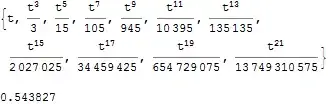
I assume you wanted the Neumann series method.
ClearAll[f, t, s];
f[0] = t;
f[n_] := f[n] = Integrate[(f[n - 1] /. t -> s) s, {s, 0, t}];
data = Table[f[i], {i, 0, 10}]
Total@data
% /. t -> .5
(*0.543827*)

Nasser
- 143,286
- 11
- 154
- 359
0
Unless you have hidden functions and variables:
n = 4; (*Put whatever term you want here*)
x0 = 0; (*This is the point you want to expand around*)
(*Define g[s] here*)
g[t] = t + Integrate[f[s], {s, 0, t}] ;
Series[g[t], {t, x0, n}];
Normal[%][[n]] (*This is the answer you want*)

DrXenocide
- 53
- 1
- 6