I have a 2D array,
data = {{0,1}, {1,2}, {2,3}};
I would like to convert it such that I get the x- and y-values separately, specifically
x[0]=0; x[1]=1; x[2]=2;
y[0]=1; y[1]=2; y[2]=3;
Is there a way to obtain this?
I have a 2D array,
data = {{0,1}, {1,2}, {2,3}};
I would like to convert it such that I get the x- and y-values separately, specifically
x[0]=0; x[1]=1; x[2]=2;
y[0]=1; y[1]=2; y[2]=3;
Is there a way to obtain this?

Probably not the prettiest but here you go:
data = {{0, 1}, {1, 2}, {2, 3}};
(x[#] = (First /@ data)[[#2]]) & @@@
  Thread@{Range[0, Length[First /@ data] - 1], Range[Length[First /@ data]]};
(y[#] = (Last /@ data)[[#2]]) & @@@
  Thread@{Range[0, Length[Last /@ data] - 1], Range[Length[Last /@ data]]};

?x
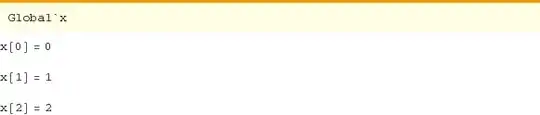

One-liner:
MapThread[Set, {{x[#], y[#]} & /@ Range[0, Length@data - 1], data}];


x[1] already has a value it will evaluate before Set sees it, so you'll be doing effectively 1 = 2 or whatever. You would need to hold that expression somehow. If you cannot see a solution for that, and you are interested, post this code in a Question asking how it may be modified to allow reassignment for existing definitions.
– Mr.Wizard
Aug 05 '14 at 22:27
Update: Öskå informs me that what you wanted is not in fact what you asked for. Next time ask the right question to get the right answer. Output formatting is often completely different and if that is your goal you need to clearly state it.
f[v_, {r_, c_}] := HoldForm[#[#2] = v;] &[{"x", "y"}[[c]], r - 1]

out = MapIndexed[f, data, {2}]\[Transpose] // Grid
x[0]=0; x[1]=1; x[2]=2;
y[0]=1; y[1]=2; y[2]=3;
You can use Copy As > Plain Text to copy that output, or you can export it like this:
Export["file.txt", ToString[out, StandardForm]]
I don't see the point of making the assignments that you describe.
Part is a fast operation so you might simply use that:
x[n_] := data[[n + 1, 1]]
y[n_] := data[[n + 1, 2]]
With different data to make the example more clear:
data = {{a, b}, {c, d}, {e, f}};

Array[x, 3, 0]
Array[y, 3, 0]
{a, c, e}{b, d, f}

Part and that there was something behind (his profile talks about C/C++).
– Öskå
Aug 05 '14 at 18:20
Use data[[All,1]] for all x coordinates and data[[All,2]] for all y coordinates

Scan, this is a duplicate of define a function from a list – Artes Aug 05 '14 at 11:24x[i](i.e. we have to know where we are in the list during scanning). Anyway here's my first attempt at usingScan:Scan[{x[#[[3]]]=#[[1]],y[#[[3]]]=#[[2]]}&,MapIndexed[Join,data]]. If anyone has a better implementation I'd love to hear them. – seismatica Aug 05 '14 at 14:28