I wanted to know how computers calculate basic functions like Sqrt so first I checked how humans do it I found that they use something called "Newton's method" that is basically a iterative method to find the root of a number.
that can be efficiently reproduced in Mathematica as:
SqRoot[x_, assump_, precision_] := N[Nest[(# + x/#)/2 &, assump, 21], precision]
Timing it for 2 gives:
In:= Timing[SqRoot[2, 1, 123]]
Out:= {1.75, 1.41421356237309504880168872420969807856967187537694807317667973799073247846210703885038753432764157273501384623091229702492}
1.75 Seconds
While using same precision with Sqrt gives:
In:=Timing[N[Sqrt[2], 123]]
Out:= {1.6237*10^-15,1.41421356237309504880168872420969807856967187537694807317667973799073247846210703885038753432764157273501384623091229702492}
1.6237*10^-15 Seconds
Meaning Mathematica uses an entirely different operation to calculate the root of a number
Like this there are tons of elementary functions like Factorial Abs Solve Sin Cos which result in similar fast results as compared to slower human results using slower loops and iterative methods.
Where can we find a compendium of all the back code that supports these functions and makes them faster than actual procedure.
P.S. This is related only to Mathematica based functions (not theoreticalcs.SE)


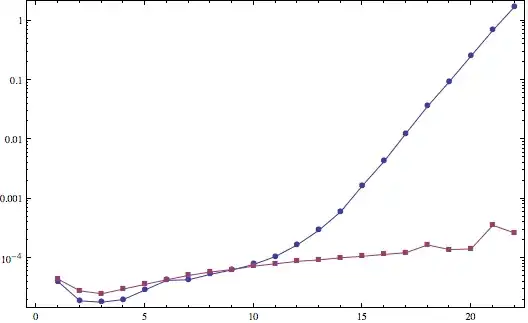

Timingdoes not mean thatMathematicauses an entirely different operation ! Functions likeSqrtare written in a compiled language (C),Mathematicais basically interpreted. You can look how it is evaluated e.g.Trace[N[Nest[(2 + x/2)/2, 1, 21], 123] ]– Artes May 17 '12 at 12:16N[]is outside as opposed to being within theNest[], and the rational numbers that get generated become more unwieldy. – J. M.'s missing motivation May 17 '12 at 12:22FixedPoint[(# + 2/#)/2 &, N[1, 123]] // AbsoluteTiming– J. M.'s missing motivation May 17 '12 at 12:24Sqrtfunction and other functions – The-Ever-Kid May 17 '12 at 12:28It is possible to tweak a few things to see the code within....like? – The-Ever-Kid May 17 '12 at 12:31