38

I am a physics teacher and I am looking for a way to create homework assignments within Mathematica so that each problem has an input field that students can use to check their answers.

For example, if the problem reads "What is the integral of 2x^2" I want an input field immediately after the question that students can type their answer into. If they type in the correct answer, it will confirm that it is right where as if it is not right it will tell them it is incorrect.

Anyone have any ideas of how I could do this?

Vitaliy Kaurov
  • 73,078
  • 9
  • 204
  • 355
Gabel
  • 483
  • 4
  • 4
  • For having e-exams and e-homework this tool might be handy http://exelearning.org/ – Ajasja May 18 '12 at 15:39
  • 2
    There is also the AcroTeX eDucation Bundle which I have used a few years ago, and just checked that it still is freely available. When I used it, I was impressed how it can take free-form input of functions and checks them for correctness - purely with JavaScript in a PDF document displayed with Adobe Reader. The trick they used to check functions is not to try and symbolically simplify them, but to numerically compare them to the correct solution at certain x-values. – Jens May 18 '12 at 15:54
  • Hello, welcome to [mathematica.se]! Please register your account so that you can continue to use this site from any computer and carry forward your points. It'll also enable you to participate in the site by voting good answers and questions :) – rm -rf May 18 '12 at 17:27
  • I have a prototype for this. It uses a combination of mathematica and a web server. I'll try to find the time to post my detailed setup. – Gustavo Delfino Jan 10 '14 at 13:40

3 Answers3

18

EDIT--- The code was updated to include anti-cheating filter to address important issues raised by @Jens in comments (thanks). More filters can be added to exclude other type of cheating. ---EDIT

I was teaching physics and math for many years and consider this to be a very important question. I would say Mathematica is very well equipped for this type of course-ware development. I cannot think of any other programming environment that can do this type of things better. Let me address here a couple of questions.

1) Symbolics, numerics & Course-ware. @R.M. numerically-based answer is very nice and is using approach that other systems (like WebWork Homework) use. This will work in many cases. Additionally Mathematica has symbolic engine, patterns, string patterns and regular expression processing which opens immensely wider field for automated assignment creation and testing. This is what I wanted to demonstrate.

2) CDF & Course-ware. This is all good for exploratory student work. What about strict testing? (see @Jens comment) Can't students just use Mathematica to compute the answer? CDF player can provide only app interface without any code around to read the hints form or ability to compute the answer outside the interface. Input filed is limited in free CDF, but there is Player Pro and (bvecause CDF platform was just launched) we may expect in future even more flexibility and functionality.

This app is just a start - a simple working prototype.

Manipulate[Grid[{{"What is the value of this integral?"},
{HoldForm[\[Integral]2 z^2 \[DifferentialD]z]}, {Framed@
      Row[{"the answer is: ", 
        If[FullSimplify[
          If[StringCases[x, "Integrate"] === {}, 
            ToExpression[x, StandardForm] // Quiet, 
            CreateDialog[Style["Please do not cheat!!!", "Title"],
              WindowSize -> {400, 60}];; Null, 
            CreateDialog[Style["Please do not cheat!!!", "Title"], 
              WindowSize -> {400, 60}];; Null] == 2 z^3/3], "CORRECT",
          "WRONG", "WRONG"]}]}}], {{x, "", ""}, 
   InputField[#, String, FieldHint -> "enter answer here..."] &}, 
  AppearanceElements -> None] // TraditionalForm

enter image description here

enter image description here

enter image description here

enter image description here

Vitaliy Kaurov
  • 73,078
  • 9
  • 204
  • 355
  • 8
    This cannot work because the student could simply enter the following input: Integrate[2 z^2,z] and get full credit. – Jens May 18 '12 at 16:18
  • 1
    @Jens Well if the students have Mathematica then they can enter this anyway (and copy-paste the result into any e-exam). One could look for Integrate inside the entered expression I guess. – Ajasja May 18 '12 at 16:39
  • @Jens It can since it's for checking answers. Evaluation of integrals can also could overridden in this case though it's an extra work. – Andrew May 18 '12 at 16:43
  • 1
    @Andrew The question asks for something where the students enter their answers and get feedback. I'm simply pointing out that the main issue of the question isn't addressed in this answer - so I personally would not have posted that. – Jens May 18 '12 at 17:16
  • @Jens I re-edited addressed this issue in the answer body. – Vitaliy Kaurov May 18 '12 at 17:58
  • 1
    What about the problem that FullSimplify is not guaranteed to find the same form for the solution, although it may be mathematically equivalent to the teacher's solution? – Sjoerd C. de Vries May 18 '12 at 18:40
  • @SjoerdC.deVries In most of the simple educational examples it should work. Teacher will invest time in testing few things, and time will show what needs to be adjusted. One technique fro complex cases is splitting expression and asking a few questions dedicated to its parts which work with FullSimplify. There are other things one can do programming custom cases with patterns. Point is, in comparison Mathematica packs more in intelligent testing than other systems I know due to nice combo of general computational and symbolic parts. – Vitaliy Kaurov May 18 '12 at 18:55
  • I still don't see a practical answer here, compared to what AcroTeX has been able to do for years. I'll try and look into that bundle again and see if it can be realized in MMA. Maybe you'll make your answer workable in the meantime... – Jens May 18 '12 at 19:42
  • Vitaliy, you need to use == (Equal) not === (SameQ) in your comparison test. SameQ evaluates instantly to True/False before FullSimplify even sees it. – Andrew Moylan May 18 '12 at 20:19
  • I tweaked the code a bit and added a With function so I can quickly make 10 different practice problems of the same style. However when I save it as a CDF and open it on another computer that only has the CDF player, all functionality is lost. Any ideas why this might not work as a CDF? – Gabel May 18 '12 at 21:20
  • @AndrewMoylan So true, corrected, thanks! – Vitaliy Kaurov May 18 '12 at 21:31
  • @Gabel Yes: it fails because the input field functionality required for this suggestion is not supported by the free CDF format. That detail was indirectly hinted at in some general language about CDF in point 2) above. For now, I would strongly suggest taking a look at the example files for AcroTeX, e.g., the "Multivariate Questions" – Jens May 18 '12 at 21:32
  • 1
    @Gabel CDF is a very new platform and we hope it's functionality will be expanded very soon. As a glimpse into future (not yet here ;-) ) I want to show you this: http://kaurov.com/wordpress/?page_id=845 For current practical solutions please contact Wolfram Research - it would be very good for them to have your feedback http://www.wolfram.com/cdf/contact-us/ – Vitaliy Kaurov May 18 '12 at 22:41
  • Referring to the example CDF at the link posted by Vitaliy: it needs a lot more thought. The particular question can easily be tricked if you know that the indefinite integral can also be written as f[z_] := 2 z^2; Derivative[-1][f][z]. Enter this, and it says you're correct. So for this particular type of testing, which I agree is an important subject, the proposed approach is still not an acceptable solution. – Jens May 19 '12 at 02:46
  • @Jens I updated the code to address your main concern about cheating with Integrate[2 z^2,z]. Derivative can be dealt with in the same manner. – Vitaliy Kaurov May 19 '12 at 08:25
  • The current version doesn't work at all. I enter 2/3x^3 and it returns WRONG. – Jens May 19 '12 at 15:32
  • @Jens It does, should be "z" instead of "x". – Vitaliy Kaurov May 19 '12 at 16:13
  • 1
    Oh yes. That's what happens when I try not to find cheats and stay honest... – Jens May 19 '12 at 16:19
  • 1
    But it never seems to end: what about the following: ToExpression[StringReplace["integrate[2 z^2,z]","i"->"I"]] – Jens May 19 '12 at 16:23
  • I think my conclusion is that it may really be better to use a "dumber" approach - an interface where symbolic manipulations are inaccessible. That's what the AcroTeX bundle does, which I mentioned in my comment to the question. I.e., use numerical checks even when the input is a free-form function and not a number. – Jens May 19 '12 at 16:26
  • When I was a physics undergrad, we occasionally used MapleTA for these sorts of tests. It hardly ever worked, students and lecturers alike grew to hate it, and eventually the only tests anyone bothered to make were multiple choice so that there wasn't room for misinterpretation by the system. That was quite a few years ago now so I expect the software has been improved since then, but I think it demonstrates quite well that this problem isn't as easy as it seems. Exhaustive testing by instructors, in particular, won't happen in practice, so the system has to be robust. – Oleksandr R. May 19 '12 at 22:06
  • I think a simple approch is ideal. In the grand scheme, no matter how perfect the code is against cheating, students can always type the question into WolframAlpha. This type of code (for me at least) is ideal for students to check themselves as they work through lectures, lessons, etc. Now they just have to find a way to integrate open-response into CDFs. Thanks for the help guys. – Gabel May 21 '12 at 20:43
  • @Jens: All those tricks should be able to be prevented by using a whitelist for the cheating filter. Basically compile a list of functions which you allow to be present in valid answers (that might even be provided per questions, e.g. if the question asks for rewriting trigonometric functions into exponential functions, you want to forbid trigonometric functions in the answer). For most tests, the whitelist will contain the basic arithmetic operations, Power and the list of mathematical functions. That list could be provided as default. – celtschk May 27 '12 at 09:32
  • @celtschk That's why Vitaliy's answer immediately looked wrong to me, and why I posted my own answer where I specifically state I want a white-list. A more restrictive white-list than the one I am using can be implemented in the function stringCheck which I separated from the rest of the code for this purpose. You can tell it's a whitelist because it uses logical And for the properties it checks before proceeding to evaluate. – Jens May 27 '12 at 14:42
  • There's an issue of what answer is "correct" for an $indefinite$ integration: if $f$($x$) is an answer, so is $f$($x$) + 5 (or add any other constant $C$). How do you intend to check for this?

    With a CAS engine such as Mathematica, this is easy: differentiate both the student's answer and the instructor's answer, simplify both, and see if they're the same. With numerical sampling, this gets a bit more complicated, of course.

    As an experienced user of, and occasional question author in, several on-line homework systems, I'm all too aware of the problem of handling alternate forms.

    – murray May 27 '12 at 20:48
  • @murray This ambiguity is accounted for in my solution, after Andrew made a similar comment. – Jens May 27 '12 at 22:12
11

Here is a proof-of-concept of something that you can build upon to create such homework assignments.

First, a helper function to check the correct answer and display the result. I'm only checking for accuracy to the third decimal, but you can tweak that as you wish.

ClearAll[checkAnswer]
checkAnswer[Null, _] := ""
checkAnswer[ans_, correct_] := If[
    Abs[N[ans] - correct] < 0.001, 
    Style[ "Correct!", Darker@Green], 
    Style[ "Wrong. Try again!", Red]
]

Next, the basic module that asks the question and gets the student to input the answer.

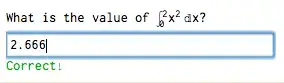
Module[{question = HoldForm[Integrate[x^2, {x, 0, 2}]], correct},
 correct = ReleaseHold@question // N;

 DynamicModule[{ans = Null},
  Column[{
    Row[{"What is the value of ", question, "?"}], 
    InputField[Dynamic@ans, Number, FieldHint -> "Enter your answer here"],
    Dynamic@checkAnswer[ans, correct]
    }]
  ] 
 ]

enter image description here

enter image description here

enter image description here

rm -rf
  • 88,781
  • 21
  • 293
  • 472
11

As I mentioned in my comment to the question, I am quite fascinated by the idea of testing free-form input by numerical means similar to what the AcroTeX bundle has been able to do for a long time. This idea differs quite fundamentally from Vitaiy's suggestion, so I have tried to make it work in Mathematica.

I will suspend discussion of the crucial obstacle that the free CDF format, though being the obvious choice to deploy such tests, does not currently allow InputFields for strings. For the moment, I have to trust in the indirect promise made by Vitaliy that this will change in the future (I realize he doesn't speak for WRI).

Now it turns out that Mathematica has a function that is almost ideal for my suggested method: PossibleZeroQ. Implementing this as a test validator is the main idea of this answer.

The second idea is that with a tool as powerful as Mathematica, making a meaningful testing environment (even for harmless practice tests) requires us to shut off access to symbolic manipulations that can be used to cheat. This problem doesn't arise if we make tests where you only have to enter numbers, as in R.M.'s answer. The question goes much further than that, in that it wants us to validate student input in the form of functions (as in integrals and derivatives).

The main difference between my approach and Vitaliy's in this respect is that I implement a "white-list" instead of a "black-list" approach. That means I want allow only a certain class of functions to be entered. In particular, I will permit only those functions that have NumericFunction in their Attribute list.

The code below tries to implement these main ideas, putting them in the form of a basic dynamic grid where the questions appear next to answer fields. This requires some juggling with Hold, HoldForm, string conversion and replacements inside Dynamic. Strings appear because for security reasons I accept the answer as String input before converting it ton a held expression.

Here is the set of definitions:

Clear[check, quantQuestions, quantAnswers, prepareQuestions];

quantQuestions[
   expressions__] := {ReleaseHold@Map[HoldForm, Hold[expressions]]};
SetAttributes[quantQuestions, HoldAll];

quantAnswers[questions__] := 
  Map[ReleaseHold[(# /. 
        Integrate[f_, x_?AtomQ] :> integralWrapper[f, x]) /. 
      Integrate[f_, {x__}] :> 
       Integrate[f, {x}, GenerateConditions -> False]] &, questions];
SetAttributes[quantAnswers, HoldAll];

check[ans_, reference_] := Module[{ans1, ref1}, 
  If[
   Head[reference] === integralWrapper, 
   ans1 = D[ans, Last[reference]];
   ref1 = First[reference], 
   ans1 = ans; 
   ref1 = reference
  ];
  If[PossibleZeroQ[ans1 - ref1], 1, 2]]
check[ans_String, reference_] := 3;

stringCheck[
  a_] := (Apply[And, 
        Map[MemberQ[Attributes[#], NumericFunction] &, 
         Cases[# /. Hold -> Unevaluated, x_[__] -> x, Infinity]]] /. 
       True :> ReleaseHold[#] /. False -> "no answer") &[
   If[SyntaxQ[a], ToExpression[a, InputForm, Hold]]] /. Null -> ""

prepareQuestions[q_] := 
 DynamicModule[{feedback = "Correct answers: ", maxAttempts = 3, ref, 
   ans, evaluation, attempts, active}, 
  Check[ref = quantAnswers[q], 
   Print["Some questions cannot be answered"]; Abort[]];
  ans = Map["" &, ref];
  evaluation = Map[4 &, ref];
  attempts = Map[0 &, ref];
  active = Map[True &, ref];
  Deploy@Labeled[
    Framed[Grid[
      Append[
       Prepend[
        Array[{
           TraditionalForm[q[[#]]], 
           InputField[Dynamic[ans[[#]], Function[{a},
              If[ans[[#]] != a, ans[[#]] = a;
               If[! (active[[#]] = (attempts[[#]] += 1) < 
                    maxAttempts), 
                FrontEndExecute[{FrontEnd`FrontEndToken[
                   FrontEnd`InputNotebook[], "MoveNextPlaceHolder"]}]];
               ];
              evaluation[[#]] = 
               check[stringCheck[ans[[#]]], ref[[#]]]]], 
            String, 
            FieldSize -> 15, 
            Enabled -> Dynamic[active[[#]]]
           ], 
           Dynamic[{"Correct.", "Wrong.", "No answer", 
              ""}[[evaluation[[#]]]]], 
           Row[{Dynamic[attempts[[#]]], " / ", maxAttempts}]} &, 
         Length[ref]
        ], 
        Map[Style[#, "Subsection"] &, 
         {"Question", "Answer", "Evaluation", "Attempts"}]
       ], 
       {InputField["", String, 
         FieldSize -> 1, ImageSize -> {0, 0}, 
         Appearance -> "Frameless"]
       }
      ]
     ], 
     FrameStyle -> Orange, 
     RoundingRadius -> 5
    ], 
    Row[{feedback, Dynamic[Count[evaluation, 1]]}, 
     Background -> Orange, Frame -> True, FrameStyle -> None, 
     FrameMargins -> 5, RoundingRadius -> 5], Bottom, 
    BaseStyle -> "Subsubsection", 
    LabelStyle -> {"Subsection", LightOrange}, 
    Background -> LightOrange]]

The starting point is quantQuestions which wraps the set of questions in HoldForm so they can be displayed as such. Internally, they are then unwrapped with quantAnswers to get the simplified results with which to compare the user's input later.

The only other user-facing function is prepareQuestions which is then applied like this:

prepareQuestions[
 quantQuestions[
  D[Sin[x + y], y], 
  D[Log[x], x], 
  Integrate[1/x^2, x], 
  Integrate[x, {x, 0, 1}]
 ]
]

This creates the dynamic input fields as shown here:

input checking

Here, I have already entered the answers and received the appropriate feedback.

You can try to enter the answers in different ways. Also try to enter cheats - they are supposed to be caught by the function stringCheck. Its job is to comb the held form of the expression in the input string for non-numerical functions, of which D and Integrate are examples.

Edit

In the updated code above, I added a check for correct Mathematica syntax using SyntaxQ. Other improvements are:

  • The number of attempts at an answer is counted, and the input field is disabled after a maximum number (3 here).
  • The total number of correct answers is displayed at the bottom.
  • If a question has no answer, the error is displayed and no table is created.
  • The problems are displayed using TraditionalForm (whether this is better is a matter of taste).

Edit 2

As pointed out in comments by Andrew and Murray, indefinite integrals have to admit constant offset. This can be done by comparing the derivatives, and I've implemented that for a single variable by substituting a formal wrapper (integralWrapper) into the automatically computed answer (quantAnswers) that tells check to differentiate instead of integrate. It is only needed for indefinite integrals, and the rest of the validation (using PossibleZerQ) works as before.

I'm also suppressing the generation of conditions for definite integrals, so that questions such as Integrate[x,{x,y,z}] with unknown boundaries can be handled too.

Jens
  • 97,245
  • 7
  • 213
  • 499
  • The latter part of this answer of mine is complementary to your stringCheck function. While I like your idea, if I were to implement such an exam module, I'd most certainly use only a whitelisted set of functions (even if malice was not a concern). This will also take care of cheating with D or Integrate... – rm -rf May 21 '12 at 05:14
  • @R.M. I agree - at the moment my white-list consists of symbols, and of functions that have attribute NumericFunction. If it turns out I should be more restrictive, I'll do that. I think that the current filter is enough to prevent ToExpression to be exploited for injecting code because NumericFunction functions aren't able to do that. If I'm wrong about that, I'd certainly be able to just admit just the "scientific calculator" range of functions. – Jens May 21 '12 at 05:36
  • Very pretty and +1, but there are some problems: I evaluate your example, enter something incorrect, e.g. Cos[x], and press Enter (1). I press Enter again (2), without changing the answer, and the attempt counter goes to 2. It probably shouldn't increment if the input has not changed at all (it could be an accidental press of Enter). Then I press Enter again (3), and the input field gets disabled. Then I press Enter again (4), and the input field disappears (!) and the Correct Answers counter gets corrupted. I press Enter again (5) and my Front End crashes. Can you reproduce the crash? – Szabolcs May 26 '12 at 19:12
  • @Szabolcs Yes I can indeed reproduce the crash. No big surprise - dynamic interactivity is just very unstable. As the other answers say: it's a "proof of concept"... just with slightly different concepts. I'll see if I can find any way around that crash later. – Jens May 27 '12 at 00:47
  • @Szabolcs I've updated the code. De-activating an InputField while the cursor is in it seems to have caused the crash, so I now send a FrontEndToken to move to the next field when that happens. When all fields are inactive, there is a dummy field with ImageSize zero to jump to, so hopefully the cursor is now always in a legal place... – Jens May 27 '12 at 06:06
  • @Jens For indefinite integrals PossibleZeroQ is not enough since primitive is defined up to a constant. For the third example answer $-x^{-1}+1$ is correct. Even dropping $+C$ in the answer, using different methods for $\int \cos x \sin x,dx\ $ one can get $\frac{1}{2} \sin ^2x$, $-\frac{1}{2} \cos ^2x$, $\frac{1}{4} \sin 2x$. – Andrew May 27 '12 at 08:07
  • @Andrew Good point. Of course, that problem is exactly the same if you use FullSimplify as @Vitaliy did in his answer. The best way around it is to make the question more specific by stating that for definite integrals we require the result to be zero at x = 0 (or x=1 here). Another option would be to check indefinite integrals by comparing their derivatives instead. In any case, PossibleZeroQ is still superior to all other methods, I think. – Jens May 27 '12 at 14:34
  • Unless one is going to commit a considerable amount of time and effort into such a project, a reasonable question to ask is how the results will end up being better than either one of the existing proprietary on-line homework/quiz systems such as WebAssing, or the open-source/free system WeBWorK. – murray May 28 '12 at 03:42
  • @murray I agree. At the moment it's a dead end, but I wanted to explore what may be possible in the future when we get better web delivery. – Jens May 28 '12 at 03:48