Here is now the - hopefully - correct (numeric) solution of the original problem.
To begin with, we define a time t0 such that y = 0 for 0<=t<=t0.
Für x(t) we have x(t) = 1 for 0<=t<=t0, otherwise we have first to solve the equation
sx = DSolve[x'[t] == x[t]^(3/4) - x[t] && x[0] == 1, x[t], t]
We can ignore the error Messages.
(* Out[701]= {{x[t] -> E^-t (-2 + E^(t/4))^4}, {x[t] ->
   E^-t ((-1 - I) + E^(t/4))^4}, {x[t] -> E^-t ((-1 + I) + E^(t/4))^4}} *)
Taking the real-valued solution:
x[t] /. sx[[1]]

(* Out[700]= E^-t (-2 + E^(t/4))^4 *)
Having caluclated that, we now define the complete function x[t,t0]
x[t_, t0_] := E^(-t + t0) (-2 + E^((t - t0)/4))^4 /; t > t0

x[t_, t0_] := 1 /; 0 <= t <= t0
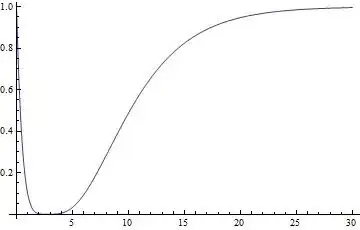
Plotting it (for t0 = 5)
Plot[{x[t, 5]}, {t, 0, 30}, PlotRange -> {0, 1}]

Now inserting x[t,t0] we can NDSolve for y(t).
Here we have selected the parameter t0 by trial and error such that y[10]=2
t0 = 1.03214;
ta = 0;
te = 12;
sn = NDSolve[{D[y[t], t] == 1 - y[t] (1/x[t, t0]^(1/4) - 1), y[t0] == 0},
    y[t], {t, ta, te}][[1]];
{ta, te} = Head[(List @@ sn[[1]])[[2]]][[1, 1]];
yy[t_] = y[t] /. sn;
Print["y[10] = ", yy[10]];
Plot[{2, Evaluate[x[t, t0]], yy[t]}, {t, ta, te}, PlotRange -> {-1, 2.2},
 PlotLabel ->
  "Solution of the two-point boundary problem\nred curve = x(t), green curve \
= y(t)\nt0 = " <> ToString[t0] <> "\ty(10) = " <> ToString[yy[10]]]

y[10] = 2.

Of course, y(t) must be set to zero below t=t0. This is trivial and not shown in the picture.
This seems to be the only solution. For greater values of t0 the boundary value y(10) decreases, and for smaller it increases.
Regards,
Wolfgang


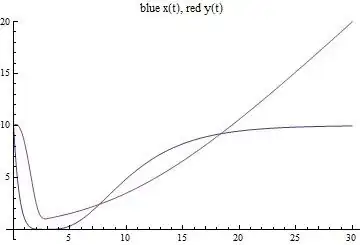

With this, y(t) can be negative and thus the equation for x becomes dependent on y.
– Mauricio Sep 09 '14 at 07:14