My first observation is that
{{x -> 2.36147 - 1.11022*10^-16 I}, {x -> -2.52892 + 0. I}, {x -> 0.167449 + 0. I}}
is not a set of solutions for
x^3 - 5 x^2 - x + 1 == 0
This can be seen by plotting the polynomial
Plot[x^3 - 5 x^2 - x + 1, {x, -1., 6.}]
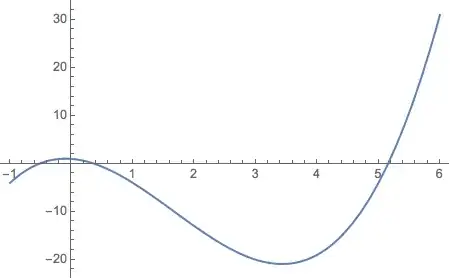
However, the problem of imaginary fuzz in the roots remains.
Solve[x^3 - 5 x^2 - x + 1 == 0, x] // N
{
  {x -> -0.525428 - 4.44089*10^-16 I},
  {x -> 0.369102 + 6.66134*10^-16 I},
  {x -> 5.15633 - 1.4803*10^-16 I}
}
Solve takes a token, Reals, which instructs it constrain solutions to be over the real numbers. This will eliminate numeric imaginary fuzz.
Solve[x^3 - 5 x^2 - x + 1 == 0, x, Reals] // N
{{x -> -0.525428}, {x -> 0.369102}, {x -> 5.15633}}
Why is there a difference? In the first case, Solve returns a complex expression involving cube roots. Then, when N is applied, the machine numerics used for taking the cube root expressions produce a small error in the imaginary part. In the second Solve avoids the cube roots and returns Root objects.
The imaginary free result can also be achieved with
Solve[x^3 - 5 x^2 - x + 1 == 0, x, Cubics -> False] // N


Chop. It will cut off very small numbers. In yur case you'll be able to ged rid of the imaginary part. – Grzegorz Rut Sep 21 '14 at 12:57NSolveinstead ofSolve– RunnyKine Sep 21 '14 at 23:29