Moments of inertia and inertia tensors are well-known characteristics of rigid bodies in physics and applied mathematics. How to calculate them in Mathematica? Is possible to use regions which was introduced recently in version 10?
Asked
Active
Viewed 2,058 times
15

J. M.'s missing motivation
- 124,525
- 11
- 401
- 574

ybeltukov
- 43,673
- 5
- 108
- 212
3 Answers
19
The inertia tensor is defined as an integral of the following tensor over the body region
vars = {x, y, z};
r2 = IdentityMatrix[3] Tr[#] - # &@Outer[Times, vars, vars];
r2 // MatrixForm

It is very simple to do with integration over a region
Integrate[r2, vars ∈ region]
It can be wrapped in the following function
inertiaTensor[reg_, assum_: {}] :=
  Module[{x, y, z, d = RegionEmbeddingDimension[reg], r2, vars},
   vars = {x, y, z};
   r2 = IdentityMatrix[3] Tr[#] - # &@Outer[Times, vars, vars];
   If[d == 2, r2 = r2 /. z -> 0; vars = {x, y}];
   If[d == 1, r2 = r2 /. {x -> 0, y -> 0}; vars = {z}];
   Integrate[r2, vars ∈ reg, Assumptions -> assum]/
     Integrate[1, vars ∈ reg, Assumptions -> assum] //
    Simplify];
I assume that the body have a unit mass. I also assume that 2D bodies lie in xy plane and 1D bodies lie on the axes z.
Now we can prepare the following demonstration which corresponds to known list of moments of inertia
gr3d = Graphics3D[{PointSize[0.03], Thickness[0.03],
     FaceForm[Opacity[0.5]], Blue, #, Gray, Thickness[0.01],
     Line[{-#, #} & /@ IdentityMatrix[3]], Black,
     Text @@@ {{x, {1.1, 0, 0}}, {y, {0, 1.1, 0}}, {z, {0, 0, 1.1}}}},
     ImageSize -> 150, PlotRange -> 1, Boxed -> False,
    SphericalRegion -> False, ViewAngle -> Pi/10] &;
gr2d = gr3d@{FaceForm[Opacity[1]], Texture[#], EdgeForm[None],
         Polygon[{{-1, -1, 0}, {1, -1, 0}, {1, 1, 0}, {-1, 1, 0}},
          VertexTextureCoordinates -> {{0, 0}, {1, 0}, {1, 1}, {0,
             1}}]} &@Rasterize[#, Background -> None] &@
    Graphics[{EdgeForm[Blue], FaceForm[{Opacity[0.5], Blue}],
      Blue, #}, PlotRange -> 1.01, ImageSize -> 150,
     Background -> Transparent] &;

Manipulate[
   Row@{type[[1]],
     MatrixForm[m inertiaTensor @@ type[[2 ;;]]]}, {type,
    Thread[#[[All, 2 ;;]] -> #[[All, 1]]]},
   Initialization :> {type = #[[1, 2 ;;]]}] &@{{"Point",
   gr3d@Point[{0, 0, 1}], Point[{0, 0, r}], r > 0},
  {"Rod", gr3d@Line[{{0, 0, -1/2}, {0, 0, 1/2}}],
   Interval[{-a/2, a/2}], a > 0},
  {"Circle", gr2d@Circle[], Circle[{0, 0}, r], r > 0},
  {"Disk", gr2d@Disk[], Disk[{0, 0}, r], r > 0},
  {"Cylinder", gr3d@Cylinder[{{0, 0, -1/2}, {0, 0, 1/2}}, 1/2],
   Cylinder[{{0, 0, -h/2}, {0, 0, h/2}}, r], {r > 0, h > 0}},
  {"Tetrahedron", gr3d@Tetrahedron[#], Tetrahedron[s #], s > 0} &@
   PolyhedronData["Tetrahedron", "VertexCoordinates"],
  {"Sphere", gr3d@Sphere[], Sphere[{0, 0, 0}, r], r > 0},
  {"Ball", gr3d@Ball[], Ball[{0, 0, 0}, r], r > 0},
  {"Cone", gr3d@Cone[{{0, 0, 2/3}, {0, 0, 0}}, 1/2],
   Cone[{{0, 0, h}, {0, 0, 0}}, r], {r > 0, h > 0}},
  {"Ellipsoid", gr3d@Ellipsoid[{0, 0, 0}, {0.7, 0.5, 0.3}],
   Ellipsoid[{0, 0, 0}, {a, b, c}], {a > 0, b > 0, c > 0}},
  {"Rectangle", gr2d@Rectangle[-{1, 1}/2, {1, 1}/2],
   Rectangle[-{a, a}/2, {a, a}/2], a > 0},
  {"Cuboid", gr3d@Cuboid[-{0.4, 0.3, 0.2}, {0.4, 0.3, 0.2}],
   Cuboid[-{a, b, c}/2, {a, b, c}/2], {a > 0, b > 0, c > 0}}}

ybeltukov
- 43,673
- 5
- 108
- 212
-
Good afternoon! I invite you to think about the problem. I'm in love with her now, but I haven't received a decision yet https://mathematica.stackexchange.com/questions/277997/inertia-tensors-for-non-typical-rigid-bodies – dtn Dec 31 '22 at 07:42
7
In Mathematica 10.4, MomentOfInertia is now built-in. So we can compute inertia tensor for named, arbitrary and formula regions. Some examples:
MomentOfInertia[Ball[]]

(* {{(8 Pi)/15, 0, 0}, {0, (8 Pi)/15, 0}, {0, 0, (8 Pi)/15}} *)

reg = DelaunayMesh[RandomReal[1, {20, 3}]]
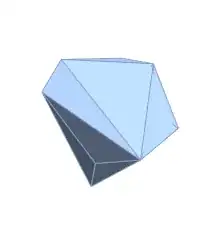
MomentOfInertia[reg]
(* {{0.0227787, 0.085264, 0.0937136}, {0.085264, 0.0226137,
  0.0801547}, {0.0937136, 0.0801547, 0.0183785}} *)

RunnyKine
- 33,088
- 3
- 109
- 176
2
For the Cuboid is wrong the right answer is
{"Cuboid", gr3d@Cuboid[-{0.4, 0.3, 0.2}, {0.4, 0.3, 0.2}],
 Cuboid[-{b, b, b}, {b, b, b}], {b > 0, b > 0, b > 0}}}
because the sides are equal

bbgodfrey
- 61,439
- 17
- 89
- 156

Pichuz Üribe
- 21
- 1
SolidData["Steinmetz2Solid", "InertiaTensor"]and friends, although I think it only works for named solids, and not arbitrary regions. – DumpsterDoofus Oct 12 '14 at 14:13