I want to calculate a 95% profile interval for f0. Do worry too much if you do not understand what it is. I will illustrate with a simple example.
mylik[f0_,p_]:=Module[
    {ans},
    ans =
    - Log[2]
    - Log[120]
    - Log[6227020800]
    - Log[1124000727777607680000]
    - Log[15511210043330985984000000]
    + f0 Log[(1 - p)^6]
    + 25 Log[6 (1 - p)^5 p]
    + 22 Log[15 (1 - p)^4 p^2]
    + 13 Log[20 (1 - p)^3 p^3]
    + 5 Log[15 (1 - p)^2 p^4]
    + Log[6 (1 - p) p^5]
    + 2 Log[p^6]
    - LogGamma[1 + f0]
    + LogGamma[69 + f0]
];
{maxlog, mles} = NMaximize[{mylik[f0, p], f0 > 0, 0 < p < 1}, {f0, p}];
proflikfun[f0_] := Module[
    {ans, p},

    ans = NMaximize[{mylik[f0, p], 0 < p < 1}, p];
    ans = ans[[1]];
    ans = ans + Quantile[ChiSquareDistribution[1], 0.95]/2 - maxlog;
    ans
];
Now to plot the function. Because I know the answer, so I will plot the range
Plot[proflikfun[f0], {f0, 0, 20}];
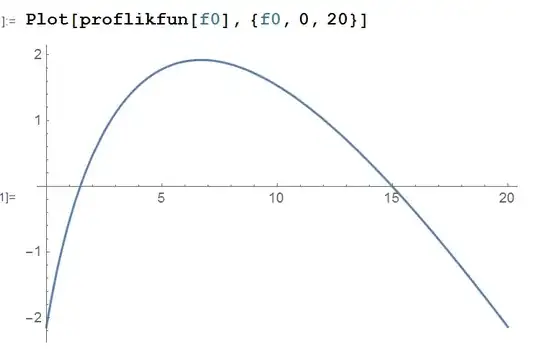 Now, how do I solve this function at 0?
I tried things like
FindRoot[proflikfun[f0] == 0, {f0, 0}]
NSolve[proflikfun[f0] == 0, {f0, 0}]
Thanks!


