You can employ the standard procedure to find the maxima of i[s],
i.e. look for s such that i'[s]==0 and i''[s] < 0
The function in question is
i[s_] := (Sin[50 \[Pi] (Cos[s] + 1)]/Sin[10 \[Pi] (Cos[s] + 1)])^2
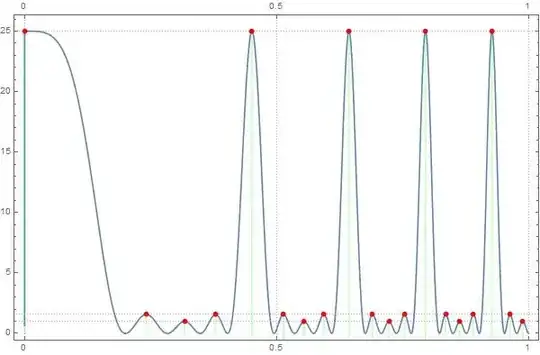
Plot it to get a first impression
Plot[{1, i[s], i'[s], i''[s]}, {s, 0, 1}, PlotRange -> {0, 30}]

(* picture not shown here *)
Now we apply reduce to the generic conditions for the maximum
r = Reduce[(i'[s] == 0) && (i''[s] < 0)] /. C[1] -> n;
Short[r, 2]
$(n\in \text{Integers}\&\&(\langle\langle 1\rangle\rangle )\&\&\text{Sin}[s]==0)\left\|\left(n\in \text{Integers}\&\&\left(\left(\text{Sin}[s]\in \text{Reals}\&\&\text{Sin}[s]\neq 0\&\&\text{Cos}[s]==\frac{-5 \pi +n \pi +\text{ArcTan}\left[\text{Root}\left[5-22 \text{$\#$1}^2+5 \text{$\#$1}^4\&,1\right]\right]}{5 \pi }\right)\left\|\left(\text{Sin}[s]\in \text{Reals}\&\&\text{Sin}[s]\neq 0\&\&\text{Cos}[s]==\frac{1}{20} (-21+4 n)\right)\right\|(\langle\langle 1\rangle\rangle )\|(\langle\langle 1\rangle\rangle )\|(\langle\langle 1\rangle\rangle )\|\left(\text{Sin}[s]\in \text{Reals}\&\&\text{Sin}[s]\neq 0\&\&\text{Cos}[s]==\frac{-5 \pi +n \pi +\text{ArcTan}\left[\text{Root}\left[5-22 \text{$\#$1}^2+5 \text{$\#$1}^4\&,4\right]\right]}{5 \pi }\right)\right)\right)\right.$
A rather long expression results. Prominent feature is the appearance of the roots of two polynomials
Table[ArcTan[Root[1 - 10 #1^2 + 5 #1^4 &, k]], {k, 1, 4}] // N

(* Out[5]= {-0.942478, -0.314159, 0.314159, 0.942478} *)

Table[ArcTan[Root[5 - 22 #1^2 + 5 #1^4 &, k]], {k, 1, 4}] // N

(* Out[6]= {-1.11493, -0.455869, 0.455869, 1.11493} *)
As an example of how to proceed let us pick just one component
r2 = r[[2, 2, 2]]

(* Out[7]= Sin[s] \[Element] Reals && Sin[s] != 0 && Cos[s] == 1/20 (-21 + 4 n) *)
and Solve it for s, removing the trivial shift by a multiple of 2 Pi
r3 = Solve[r2, s] /. C[1] -> 0

(* Out[10]= {{s -> -ArcCos[-(21/20) + n/5]}, {s -> ArcCos[-(21/20) + n/5]}, {s ->
   ConditionalExpression[-2 ArcTan[Sqrt[(41 - 4 n)/(-1 + 4 n)]],
    1/4 < n < 41/4]}, {s ->
   ConditionalExpression[2 ArcTan[Sqrt[(41 - 4 n)/(-1 + 4 n)]],
    1/4 < n < 41/4]}} *)
In order to obtain all typical values for this component we need to go to n = 11.
In fact
s1 = s /. Table[r3, {n, 0, 11}] // N;
Now we select the real roots and remove multiple roots to get
s2 = Union[Select[Round[Flatten[s1], 10^(-5)], (# \[Element] Reals) && (# > 0) &]] //
  N

(* Out[62]= {0.31756, 0.72273, 0.98843, 1.21323, 1.42023, 1.62082, 1.82348, 2.03756, \
2.27838, 2.58678} *)
These all give maximum = 1:
i[s2]

(* Out[63]= {1., 1., 1., 1., 1., 1., 1., 1., 1., 1.} *)
I leave it to the attentive and patient reader, to explore the other solutions along the same lines.
Regards,
Wolfgang




NSolve[Simplify[i'[s]] == 0 && 0 <= s <= 2 \[Pi], s]finds all of the stationary points, which you could then develop into a full solution to your problem. – Stephen Luttrell Oct 25 '14 at 11:28NSolveissue is solved and updated my answer accordingly. – Michael E2 Oct 26 '14 at 16:53