I want to multiply 1000by1000 matrices but MMA runs out of RAM.
LaunchKernels[]

dim = 1000;(*dimension of the matrices. There is 1000 of these 1000by1000 matrices*)

v = Developer`ToPackedArray[
Table[{
       Table[

      N@(KroneckerDelta[i, j] + Sin[i*j])

      , {j, 1, dim}]}
, {i, 1, dim}]];(* The matrices themselves.*)

Developer`ToPackedArray[
  ParallelSum[
              Cos[i*k]*(v[[k]]\[Transpose].v[[i]] + v[[i]]\[Transpose].v[[k]])
, {i, 1, dim}, {k, 1, dim}]];(*Multiplication part and summation*)
Here is a snapshot of task manager. I ran the code then killed the kernels:
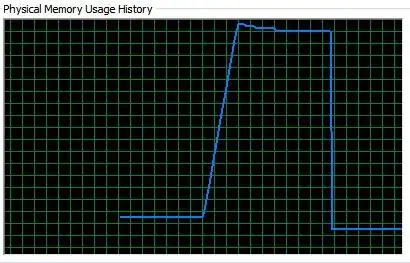
How can I improve this code. The problem is MMA uses a lot of RAM. I even used packed array but it didn't help. I know that in the summation part I am summing the transpose of the multiplied matrices and I could not to do the multiplication for the second term.
I edited the question to reflect the real problem better.
I used $HistoryLength = 0;, it didn't help.
Edit2
I want to see the effect of using packed arrays so I changed the dimension of the matrices and calculated the maximum used memory in the process of evaluation of those multiplications. For packed arrays I used:
v[dim_] :=
 Developer`ToPackedArray[
  Table[{Table[N@(KroneckerDelta[i, j] + Sin[i*j]), {j, 1, dim}]}, {i,
     1, dim}]];(*The matrices themselves.*)

m1 = MaxMemoryUsed[]/N[10^6]

res = Table[{MaxMemoryUsed[]/N[10^6] - m1,
   Developer`ToPackedArray[
     Table[Cos[1.0*i*k]*(v[dim][[k]]\[Transpose].v[dim][[i]]), {i, 1,
       dim}, {k, 1, dim}]];}, {dim, 28, 40}](* I removed the addition to the transpose  in contrast to the code provided in the above*)

axis = Table[i, {i, 28, 40}];

ListPlot[
Join[{axis}\[Transpose], {Cases[Flatten[res], _Real]}\[Transpose], 2],
 PlotMarkers -> {\[FilledCircle], 15},
 PlotStyle -> Red,
 Frame -> True,
 FrameLabel -> {Style["Dimension", Bold, FontSize -> 15], Style["MaxMemoryUsed", Bold, FontSize -> 15]},
 FrameStyle -> Directive[Black, Bold, 20]]
Here is the result:
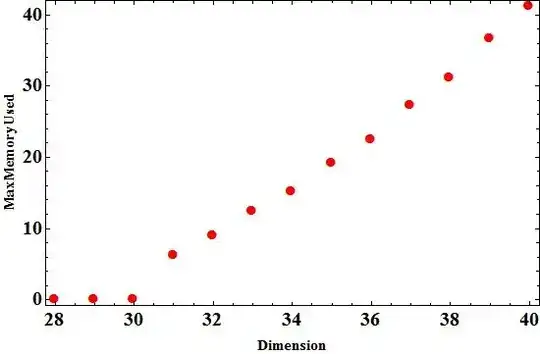
and here the result for the case I did not use packed arrays. After I got the result for packed arrays, I restart kernels.
v2[dim_] :=
  Table[{Table[N@(KroneckerDelta[i, j] + Sin[i*j]), {j, 1, dim}]}, {i,
     1, dim}];

m1 = MaxMemoryUsed[]/N[10^6]

res2 = Table[{MaxMemoryUsed[]/N[10^6] - m1,
   Table[Cos[i*k]*(v2[dim][[k]]\[Transpose].v2[dim][[i]]), {i, 1,
      dim}, {k, 1, dim}];}, {dim, 28, 40}]

axis = Table[i, {i, 28, 40}];

ListPlot[Join[{axis}\[Transpose], {Cases[
     Flatten[res2], _Real]}\[Transpose], 2],
 PlotMarkers -> {\[FilledCircle], 15}, PlotStyle -> Blue,
 Frame -> True,
 FrameLabel -> {Style["Dimension", Bold, FontSize -> 15],
   Style["MaxMemoryUsed", Bold, FontSize -> 15]},
 FrameStyle -> Directive[Black, Bold, 20]]
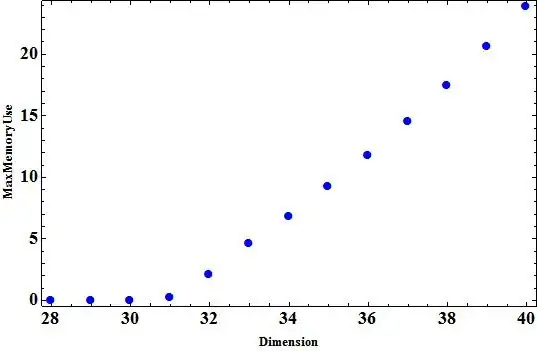
It seems using packed arrays is not memory efficient temporary. Can anybody reproduce these results?

SparseArrayshould be considered. You can work with those just like with any other matrix. – Yves Klett Nov 07 '14 at 12:18ParallelSum), first of all you need distribute definition of variables in parallel kernels withSetSharedVariables– molekyla777 Nov 07 '14 at 12:25t = Total[v]; u = Transpose[t].t; result = u + Transpose[u];will give the same result in a fraction of the time. – Simon Woods Nov 07 '14 at 13:01SetSharedvariabledoes not distribute definitions, it has a completely different purpose.DistributeDefinitionsis used for distributing definitions but since Mathematica 8 this happens automatically when usingParallelSum. – Szabolcs Nov 07 '14 at 14:44w = First@Transpose[v]; f = Array[Cos[#1 #2] &, {dim, dim}]; u = Transpose[w].f.w; result = u + Transpose[u];– Simon Woods Nov 07 '14 at 15:18Dotis super-optimised for packed arrays, far far quicker than the equivalent number of arithmetic operations. I expect @ybeltukov or @Szabolcs could give a more knowledgeable explanation. – Simon Woods Nov 07 '14 at 17:33