In MATLAB, there is a function named eps.
eps Spacing of floating point numbers. D = eps(X), is the positive distance from ABS(X) to the next larger in magnitude floating point number of the same precision as X. X may be either double precision or single precision. For all X, eps(X) is equal to eps(ABS(X)).
Is there an equivalent in Mathematica?
Edit:
eps, with no arguments, is the distance from 1.0 to the next larger double
precision number, that is eps with no arguments returns 2^(-52).
eps('double') is the same as eps, or eps(1.0).
eps('single') is the same as eps(single(1.0)), or single(2^-23).
Except for numbers whose absolute value is smaller than REALMIN,
if 2^E <= ABS(X) < 2^(E+1), then
eps(X) returns 2^(E-23) if ISA(X,'single')
eps(X) returns 2^(E-52) if ISA(X,'double')
For all X of class double such that ABS(X) <= REALMIN, eps(X)
returns 2^(-1074).   Similarly, for all X of class single such that
ABS(X) <= REALMIN('single'), eps(X) returns 2^(-149).

Replace expressions of the form
   if Y < eps * ABS(X)
with
   if Y < eps(X)

Example return values from calling eps with various inputs are
presented in the table below:

      Expression                   Return Value
     ===========================================
      eps(1/2)                     2^(-53)
      eps(1)                       2^(-52)
      eps(2)                       2^(-51)
      eps(realmax)                 2^971
      eps(0)                       2^(-1074)
      eps(realmin/2)               2^(-1074)
      eps(realmin/16)              2^(-1074)
      eps(Inf)                     NaN
      eps(NaN)                     NaN
     -------------------------------------------
      eps(single(1/2))             2^(-24)
      eps(single(1))               2^(-23)
      eps(single(2))               2^(-22)
      eps(realmax('single'))       2^104
      eps(single(0))               2^(-149)
      eps(realmin('single')/2)    2^(-149)
      eps(realmin('single')/16)   2^(-149)
      eps(single(Inf))             single(NaN)
      eps(single(NaN))             single(NaN)


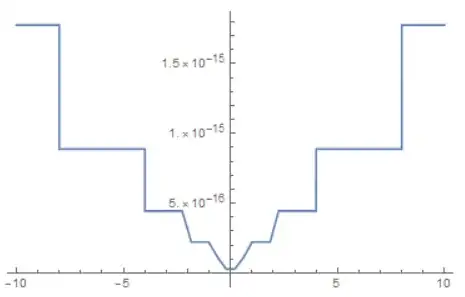


Log[2,$MachineEpsilon]==-52– LLlAMnYP Oct 09 '15 at 08:48In[430]:= Log2[Map[eps, {.2, .5, 1., 1.6, 2., 5.5}]]
Out[430]= {-54., -53., -52., -51., -51., -50.}`
– Daniel Lichtblau Aug 02 '16 at 20:58nextafterto get something equivalent toeps. – J. M.'s missing motivation Mar 28 '17 at 16:12