I have the following code to solve a PDE:
e = 2.5;
xmax = 5;
ymax = 5;
sol[x_, y_] = f[x, y] /. First@NDSolve[{
     -D[f[x, y], x, x] - D[f[x, y], y, y] == e f[x, y],
     Derivative[0, 1][f][x, -ymax] == Cos[\[Pi]/(2 xmax) x],
     f[x, -ymax] == 0,
     f[-xmax, y] == 0,
     f[xmax, y] == 0
     }, f[x, y], {x, -xmax, xmax}, {y, -ymax, ymax}]
I'd expect to get a Sin[]-like solution in y direction, but what I get instead is this:
Plot3D[sol[x, y], {x, -xmax, xmax}, {y, -ymax, ymax}, PlotRange -> {-1, 1}, AxesLabel -> {"x", "y", "f"}, MaxRecursion -> 3]
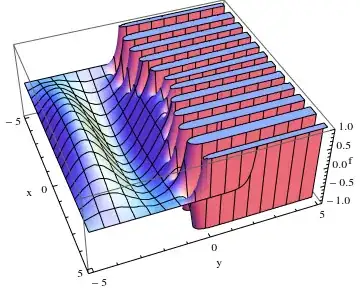
If I try using something like MaxStepSize -> 0.25, then the blow-up is just more frequent in x direction, and becomes visible at even smaller y values:

What can I do to prevent this blow-up and make NDSolve give the expected solution?
EDIT
In fact, the problem above is a minimal example showing the instability. What I'd actually like to solve is the equation with additional +U[x,y]f[x,y] on the LHS, where U[x,y]=-70Exp[-x^2-y^2]. I.e. the equation would look like
-D[f[x, y],x,x]-D[f[x,y],y,y]-70Exp[-x^2-y^2]f[x,y]==e f[x,y]
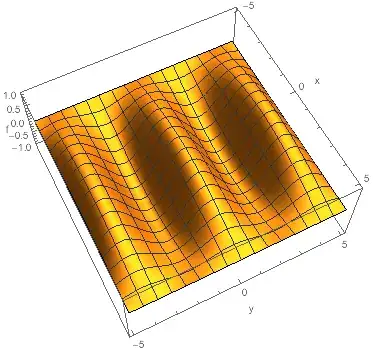
So, the answer I'm looking for should be extensible to this case. The answer by @xzczd solves the problem with minimal example, but unfortunately fails to extend to this one.




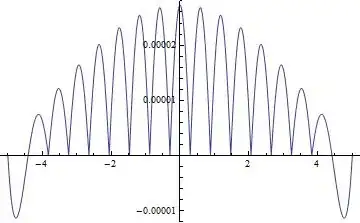


e<0), but in this case the solutionNDSolvegives blows up with the frequency of the grid, so in the limit of infinite grid density the function won't be differentiable, which doesn't look right. – Ruslan Dec 29 '14 at 13:44