I am trying to solve two equation to find /[Phi][x] and plot h vs. /[Phi][x] for different values of L.I tried by writing as:
sol[h_, L_] := NDSolve[{f''[x] == f[x] (Φ'[x])^2 - f[x] (1 - f[x]^2),
  h - (f[x])^2 Φ'[x] == 0., Φ[0.] == 0.,
  f[0.] == f[L] == 1.}, {Φ}, {x, 0, L}, Method -> {"Shooting",
 "StartingInitialConditions" -> {f[0] == 1,
  f'[0] == 0, Φ[0.] == 0.}, MaxIterations -> 100}]
t3 = Table[{sol[h, L], h}, {h, 0, 1}, {L, 1, 8}]
ListPlot[Evaluate[t3]]
But it's not giving any plot. Can anyone please help me.
Thanks @Alexei Boulbitch for your help. But you have plotted f[x] with x, but I'm looking for h vs. ϕ[x]. You're absolutely correct that there are some restrictions on the value of h. The range of h will be controlled by the the condition that f[L]=1. So to see the range of h for different values of L I've coded the following :
Manipulate[sols =
  NDSolve[{f''[x] == h^2/f[x]^3 - f[x] (1 - f[x]^2), f[0] == f[L] == 1}, f[x], x,
   Method -> {"Shooting", "StartingInitialConditions" -> {f[0] == 1, f'[0] == 0},
     MaxIterations -> 100}];
 Plot[Evaluate[{f[x]} /. sols], {x, 0, L}, PlotRange -> {0, 1}], {{h, .7, "cureent"},
  0, .99}, {{L, 1, "length"}, 1, 8}]
This gives out the following-

Now with this in my hand I can Plot h vs. ϕ[x] . To do that I'm doing the following
t1 = Table[{h,
    NDSolve[{f''[x] - h^2/f[x]^3 + f[x] (1 - f[x]^2) == 0, f[0.] == f[1.] == 1.},
     f[x], {x, 0, 1},
     Method -> {"Shooting", "StartingInitialConditions" -> {f[0] == 1, f'[0] == 0},
       MaxIterations -> 100}]}, {h, 0, .98, .01}];

t2 = Table[{Evaluate[ϕ[x] /.
      NDSolve[{t1[[n]][[1]] - (Evaluate[f[x] /. t1[[n]][[2]]])^2 ϕ'[x] ==
         0, ϕ[0.] == 0}, ϕ[x], {x, 0, 1}]], t1[[n]][[1]]}, {n, 1, 99}];

ListPlot[table2]
But, unfortunately this is not working . I've also tried with ParametricNDSolve, again there was some similar problems. Could you please help me getting the plot I'm


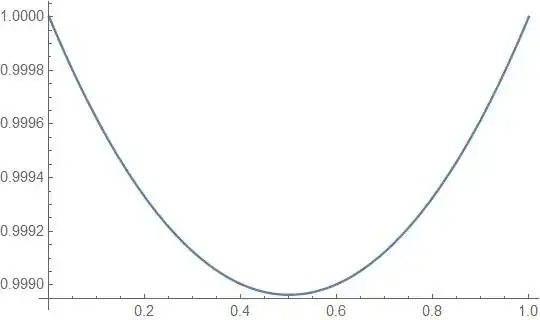


h = 1it seems to be impossible to find a proper initial guess for shooting method. Using the approach in this post, the best initial guess I can find issol[h_, L_, i_] := sol[h, L, i] = {i, NDSolve[{f[x]^3 # & /@ (f''[x] == f[x] (h/f[x]^2)^2 - f[x] (1 - f[x]^2)), f[0] == f[L] == 1}, {f}, {x, 0, L}, Method -> {"Shooting", "StartingInitialConditions" -> {f[L] == 1, f'[L] == i}}]}; sol[1, 8, 9000000003/10000000000]– xzczd Feb 13 '15 at 15:12