There doesn't seem to be so much a problem with the fitting method. Your model is actually linear, but values of zero are problematic for it.
Quoting from J. Johnston's Econometric Methods, edition 3, page 13:
A linear specification means that Y, or some transformation of Y, can
be expressed as a linear function of X, or some transformation of X.
In this sense,
Y = α + βX

Y = αX^β

and Y = exp{α + β 1/X}
are all linear specifications. The first is already linear in Y and
X. The second, on taking logarithms of both sides of the equation,
may be written as
log Y = log α + β log X
which is linear in log Y and log X.
To get around the problem of Log[0.] why not introduce small values?
E.g. comparing methods, first with the {0., 0.} point included:
newData = Table[{q, 2*q^2*RandomReal[{0.80, 1.2}]}, {q, 0, 2, 0.01}];
newModel = NonlinearModelFit[newData, a*q^b, {a, b}, q, Method -> "PrincipalAxis"];
Normal[newModel]
1.9184111799203873 q^2.1104032823834475
newData[[1]]
{0., 0.}
Setting small values:
newData[[1]] = {1.*^-100, 1.*^-100};
newModel2 = NonlinearModelFit[newData, a*q^b, {a, b}, q];
Normal[newModel2]
1.9184111852020502 q^2.110403278099661
The results are not much different.
Furthermore, upon checking, Method -> "PrincipalAxis" doesn't actually help for this model:
With the small values included the "PrincipalAxis" method gives the same result as before (when the zeros were used), indicating that it is less precise than the default method.
newModel = NonlinearModelFit[newData, a*q^b, {a, b}, q, Method -> "PrincipalAxis"];
Normal[newModel]
1.9184111799203873 q^2.1104032823834475
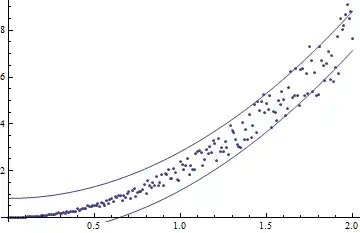
Plotting the bands with the default method (and small values replacing zeros):
Show[ListPlot[newData], Plot[newModel2["SinglePredictionBands",
   ConfidenceLevel -> 0.95], {q, 0, 2}]]