8

I have a list of pairs, for example:

pairs={{13, 10}, {12, 14}, {10, 36}, {35, 11}, {3, 5}, {1, 6},
{20, 24}, {21, 22}, {33, 7}, {31, 8}, {31, 27}, {32, 25}, 
{21, 35}, {34, 19}, {18, 15}, {14, 16}, {9, 5}, {4, 7}, 
{1, 13}, {15, 2}, {6, 36}, {4, 34}, {8, 2}, {9, 3}, {25, 20},
{19, 26}, {22, 11}, {23, 12}, {32, 28}, {30, 33}, {23, 16},
{24, 17}, {29, 27}, {26, 30}, {17, 28}, {18, 29}};

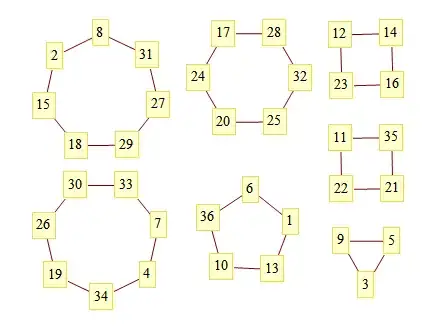
pairs can be seen as the definition of a relation $R$. $x$ and $y$ satisfy the relation if and only if {x,y} $\in$ pairs. I need to compute the equivalence classes of the symmetric transitive closure of $R$.

In other words, I need to compute a list eqvclss. The elements of eqvclss are lists themselves. For example, 13, 10, 36, 6, 1, ... should all be in the same list in eqvclss. (If you understand that, then I explained the question properly; if you don't, say so in the comments so I can try to improve).

a06e
  • 11,327
  • 4
  • 48
  • 108
  • Related: http://mathematica.stackexchange.com/q/3234/121 – Mr.Wizard Jun 29 '12 at 05:29
  • From {13,10} and {10, 36}, you conclude that 10 and 13 belong together. But 13 also belongs with 1 because {1, 13} exists. However, there is no pair {1, 10} or {10, 1}, so 1 shouldn't be in the same group as 10, which is in the same group as 13 which belongs with 1. So the problem for Gather is that your identity relation is not transitive. As a result, you have to give up some conditions. Maybe you want all gathered groups to be numbers that are at least indirectly connected? – Jens Jun 29 '12 at 05:29
  • @Jens Thanks for your comment. I see now. I did some drastic edits to the question (prior to seeing your comment). Now it's more to the point of what I want. Your comment now seems out of context, but it does answer the original question. – a06e Jun 29 '12 at 05:32

5 Answers5

12

ConnectedComponents

Using Daniel Lichtblau's answer to a related question

ConnectedComponents[pairs] //Sort /@ # & //Sort (* thanks: CarlWoll *)

{{3, 5, 9},
{11, 21, 22, 35},
{12, 14, 16, 23},
{1, 6, 10, 13, 36},
{17, 20, 24, 25, 28, 32},
{2, 8, 15, 18, 27, 29, 31},
{4, 7, 19, 26, 30, 33, 34}}

In versions prior to 10.3 use

 ConnectedComponents[Graph[UndirectedEdge @@@ pairs]] //Sort /@ # & //Sort

MatrixPower

Implementing transitive closure using MatrixPower:

m = Max@pairs;

(*the adjacency matrix of atomic elements in pairs:*)
SparseArray[pairs ~Append~ {i_, i_} -> 1, {m, m}];

(*symmetrize the adjacency matrix:*)
% + %\[Transpose] // Sign;

(*find the transitive closure:*)
Sign @ MatrixPower[N@%, m];

(*eliminate duplicate rows,and extract the atomic elements of pairs in each row:*)
Select[DeleteDuplicates @ Normal @ %, Tr@# > 1 &];
Join @@ Position[#, 1] & /@ %;

(*organize:*)
Sort[Sort /@ %]

{{3, 5, 9},
{11, 21, 22, 35},
{12, 14, 16, 23},
{1, 6, 10, 13, 36},
{17, 20, 24, 25, 28, 32},
{2, 8, 15, 18, 27, 29, 31},
{4, 7, 19, 26, 30, 33, 34}}

kglr
  • 394,356
  • 18
  • 477
  • 896
6

Adapting Heike's fine answer from the prior question:

pairs //. x_ :> Union @@@ Gather[x, # ⋂ #2 =!= {} &]
{{1, 6, 10, 13, 36},
 {12, 14, 16, 23},
 {11, 21, 22, 35},
 {3, 5,  9},
 {17, 20, 24, 25, 28, 32},
 {4, 7, 19, 26, 30, 33, 34},
 {2, 8, 15, 18, 27, 29, 31}}
Mr.Wizard
  • 271,378
  • 34
  • 587
  • 1,371
5

Here's code for version 7:

Needs["Combinatorica`"]

gr = FromUnorderedPairs @ pairs;

ConnectedComponents @ gr
{{1, 6, 10, 13, 36},
 {2, 8, 15, 18, 27, 29, 31},
 {3, 5, 9},
 {4, 7, 19, 26, 30, 33, 34},
 {11, 21, 22, 35},
 {12, 14, 16, 23},
 {17, 20, 24, 25, 28, 32}}
GraphPlot[gr, VertexLabeling -> True]

Mathematica graphics

Mr.Wizard
  • 271,378
  • 34
  • 587
  • 1,371
4

I have separately posted this method as an answer to this question

If you want to preserve the order in which the vertices are connected within each cycle,

ExtractCycles (in the Combinatorica package) may also be of interest.

For example

Needs["Combinatorica`"]
ExtractCycles@FromUnorderedPairs@pairs

gives

(* { {28, 17, 24, 20, 25, 32, 28},

{23, 12, 14, 16, 23},

{35, 11, 22, 21, 35},

{34, 4, 7, 33, 30, 26, 19, 34},

{9, 3, 5, 9},

{15, 2, 8, 31, 27, 29, 18, 15},

{13, 1, 6, 36, 10, 13} } *)

user1066
  • 17,923
  • 3
  • 31
  • 49
2

I just found a way to do it:

SymmetricTransitiveClosure[pairs : {{_, _} ..}] := 
    FixedPoint[DeleteDuplicates /@ 
        Flatten /@ Gather[#, Intersection[#1, #2] =!= {} &] &, pairs]

I won't acccept this yet. Perhaps someone comes up with something better.

a06e
  • 11,327
  • 4
  • 48
  • 108