1

Briefly (with thank to all reader)

  1. Want to determine the sign in the interval $[0,1]$ of the expression $$ b (p-1) x^{-p}-\gamma +\eta _1 k_0+\frac{\beta _0 \left(\eta _1+\eta _2-1\right) (n-1) x^n}{\left(x^n+1\right)^2}+\frac{\beta _0 \left(\eta _1+\eta _2-1\right)}{\left(x^n+1\right)^2} $$ Where $x$ in the variable and other parameter $k_0\, , \eta_1\, , \eta_2\, ,\beta_0\, , p\, , \gamma\,, b\, , \text{and} \, n $ are non negative constants.
  2. Why Mathematica 10 give Manipulate Plot of the derivative with respect to $x$? but refuse to it for the initial function. Plot
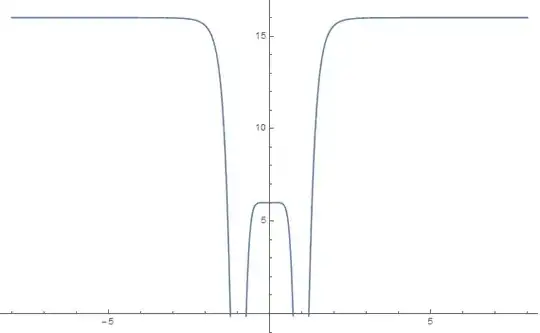
Partial answers are also much appreciated.

Zbigniew
  • 411
  • 1
  • 4
  • 12
  • One simplification is that the denominator is always positive -- hence it can be ignored. – bill s Mar 02 '15 at 08:59
  • 1
    What about $b$ and $k_0$? Please write the formula so that it can be copy/pasted.. there is a lot of room for error with all the parentheses. Is $n$ an integer? – bill s Mar 02 '15 at 09:14
  • @Bill Thank you for your speed comment. I have correct it. – Zbigniew Mar 02 '15 at 09:23

1 Answers1

2

Let's see if we can simplify the decision task a bit.

Let

$$f = b (p-1) x^{-p}-\gamma +\eta _1 k_0+\frac{\beta _0 \left(\eta _1+\eta _2-1\right) (n-1) x^n}{\left(x^n+1\right)^2}+\frac{\beta _0 \left(\eta _1+\eta _2-1\right)}{\left(x^n+1\right)^2}$$

With the abbreviations

$$r = b (p-1), s = \beta _0 \left(\eta _1+\eta _2-1\right), t = -\gamma +\eta _1 k_0$$

$f$ can be written as

$$f = r x^{-p}+\frac{s(1+ (n-1) x^n)}{\left(x^n+1\right)^2}+t$$

For $x \to 0$ we have approximately

$$f \to r x^{-p}$$

Hence close to $x = 0$ the sign of $f$ is given by the sign of the parameter $r$ only.

For $x = 1$ we have

$$f = r +\frac{s n}{4}+t$$

Hence a change in the sign of $f$ requires $\frac{s n}{4}+t$ to have the opposite sign of $r$ and have an absolute value greater than that of $r$.

Dr. Wolfgang Hintze
  • 13,039
  • 17
  • 47