I have a function g=f(x,t). The function "g" came from a numerical integration:
g[x_?NumericQ,t_?NumericQ]:=NIntegrate[tt[x,r,t],{r,rmin,rmax}]
and tt(x,r,t) came from a data file.
How to plot the second derivative of g(x,t) with respect to "t" for a fixed "x" using the ND command?

For the first derivative, I can use:
ListPlot[Table[{y, ND[g[y, t], t, 15]}, {y, 50, 200, 3}]]
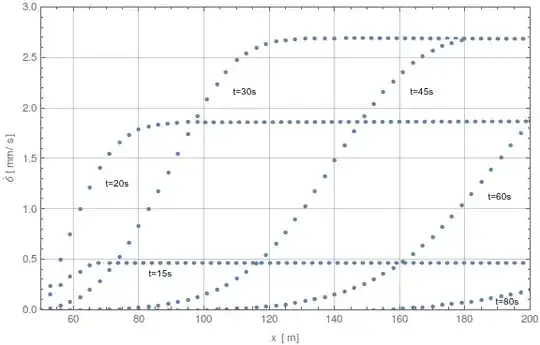
What about the second derivative? The query "numerical partial derivative" have no answer for the second derivative with respect to the same variable.


NIntegrate[D[tt[x,r,t],{t,2}], {r,rmin,rmax}]. – N.J.Evans Apr 23 '15 at 01:05NDfunction withND[f[x,y], {x, order}, x0]. – N.J.Evans Apr 23 '15 at 17:34