9

so what I want to do is take an undirected graph, and remove all the "dead ends" (that is, vertices that are attached to only one other vertex), but do it in such a way that it does it until reaches "steady state", i.e., it keeps doing this until there are no more dead ends to remove.

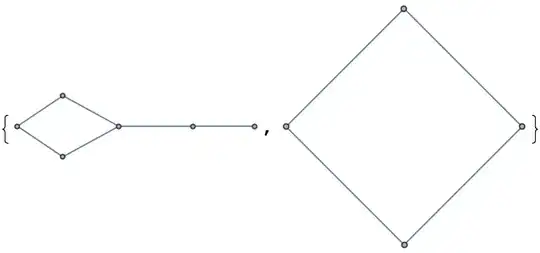
For example, here's a starting graph, h:

enter image description here

I would like it to remove vertices 4 and 5 (and edges 3<->4 and 4<->5, of course), just leaving the loop really.

So I made a really simple function:

RemoveDeadEnds[g_] := (

  gcopy = g;
  Do[
   If[EdgeCount[gcopy, i <-> _] ==  1, gcopy = VertexDelete[gcopy, i]];
   , {i, Length@VertexList@g}];
  Return@gcopy;
  )

The problem is that, in the case of the example I had above, it just remove Vertex 5, because at the time in the loop when it checks vertex 4, vertex 4 had 2 edges. By the time it removes vertex 5, when vertex 4 has 1 edge (and should thus be removed), it is already past it, so it returns:
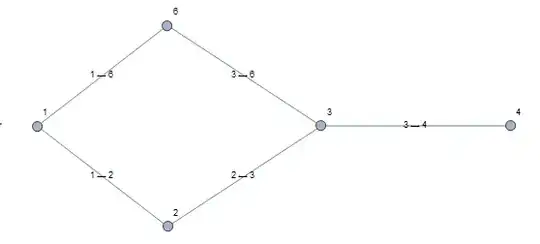
enter image description here

Obviously I could loop it several times. But that's obviously inelegant, and who knows how long this chain of dead ends is?

I can think of another way, but a little messy: you have a nested function so when you remove a vertex, you check the other vertex it was (formerly) attached to, and test that one. But that's not ideal either.

Is there a better way to do it? Ideally some magical Mathematica function that's already built in?

Edit: I implemented the method I said right above, using recursion:

CheckAndRemoveDeadEnd[g_, node0_] := (
gcopy = g;
 If[EdgeCount[gcopy, node0 <-> _] ==  1,
   j = First@AdjacencyList[gcopy, node0];
   gcopy = VertexDelete[gcopy, node0];
   gcopy = CheckAndRemoveDeadEnd[gcopy, j];
   ];
 Return@gcopy;
 )

DeleteAllDeadEnds[g_] := (
  gcopy = g;
  Do[
   gcopy = CheckAndRemoveDeadEnd[gcopy, i];
   , {i, Max@VertexList@g}];
  Return@gcopy;
  )
YungHummmma
  • 3,042
  • 15
  • 30

3 Answers3

12

Update: It turns out that the built-in function KCoreComponents does exactly what you need:

KCoreComponents[g , k] gives the k-core components of the underlying simple graph of g.

A k-core component is a maximal weakly connected subgraph in which all vertices have degree at least k.

kccF[g_, o: OptionsPattern[Graph]] := Subgraph[g, KCoreComponents[g, 2], o]

kccF[g0, ## & @@ options]

Mathematica graphics

Original post:

You can also use VertexDelete with ReplaceRepeated or FixedPoint:

vdF = VertexDelete[#, v_ /; VertexDegree[#, v] <= 1] &; (* thanks: @Guesswhoitis  *)
(* or vdF = VertexDelete[#, _?(Function[v, VertexDegree[#, v] <= 1])] &; *)

Using vdF with ReplaceRepeated:

rrF = # //. g_Graph :> vdF[g] &;

and with FixedPoint:

fpF = FixedPoint[vdF, #] &;

You can rrF@g or fpF@g to remove dead ends from graph g.

Example:

options = {AspectRatio -> 1, VertexLabels -> Placed["Name", Center], 
   VertexSize -> Scaled[.1], VertexStyle -> Opacity[0], VertexLabelStyle -> 20, 
   BaseStyle -> Directive[Opacity[1], Thick], EdgeLabels -> "Name", ImageSize -> 300};
edges = UndirectedEdge @@@ {{1, 6}, {1, 2}, {2, 3}, {6, 3}, {3, 4}, {4, 5}};

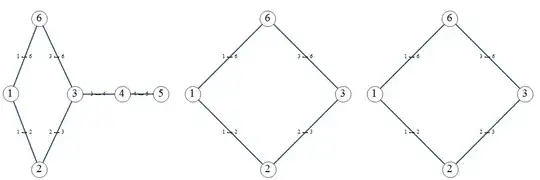
g0 = Graph[Range[6], edges, ## & @@ options]; Row[{g0, rrF@g0, fpF@g0}, Spacer[20]]

gradual removal of dead ends

kglr
  • 394,356
  • 18
  • 477
  • 896
9
ClearAll[RemoveDeadEnds];

RemoveDeadEnds[g_Graph] := 
 FixedPoint[
  Function[g2, 
   Subgraph[g2,
    Select[VertexList@g2, VertexDegree[g2, #] > 1 &]]], g]

{#, RemoveDeadEnds@#} &@
 Graph[{1 <-> 2, 2 <-> 3, 3 <-> 4, 4 <-> 5, 3 <-> 6, 6 <-> 1}]

enter image description here

kirma
  • 19,056
  • 1
  • 51
  • 93
3

Here's my "one-liner" for graphs with undirected edges.

FixedPoint[
 IncidenceGraph[
   Transpose[
    Transpose[
      Normal[IncidenceMatrix[#]] /. {0 ..., 1, 0 ...} -> 
        Unevaluated[Sequence[]]] /. {0 ..., 1, 0 ...} -> 
      Unevaluated[Sequence[]]]] &, graph]
LLlAMnYP
  • 11,486
  • 26
  • 65
  • (+1) This does not preserve the vertex names. A shorter variant : AdjacencyGraph@ FixedPoint[Select[Transpose@#, Tr[#] > 1 &] &, AdjacencyMatrix@g0] – kglr May 06 '15 at 21:37
  • Thanks. I almost never deal with graphs in MMA, so questions like these always earn an upvote as they force me to learn something new :-) – LLlAMnYP May 06 '15 at 21:44
  • ... or AdjacencyGraph@ FixedPoint[Transpose[# /. {0 ..., 1, 0 ...} :> (## &[])] &, Normal@AdjacencyMatrix@g0]. – kglr May 06 '15 at 21:45
  • @kguler, are you sure? The double transpose will return the matrix to the initial state, but can not FixedPoint get stuck between two alternating states in this case (for a directed graph)? You are absolutely right, that the conversion back to graph form should be moved outside of the FixedPoint. As for (##&[]), there was a lengthy discussion somewhere here on the merits of this vs. Unevaluated[Sequence[]]. – LLlAMnYP May 06 '15 at 21:50
  • 1
    LLlAMnYP, good point re directed graphs. I should have added "it works in OP's example". Re ##&[]: the cool kids... – kglr May 06 '15 at 22:09