so i have this:
Cases[RecurrenceTable[{a[n + 1] == 7 a[n] + n, a[1] == 1}, a, {n, 7}], Except[7]]
But i noticed that it will only exclude numbers that are 7, and not numbers which contain 7.
If anyone can tell me the answer, i will be very grateful. Any help is appreciated. Thanks!
Asked
Active
Viewed 548 times
3


4 Answers
4
An interesting problem which at first sight looks innocent. But then ...
My (bold) conjecture is that the maximum number lg of terms you can get of this recurrence if a[1] == 1 is lg = 11.
First we solve the recurrence explicitly
sol = RSolve[a[n + 1] == 7 a[n] + n && a[1] == 1, a[n], n];

a[n] /. First[sol]

(*
Out[317]= 1/252 (-7 + 43 7^n - 42 n)
*)
This can be simplified to
c[n_] = 7^(-1 + n) + 1/36 (-1 + 7^n - 6 n)
Remark: I did it by hand because Mathematica was reluctant to do so as almost always in simple cases like this.
Next we calculate nn terms of the series. Let's start with nn = 50
nn = 50;
t = Table[c[n], {n, 1, nn}];
and select the terms which do not contain any digit 7.
s = Select[t, FreeQ[IntegerDigits[#], d] &]

(*
Out[348]= {1, 8, 58, 409, 140524, 48200140, 2361806941, 16532648599, 39694889291465, \
549428363095106064500063, 306880939816820326605841486684503658800800}
*)
The length of this list is
lg = Length[s]

(*
Out[350]= 11
*)
nn = 50 is "critical" in the sense that nn = 49 only leads to lg = 10.
The last term
c[50]

(*
Out[351]= 306880939816820326605841486684503658800800
*)
has
Length[IntegerDigits[%]]

(*
Out[353]= 42
*)
digits.
Now we increase nn in order to find longer lists.
I tested up to nn = 10^5 without finding new terms.
The maximum term tested had
Length[IntegerDigits[c[10^5]]]

(*
Out[356]= 84510
*)
digits.
Extension 1:
Considering different values for a[1] we observe that the lengths of the series remain rather small.
With nn = 10^4 and a[1] between 0 and 200 the lengths and their multiplicities, respectively, are
tallylga =
{{4, 2}, {5, 2}, {6, 7}, {7, 21}, {8, 28}, {9, 31}, {10, 44},
{11, 26}, {12, 20}, {13, 13}, {14, 5}, {15, 1}, {16, 1}}
The maximum of 16 is reached for a[1] = 86.
Extension 2:
Replacing 7 by any other (decimal) digit.
But wait, there's still a hole to be fixed: the proof that no more terms exist or the falseness of my conjecture. But this requires sufficient theoretical knowledge in number theory - which I don't have at the moment.
EDIT #1 21.05.15
This is not a proof of the conjecture but a plausibility argument that for a large integer the probability of lacking a specific decimal digit goes to zero.
In fact, let d be the number of decimal digits of n. The number of nubers with d digits in which one specific digit is missing is less than 9^d. Hence the density of theses numbers within all numbers of d digits is (9/10)^d which goes to zero with increasing d i.e. increasing n.
However, this does not help in our specific problem with expressions of the form b^n for which we conjecture the much stronger statement that above a certain n = n_crit there is no (!) decimal digit missing.

Dr. Wolfgang Hintze
- 13,039
- 17
- 47
3
This is mostly a copy and paste of the brilliant answer by @WReach regarding implementation of lazy lists in Mathematica.
I'll refer you to that answer for a detailed explanation of his concept of a stream and only detail the modifications I made for this particular problem.
ClearAll[stream]
SetAttributes[stream, {HoldAll, Protected}]

sEmptyError[] := (Message[stream::empty]; Abort[])
stream::empty = "Attempt to access beyond the end of a stream.";

ClearAll[sEmptyQ, sHead, sTail, sTake, sList, sMap, sFilter, sIntegers]

sEmptyQ[stream[]] := True
sEmptyQ[stream[_, _]] = False;

sHead[stream[]] := sEmptyError[]
sHead[stream[h_, _]] := h

sTail[stream[]] := sEmptyError[]
sTail[stream[_, t_]] := t

sTake[s_stream, 0] := stream[]
sTake[s_stream, n_] /; n > 0 :=
 With[{nn = n - 1}, stream[sHead[s], sTake[sTail[s], nn]]]

sList[s_stream] :=
 Module[{tag},
  Reap[NestWhile[(Sow[sHead[#], tag]; sTail[#]) &, s, ! sEmptyQ[#] &],
      tag][[2]] /. {l_} :> l]

sMap[stream[], _] := stream[]
sMap[s_stream, fn_] := stream[fn[sHead[s]], sMap[sTail[s], fn]]

sFilter[s_, pred_] :=
 NestWhile[sTail, s, (! sEmptyQ[#] && ! pred[sHead[#]]) &] /.
  stream[h_, t_] :> stream[h, sFilter[t, pred]]
The above code block defines operations on expressions with head stream. Explanations are given in the linked answer.
sSequence[v_: 1, n_: 1] := With[{nn = n + 1, vv = 7 v + n}, stream[v, sSequence[vv, nn]]]
I create a function called sSequence which generates a lazy list conforming to the rule given by OP: next element is seven times previous element plus number of element. As you can see, it takes two arguments - value of element, plus number of element and creates a lazy list generating all subsequent elements in accordance with the rule.
Then define a filter to get rid of numbers with the digit 7:
noSevenQ = FreeQ[IntegerDigits[#], 7] &
and take the first nine elements. Ten is also fine. Mathematica fails to find an 11th element without 7 quickly enough.
sSequence[]~sFilter~noSevenQ~sTake~9 // sList


-
Now that I think about it,
DigitCount[]could also be used:no7Q = DigitCount[#, 10, 7] == 0 &. – J. M.'s missing motivation May 16 '15 at 12:03
2
I don't have Mathematica to test this, but I think something like this ought to work:
Block[{n = 10, k= 0},
          NestList[NestWhile[(k++; 7 # + k) &, #, DigitCount[#, 10, 7] != 0 &,
                                          {2, 1}] &, 1, n]]

J. M.'s missing motivation
- 124,525
- 11
- 401
- 574
-
-
Thanks. :) I forgot to test the blasted thing a few hours ago, when I had Mathematica access. Oh well… – J. M.'s missing motivation May 24 '15 at 13:33
-
And I just saw it :D BTW you can access the Programming Cloud and still use (somewhat) Mathematica. – Sektor May 24 '15 at 13:53
-
I know a number of you guys are exhorting me to try the thing out, but somehow I feel I won't fully appreciate the thing on a smartphone… – J. M.'s missing motivation May 24 '15 at 13:59
-
Have to set-up a Mathematica session over SSH for you then :D BTW If it is not private aren't you working with computers ? How come you are left without one ? – Sektor May 24 '15 at 14:41
-
Nope, my current occupation involves no computers at all; for the past few weeks, I have only been writing from a borrowed smartphone (except for the answers I wrote a few hours ago). – J. M.'s missing motivation May 24 '15 at 14:44
-
I will try to run a session over SSH later and if you are interested will give you access. – Sektor May 24 '15 at 14:47
-
Thanks for the kindness. :) For now, I must decline; writing on a smartphone is making my thumbs muscular already. I'll save the programming for when I'm using a real computer. :) – J. M.'s missing motivation May 24 '15 at 14:49
-
2
s[n_] := Reap[
    NestList[
     Sow[{#[[1]] + 1, 7 #[[2]] + #[[1]]},
       FreeQ[IntegerDigits[7 #[[2]] + #[[1]]], 7]] &,
     Sow[{1, 1}, True], n], True][[2, 1]];
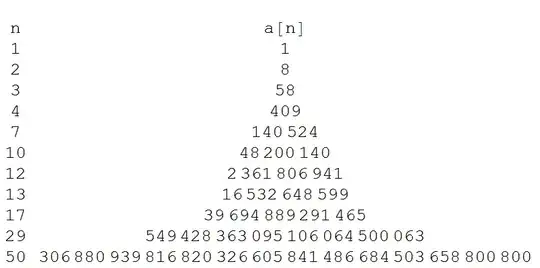
So for the first 100 members of sequence 11 comply:
Grid[Prepend[s[100], {"n", "a[n]"}]]

ubpdqn
- 60,617
- 3
- 59
- 148
-
you might be interested that in my solution I already had tested up to n = 10^5 – Dr. Wolfgang Hintze May 24 '15 at 13:59
-
@Dr.WolfgangHintze...thank you, NestList...will get unwieldy, so like a constructive method – ubpdqn May 24 '15 at 23:24
Select[RecurrenceTable[{a[n + 1] == 7 a[n] + n, a[1] == 1}, a, {n, 7}], FreeQ[IntegerDigits@#, 7] &]– ciao May 15 '15 at 22:47Cases[]should probably ben_ /; FreeQ[IntegerDigits[n], 7]… – J. M.'s missing motivation May 15 '15 at 22:48{n,7}to{n,<something bigger>}... – ciao May 15 '15 at 23:14RSolve[]? – J. M.'s missing motivation May 16 '15 at 00:16RSolveyou would also not know up front, if you need to take 20, 21, 22 or some more elements of the sequence in order to get 20 elements not containing the digit 7. What ticks me here is a defined recurrence relation, as well as a filter. I've seen this in the discussion of Lazy Lists – LLlAMnYP May 16 '15 at 11:27