We know about the possibility of series expansion of a function in Mathematica. Same as below, where a function f[a x] is expanded around zero up to 5th order.
Series[f[a x], {x, 0, 5}]=

The function f[a x] can be an Exponential function such as Exp[a x]; and it can be shown with the series:

Are there any way to expand an Exponential function in which a differential operator is contained? same as:
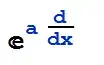
the desired case must be written by the series:

or by clear amounts of factorials:

Although we know that for Mathematica it will be meaningless, because in the series must exist the value of the function (f[x]) in the point around which the function has to be expand (I mean f[0] in the above example). But in the differential form there is not this value. But actually, in quantum mechanic, there are many exponential functions with differential operators which must be expanded as a series and we don't know how we can do it!


T[x_, a_] := Function[expression, expression /. {x -> x - a}]. ThenT[x,7]@f[x]evaluates tof[ -7 + x ]whileT[x, a]@f[a]becomesf[-a+x]whileT[x, a]@f[y]evaluates tof[y]. If you need something that operates on a formal parameter it may be more tricky... – evanb May 16 '15 at 05:42