This is a question very close related to Breaking up long equations in TeXForm. Last time, because @Adam doest not present a clear goal for this problem, as stated by Massimo Ortolano
there's no general solution to your question, especially if the splitting has to be done for a publication where clarity is of utmost importance.
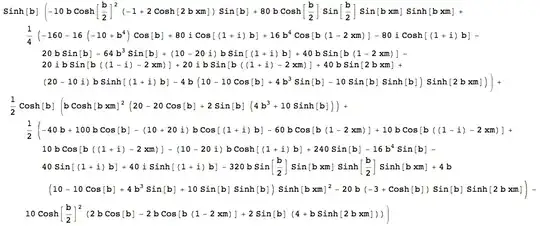
I think imitate the way implemented by Mathematica in StandardForm is a reasonable result for this problem.
Consider following expression:
Sinh[b]*(-10*b*Cosh[b/2]^2*(-1 + 2*Cosh[2*b*xm])*Sin[b] +
   80*b*Cosh[b/2]*Sin[b/2]*Sin[b*xm]*Sinh[b*xm] +
   (-160 - 16*(-10 + b^4)*Cos[b] + (80*I)*Cos[(1 + I)*b] +
     16*b^4*Cos[b*(1 - 2*xm)] - (80*I)*Cosh[(1 + I)*b] - 20*b*Sin[b] -
     64*b^3*Sin[b] + (10 - 20*I)*b*Sin[(1 + I)*b] + 40*b*Sin[b*(1 - 2*xm)] -
     (20*I)*b*Sin[b*((1 - I) - 2*xm)] + (20*I)*b*Sin[b*((1 + I) - 2*xm)] +
     40*b*Sin[2*b*xm] + (20 - 10*I)*b*Sinh[(1 + I)*b] -
     4*b*(10 - 10*Cos[b] + 4*b^3*Sin[b] - 10*Sin[b]*Sinh[b])*Sinh[2*b*xm])/4) +
 (Cosh[b]*(b*Cosh[b*xm]^2*(20 - 20*Cos[b] + 2*Sin[b]*(4*b^3 + 10*Sinh[b])) +
    (-40*b + 100*b*Cos[b] - (10 + 20*I)*b*Cos[(1 + I)*b] -
      60*b*Cos[b*(1 - 2*xm)] + 10*b*Cos[b*((1 - I) - 2*xm)] +
      10*b*Cos[b*((1 + I) - 2*xm)] - (10 - 20*I)*b*Cosh[(1 + I)*b] +
      240*Sin[b] - 16*b^4*Sin[b] - 40*Sin[(1 + I)*b] + (40*I)*Sinh[(1 + I)*b] -
      320*b*Sin[b/2]*Sin[b*xm]*Sinh[b/2]*Sinh[b*xm] +
      4*b*(10 - 10*Cos[b] + 4*b^3*Sin[b] + 10*Sin[b]*Sinh[b])*Sinh[b*xm]^2 -
      20*b*(-3 + Cosh[b])*Sin[b]*Sinh[2*b*xm])/2 -
    10*Cosh[b/2]^2*(2*b*Cos[b] - 2*b*Cos[b*(1 - 2*xm)] +
      2*Sin[b]*(4 + b*Sinh[2*b*xm]))))/2
By adjusting the width of the window, several ways to break the expression is given by Mathematica. The question is whether it is possible to obtain $TeX$ codes equivalent to these StandardForm outputs.



breqnlatex package. – Kattern Jun 18 '15 at 08:06LinebreakAdjustmentswhich gives general overview of how it works and how to customize it, but not much on how it's implemented. – jkuczm Jun 18 '15 at 12:46