I don’t know how to impose discontinuous internal boundary conditions (BCs) in NDSolve, so I’ve set up an example problem to illustrate my issue. Consider the simple first-order ODE for $f(z)$ on the interval $-1 ≤ z ≤ 1$:
k f[z] + f'[z] == 0
where $k$ is an eigenvalue to be determined. At the interval edges I fix $f(-1)$ and $f(1)$ to the two constants $f_L$ and $f_R$, respectively. But I also want to be able to specify a jump discontinuity internally at $z = 0$ by setting the ratio $f(0+)/f(0-)$ to a third fixed value $r_0$. Since the above ODE is satisfied by a single exponential, it’s easy to match all the BCs and solve analytically for $k$ and $f(z)$, resulting in:
kEV[fL_, fR_, r0_] := Log[r0 fL/fR]/2;

fSol[fL_, fR_, r0_, z_] :=
Module[{k}, k = kEV[fL, fR, r0];
UnitStep[-z] fL Exp[-k (1 + z)] + UnitStep[z] fR Exp[k (1 - z)] ]
Let’s look at two examples of this solution with $f_L = e^2$ and $f_R = 1$. First, setting $r_0 = 1$ eliminates the internal discontinuity and gives a nice smooth curve with $k = 1$:
Plot[fSol[Exp[2.], 1., 1., z], {z, -1, 1},
PlotRange -> {{-1, 1}, {0, Automatic}}, Exclusions -> None,
Epilog ->
Inset[Style["k = " <> ToString[kEV[Exp[2.], 1., 1.]],
14], {-.5, .5}]]

Second, putting $r_0 = 0.5$ gives a discontinuous solution with $k = 0.653426$:
Plot[fSol[Exp[2.], 1., .5, z], {z, -1, 1},
PlotRange -> {{-1, 1}, {0, Automatic}}, Exclusions -> None,
Epilog ->
Inset[Style["k = " <> ToString[kEV[Exp[2.], 1., .5]],
14], {-.5, .5}]]

Now the crux of my question: how to get both of these results using NDSolve? It’s straightforward to duplicate the continuous plot above by simply ignoring the internal boundary and solving numerically with just the two edge BCs:
sol = NDSolve[{k[z] f[z] + f'[z] == 0, k'[z] == 0,
f[-1] == Exp[2], f[1] == 1}, {f, k}, {z, -1, 1}];

Plot[Evaluate[f[z] /. sol], {z, -1, 1},
PlotRange -> {{-1, 1}, {0, Automatic}}, Exclusions -> None,
Epilog ->
Inset[Style["k = " <> ToString[k[1.] /. sol[[1]]], 14], {-.5, .5}]]
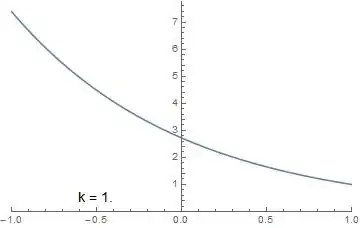
But at this point I’m stuck and can’t see how to repeat the discontinuous case with NDSolve. According to the documentation, the “Chasing” method can solve multipoint boundary value problems, allowing the imposition of internal BCs, but the only example shown seems to assume continuity on the internal boundaries. What I need, but lack, is a mechanism in NDSolve for specifying the solution (and its derivatives for higher-order problems) just to the left and, separately, just to the right of an internal boundary. Can anyone suggest a way to make NDSolve work for my discontinuous case? Thanks!


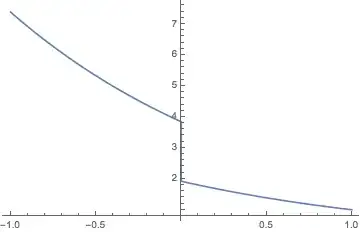


z=0with OP's, they're apparently different. – xzczd Jun 20 '15 at 12:12NDSolvesolve the BVP without theWhenEventusing the shooting method and then after solving fork, it integrates with the event. I'll look into it further. It might be a bug, because it should work. (Works if I do the shooting method manually withParametericNDSolve.) – Michael E2 Jun 20 '15 at 13:06r0 f[1] == 1, but of course that's a klugde. Still trying to see if I can track it down definitively... – Michael E2 Jun 20 '15 at 15:02ParametricNDSolve[]was finally inplemented, my first thought was "this should make shooting easier". The equivalent code using justNDSolve[]would probably have looked messy. – J. M.'s missing motivation Jun 21 '15 at 01:10WhenEventcan only deal with IVP (at least now). (Just checked the document ofWhenEventand saw no example for a BVP. ) – xzczd Jun 21 '15 at 04:41WhenEventto the shooting method set-up inNDSolvewould be difficult, if not impossible in some cases. But surely a warning message would be polite, as well as time-saving. – Michael E2 Jun 21 '15 at 05:32