Consider a list like below:
ttable={{0, 2.6596 - 66.137 I}, {1/9, 2.45339 - 65.3148 I}, {2/9,
  1.82053 - 62.8922 I}, {1/3, 0.720006 - 58.9982 I}, {4/
  9, -0.911205 - 53.8382 I}, {5/9, -3.15056 - 47.6797 I}, {2/
  3, -6.08057 - 40.8346 I}, {7/9, -9.77826 - 33.6382 I}, {8/
  9, -14.3047 - 26.4282 I}, {1, -19.6947 - 19.5216 I}}`
by defining "f" as interpolating function we'll have:
f = Interpolation[ttable]
now we define ff as the following integration:
ff[\[Xi]_]:=NIntegrate[(f[rr]) Cos[rr \[Xi]], {rr, 0, 1}]
the first problem is that this function can not be calculated and I have no idea why the followoing error happens:
In[87]:= ff[.1]
During evaluation of In[87]:= NIntegrate::inumr: The integrand Cos[rr \[Xi]] InterpolatingFunction[{{0.,1.}},{4,15,0,{10},{4},0,0,0,0,Automatic,{},{},False},<<1>>,{
Developer`PackedArrayForm,{0,<<10>>},{2.6596 -66.137 I,<<8>>,-19.6947-19.5216 I}},{Automatic}][rr] has evaluated to non-numerical values for all sampling points in the region with boundaries {{0,0.111111}}. >>
Out[87]= NIntegrate[f[rr] Cos[rr \[Xi]],{rr,0,1}]
The other thing should be mentioned is that I have to use ff in integrand of another integration like below:
NIntegrate[ff[\[Xi]] * \[Xi],{\[Xi],0,3}]
I've manipulated the former equations in many ways but none of them made an accurate output for the last integration, so I would be greatly thankful if somebody out there could help me!


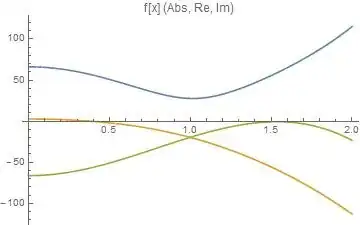
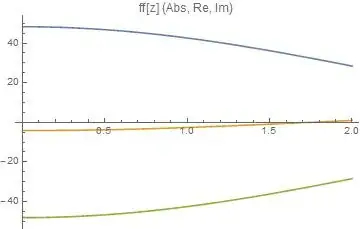


ttable, which is probably a typo anyways. – Wizard Jun 23 '15 at 10:10fffunction sometimes works and sometimes not which makes me really confused but what about the last integral could you calculate it too?! cause that one never showed to be solved!!! – zag Jun 23 '15 at 10:21ff[.1]evaluates to-4.1238 - 48.0535 Iin V10.1 running on OS X (10.10.2). – m_goldberg Jun 23 '15 at 11:06NIntegrate[ff[\[Xi]] * \[Xi],{\[Xi],0,3}]too?!!!! – zag Jun 23 '15 at 11:15