1

How can I reduce the inequality in terms of modulus of alpha.

Reduce[Abs[-((-1 + Sqrt[ 1 + 4 α] + α (-3 + Sqrt[1 + 4 α]) + 
          Sqrt[ 2 - 2 Sqrt[1 + 4 α] +  2 α (-2 +  4 Sqrt[1 + 4 α] + 
          α (-11 + 2 α + Sqrt[ 1 + 4 α]))])/(2 (-1 - 2 α + Sqrt[1 + 4 α])))] < 1]
Dr. belisarius
  • 115,881
  • 13
  • 203
  • 453
Sk Sarif Hassan
  • 277
  • 2
  • 8

1 Answers1

5

For Reals

f[α_]:= -((-1 + Sqrt[1 + 4 α] + α (-3 + Sqrt[1 + 4 α]) + 
           Sqrt[2 - 2 Sqrt[1 + 4 α] + 2 α (-2 + 4 Sqrt[1 + 4 α] + α (-11 + 2 α + 
           Sqrt[1 + 4 α]))])/(2 (-1 - 2 α +  Sqrt[1 + 4 α])))
Reduce[-1 < f[α] < 1, α]

(* Root[-4 + 20 #1 - 12 #1^2 + #1^3 &, 2] <= α < 2 *)

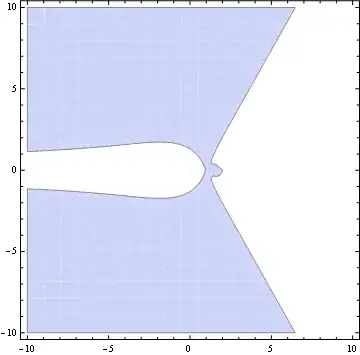
For Complexes (still working on it)

RegionPlot[Abs@f[x + I y] < 1, {x, -10, 10}, {y, -10, 10}]

Mathematica graphics

Dr. belisarius
  • 115,881
  • 13
  • 203
  • 453
  • What about for Complex case? – Sk Sarif Hassan Jul 06 '15 at 17:24
  • Root[-4 + 20 #1 - 12 #1^2 + #1^3 &, 2] <= α < 2 What is this? I do not understand the equation with # symbo. Can you please tell me what is the equation of which Roots should be less than equal to 2 alpha. – Sk Sarif Hassan Jul 06 '15 at 17:30
  • @SkSarifHassan You could check the docs for Root[ ] or search for questions in this site involving about it. In any case, if feel too lazy to do that try Root[-4 + 20 #1 - 12 #1^2 + #1^3 &, 2] //N – Dr. belisarius Jul 06 '15 at 17:34
  • Thanks a lot. I am not lazy really. I do not know these. – Sk Sarif Hassan Jul 06 '15 at 17:36
  • 1
    @SkSarifHassan ToRadicals (sometimes combined with ComplexExpand) may also make Root values (at least simpler ones with closed form) more understandable. For instance, try Root[-4 + 20 #1 - 12 #1^2 + #1^3 &, 2] // ToRadicals // ComplexExpand. This may be good for the end user; if you plan to feed these results back to Mathematica, don't perform such transitions for no apparent reasons. Mma likes Roots. – kirma Jul 06 '15 at 18:16