The plan is first get the "external" contour and then use Green's theorem to find its area.
r[t_] := {-9 Sin[2 t] - 5 Sin[3 t], 9 Cos[2 t] - 5 Cos[3 t], 0}

(*find the intersections*)
tr = Quiet@ToRules@Reduce[{r@t1 == r@t2, 0 < t1 < t2 < 2 Pi}, {t1, t2}];
pt = {t1, t2} /. {tr} // Flatten;
pts = SortBy[pt, N@# &];
pps = Partition[pts, 2];
Now we can use Green's theorem to calculate the area by evaluating a line integral of a piecewise smooth function between those points. First we verify that the curve is oriented as expected:
Show[ParametricPlot[Most@r@t, {t, #[[1]], #[[2]]},
                    PlotRange -> {{-14, 14}, {-14, 14}}] & /@ pps] /. Line :> Arrow
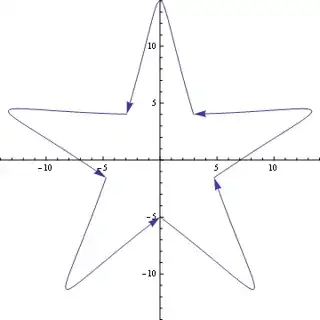
So:
(*Green's theorem, "vectorial" form*)
k[{t2_, t1_}] = Integrate[Last@Cross[r@t, r'@t], {t, t1, t2}]/2;
arean = k /@ pps;
area = Total@arean;
arean // N
area // N
(* {42.9706, 42.9706, 42.9706, 42.9706, 42.9706} *)
(* 214.853 *)
So area is composed by five numerically equivalent integrals.
Let's get a symbolic form by using the first of them (the easier one to work with). You can verify that if we define:
ff[n_] := ArcTan[Sqrt@Root[1 - 2026 #1 + 67761 #1^2 - 2123042 #1^3 + 33867982 #1^4 -
          251359006 #1^5 + 1020220287 #1^6 - 2365497302 #1^7 + 3139485186 #1^8 -
          2365497302 #1^9 + 1020220287 #1^10 - 251359006 #1^11 + 33867982 #1^12 -
          2123042 #1^13 + 67761 #1^14 - 2026 #1^15 + #1^16 &, n]];
then
arean[[1]] == -((252*Sqrt[3*(-68561 + 5154*Sqrt[181])])/3125) - 174*(ff[1] - ff[2])
which is one fifth of the symbolic result you're after.
We may try to quickly verify if the result is reasonable by doing some image processing. We'll use a somewhat large image size (3000 pxs width) to get some accuracy:
lims = {-1, 1} + # &/@ N@Outer[#2[#1, t] &, Most@r@t, {MinValue, MaxValue}];

img = Show[ParametricPlot[a Most@r@t, {t, #[[1]], #[[2]]}, {a, 0, 1},
           PlotRange -> lims, Axes -> False, Mesh -> False, Frame -> False,
           ImageSize -> 3000] & /@ Partition[pts, 2]];

And now we count colored and white pixels
counts = Last /@ (ImageData[Binarize@img] // Flatten // Tally)
(* {6228712, 2366288} *)
And comparing the the area quotients calculated by both methods:
Times @@ (Subtract @@@ lims)/area // N
(* 3.64587 *)

Tr@counts/counts[[2]] // N
(* 3.63227 *)
we see that the results agree within reasonable limits


ContourPlot[625x^6+1875x^4y^2+1875x^2y^4+625y^6-182250x^4y+364500x^2y^3-36450y^5+585816x^4+1171632x^2y^2+585816y^4-41620992x^2-41620992y^2+550731776==0,{x,-15,15},{y,-15,15}]– LCFactorization Jul 20 '15 at 22:48