To be able to answer this question, we need to agree what "random" means precisely. To me, the most reasonable interpretation is to require a uniform distribution on the $\sum_i x_i = a$ simplex.
This will be satisfied by Praan's solution once we filter tuples containing negative numbers. Let's illustrate using $a=1$ and $n=3$.
Praan's method:
pts = Select[
   Append[#, 1 - Total[#]] & /@ RandomReal[1, {10000, 2}],
   Positive[Times @@ #] &
   ];

ListPointPlot3D[
 pts,
 BoxRatios -> {1, 1, 1}
 ]

Or let's just project down to 2D to make things easier to see:
Appropriate basis vectors:
a = Normalize[{-1, 1, 0}];
b = Normalize[{-1, -1, 1}];

ListPlot[
 {a.#, b.#} & /@ pts,
 AspectRatio -> Automatic,
 Axes -> False, Frame -> True
 ]

The fact that the distribution will be uniform is also clear from the fact that this method is effectively doing a linear transformation on points of the form $(x,y,0)$, which are already uniformly distributed within a plane.
ciao's idea (comments) gives a very different distribution:
pts = Table[
   Normalize[RandomReal[{0, 1}, 3], Total],
   {10000}
   ];

And Simon Rochester's method (comments) produces a distribution that's different from both:
pts = Table[
   Differences@Append[NestList[# + RandomReal[{0, 1 - #}] &, 0, 2], 1],
   {10000}
   ];
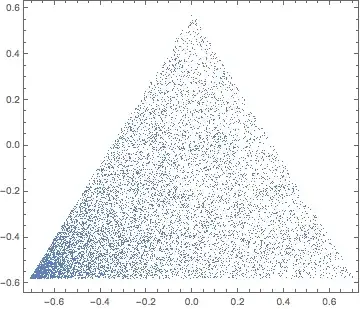
To decide which one is right, we need to agree on the interpretation of random. To me, the most reasonable interpretation is this: a "random triplet of numbers" means uniform distribution in 3D Euclidean space. Adding a constraint (i.e they must sum to $a$) should not modify this requirement, i.e. that we need to have uniform distribution in 3D Euclidean space.
This is only satisfied by Praan's method.


Differences@Append[NestList[# + RandomReal[{0, 60 - #}] &, 0, 4], 60]– Simon Rochester Jul 20 '15 at 10:07a Normalize[RandomReal[1, n], Total]. – J. M.'s missing motivation Jul 20 '15 at 10:10ListPointPlot3D[ Table[ Normalize[RandomReal[{0, 1}, 3], Total], {10000} ], BoxRatios -> {1, 1, 1} ]. In this sense not every triplet generated by this method is equally likely. – Szabolcs Jul 20 '15 at 10:16Block[{a = 11, n = 3}, a #/Total[#, {1}] &@Log@RandomReal[{0, 1}, {n}]]. His answer shows how to getmsuch vectors in one similar efficient call. – Michael E2 Jul 20 '15 at 11:47