24

I have a list which looks like this: l={{1,0,3,4},{0,2},{0,0,1,3},{1,2,0}}. Now I would like to count how many 0s the sublists contain in the first, second,... slot. The result for this example should be: {2,2,1,0}. Since the sublists do not have the same length MapThread does not work.

I would be grateful for a solution.

kglr
  • 394,356
  • 18
  • 477
  • 896
RMMA
  • 2,710
  • 2
  • 18
  • 33

6 Answers6

31

You can use Flatten to transpose a ragged array:

list = {{1, 0, 3, 4}, {0, 2}, {0, 0, 1, 3}, {1, 2, 0}}

Count[#, 0] & /@ Flatten[list, {{2}, {1}}]
(* {2, 2, 1, 0} *)

Edit

Step one is to transpose your list but in this case the list is ragged so Tranpose doesn't work:

Transpose[list]

However Flatten can transpose a ragged list (type Flatten in the documentation center and then go to "Applications"):

Flatten[list, {{2}, {1}}]
(* {{1, 0, 0, 1}, {0, 2, 0, 2}, {3, 1, 0}, {4, 3}} *)

Now that the list is transposed you can count the number of zeros, this is done by mapping the transposed list onto Count

Map[Count[#, 0] &, Flatten[list, {{2}, {1}}]]
Mike Honeychurch
  • 37,541
  • 3
  • 85
  • 158
16

I propose this:

Total @ PadRight[1 - Unitize[list]]
Simon Woods
  • 84,945
  • 8
  • 175
  • 324
11

Say you have

l = {{1, 0, 3, 4}, {0, 2}, {0, 0, 1, 3}, {1, 2, 0}, {1, 1, 1, 1, 0}};

There is a bit different approach to your function:

Sort@Tally@Position[l, 0][[All, 2]]

{{1, 2}, {2, 2}, {3, 1}, {5, 1}}

which is compressed from of your information. It gives you slot index and number of 0s there. If slot has no zeros it is not mentioned. If you have a lot of zero-less slots such format is much shorter.

Grid[{{"slot", "zeros"}}~Join~%, Frame -> All]

enter image description here

And here is clunky exercise in padding arrays (with help of Mike's comment) :

zcount[l_List] := With[{m = Max[Length /@ l]}, (Count[#, 0] & /@ 
                         Transpose[PadRight[#, m, None] & /@ l])]

The usage:

zcount[l]

{2, 2, 1, 0, 1}

Vitaliy Kaurov
  • 73,078
  • 9
  • 204
  • 355
8

Since MapThread accepts a level specification, I think our ragged MapThread function should too.

raggedMapThread[f_, expr_, level_Integer: 1] :=
  Apply[f, Flatten[expr, List /@ Range[2, level + 1]], {level}]

To solve the specific case posed in the question:

raggedMapThread[
  Count[{##}, 0] &,
  {{1, 0, 3, 4}, {0, 2}, {0, 0, 1, 3}, {1, 2, 0}}
]

{2, 2, 1, 0}

Extended to level 2 with an example function test:

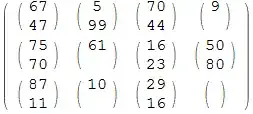
a = {{{67, 47}, {5, 99}, {70, 44}, {9}},
     {{75, 70}, {61}, {16, 23}, {50, 80}},
     {{87, 11}, {10}, {29, 16}}};

PadRight[a, Automatic, ""] // MatrixForm  (* for illustration *)

raggedMapThread[test, a, 2] // MatrixForm

Mathematica graphics

Mathematica graphics

Mr.Wizard
  • 271,378
  • 34
  • 587
  • 1,371
  • how would you parallelize raggedMapThread? – s0rce Nov 30 '12 at 01:26
  • @s0rce since there is no "ParallelApply" (at least not in v7) you would need to use something like ParallelMap: raggedMapThread[f_, expr_, level_Integer: 1] := ParallelMap[Function[, f @@ #, HoldAll], Flatten[expr, List /@ Range[2, level + 1]], {level}] the HoldAll function might be replaced with f @@ # & if you are certain of no surprise evaluations. – Mr.Wizard Nov 30 '12 at 01:48
5

Since

enter image description here

and

enter image description here

the following variations also work:

list = {{1, 0, 3, 4}, {0, 2}, {0, 0, 1, 3}, {1, 2, 0}, {1, 1, 1, 1, 0}};
Count[#, 0] & /@ Transpose@PadRight[list, Automatic, "x"]
(* or *)
Tr /@ Transpose@PadRight[Map[Boole[# == 0] &, list, {-1}]]
(* or *)
Plus @@ PadRight[Boole[# == 0] & /@ # & /@ list]
(* => {2,2,1,0,1} *)

EDIT: Few more ways:

Rest@Total@BinCounts@Position[list, 0]
Count[Position[list, 0], {_, #}] & /@ Range@Length@list
Length@Position[Position[list, 0], {_, #}] & /@ Range@Length@list
kglr
  • 394,356
  • 18
  • 477
  • 896
1

Here's a solution for when you have one list and one scalar. Perhaps it can be adapted to your needs -- maybe I'll come back and edit it tailored to your use-case a little more later, but I think you'll get the point.

EDIT: Just saw that this post was from 2012; maybe I won't rush on tailoring it to your needs, but this post came up near the top in my Google search, so maybe somebody else will get some use out of these...

Method 1

Inner[MyFunction, {d}, {{a, b, c}}]
Inner[MyFunction, {{a, b, c}}\[Transpose], {d}, Reverse]

Output (they're equivalent) [leaving it to the reader to do it in the opposite order]:

{MyFunction[d, a], MyFunction[d, b], MyFunction[d, c]}

Method 2 - might be more adaptable for you:

Outer[MyFunction, {a, b, c}, {d}]

Output:

{{MyFunction[a, d]}, {MyFunction[b, d]}, {MyFunction[c, d]}}

Method 3

Distribute[MyFunction[{a, b, c}, d], List]

Output:

{{MyFunction[a, d]}, {MyFunction[b, d]}, {MyFunction[c, d]}}

Update -- GENERAL-CASE SOLUTIONS:

  • These were also written to work with any combination of lists and scalars...
DistributeOp[distributeOver_] := Function[expr, Distribute[expr, distributeOver]]
EnsureList[expr_] := Flatten[{expr}, 1]

MapThreadRagged1[func_, a_, b_] := Inner[func, {EnsureList[a]}[Transpose], {EnsureList[b]}] MapThreadRagged2[func_, a_, b_] := Outer[func, EnsureList[a], EnsureList[b]] MapThreadRagged3[func_, a_, b_] := DistributeOp[List]@func[EnsureList[a], EnsureList[b]]

Output:

MapThreadRagged1[f, {a, b}, {c, d}]
MapThreadRagged1[f, a, b]
MapThreadRagged2[f, {a, b}, {c, d}]
MapThreadRagged2[f, a, b]
MapThreadRagged3[f, {a, b}, {c, d}]
MapThreadRagged3[f, a, b]

{{f[a, c], f[a, d]}, {f[b, c], f[b, d]}} {{f[a, b]}}

{{f[a, c], f[a, d]}, {f[b, c], f[b, d]}} {{f[a, b]}}

{f[a, c], f[a, d], f[b, c], f[b, d]} {f[a, b]}

Sean
  • 645
  • 4
  • 10