If I have two expressions with sums in them, like this:
$$\begin{align*} b&=\frac{\sum_{i} (x_i - \bar{x})(y_i -\bar{y})}{\sum_{i}(x_i -\bar{x})^2}\\ r&=\frac{\sum_{i} (x_i - \bar{x})(y_i -\bar{y})}{\sqrt{\sum_{i}(x_i -\bar{x})^2\sum_{i}(y_i -\bar{y})^2}} \end{align*}$$
and I wanted to produce a simplified expression of $\frac{b}{r}$, how would I do it? The problem is the sums. It seems Mathematica doesn't like the unspecified, unevaluated sums.
Edit: I was expecting to end up with something like this:
$$\sqrt{\frac{\sum_{i}(y_i -\bar{y})^2}{\sum_{i}(x_i -\bar{x})^2}}$$
I've been playing around with Expand, Simplify, FullSimplify. There may just be a way to apply it that I'm missing.


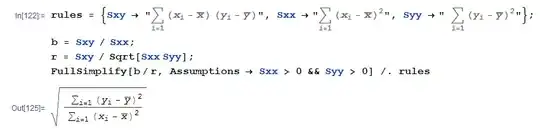


(Sum[(Subscript[x, i] - OverBar[x]) (Subscript[y, i] - OverBar[y]), i]/Sum[(Subscript[x, i] - OverBar[x])^2, i])/(Sum[(Subscript[x, i] - OverBar[x]) (Subscript[y, i] - OverBar[y]), i]/ Sqrt[Sum[(Subscript[x, i] - OverBar[x])^2, i] Sum[(Subscript[y, i] - OverBar[y])^2, i]])works on my end... – J. M.'s missing motivation Aug 09 '12 at 12:37Mean[ ]. – Dr. belisarius Aug 09 '12 at 12:40Mean[]doesn't know how to handle something that isn't explicitly a list... – J. M.'s missing motivation Aug 09 '12 at 12:41