19

In wanting to demonstrate the power of Mathematica, I wanted to show my 11-year-old son how we could validate that his sequences homework was correct. We could generate the next value in sequence in a simple expression, but when it came to repeatedly doing this (for the next 10 values), I got stuck.

We have seed list of values {0,2,2,4} which we called seedlist. The sequence is simply taking the last two numbers and adding them together to create the next number.

What I wanted to show was how we could generate an extended list for the first 10 (say) values e.g.

{0, 2, 2, 4, 6, 10, 16, 26, 42, 68}

In an attempt to append the next value into the list we did the following

Append[seedlist, (Extract[seedlist, 3] + Extract[seedlist, 4])]

Now I wanted to be able to recursively append to the list. So I tried several approaches as follows:

  1. Tried to use a function and the called NestList:

    rec[dat_, n_] :=
     Append[seedlist, (Extract[seedlist, n] + Extract[seedlist, n - 1])]
    
    NestList[rec[#, i] &, seedlist, {i, 1, 10}]
    

This gave me an error "Non-negative machine-sized integer expected at position 3 in NestList[rec[#1,i]&,{0,2,2,4},{i,1,10}]"

  1. After a bit more digging in the documentation, I then tried a simpler version

    NestList[Append[
     Rest[#], (Extract[#, 4] + Extract[#, 4 - 1])] &, seedlist, 7]
    

This worked to a degree but I got presented with the following list

{{0, 2, 2, 4}, {2, 2, 4, 6}, {2, 4, 6, 10}, {4, 6, 10, 16}, {6, 10, 16, 26},
 {10, 16, 26, 42}, {16, 26, 42, 68}, {26, 42, 68, 110}}

This has all the answers, just not necessarily in the right places! This is, without necessarily knowing it, what I asked for in the above of course but not what I want to achieve.

I'd be really grateful for someone to point me in the right direction and get the correct list out. I have a feeling I'm fairly close with the last attempt, but I'd appreciate a nudge to solve this correctly.

J. M.'s missing motivation
  • 124,525
  • 11
  • 401
  • 574
AnthonyMiller
  • 191
  • 1
  • 5
  • 1
    NestList[Append[#, #[[-2]] + #[[-1]]] &, seedlist, 7] – Karsten7 Oct 23 '15 at 11:42
  • Or NestList[#~Join~{#[[-2]] + #[[-1]]} &, seedlist, 7] – Karsten7 Oct 23 '15 at 11:42
  • 4
    and +1 for preaching MMA to the younger generation – LLlAMnYP Oct 23 '15 at 11:46
  • 2
    LinearRecurrence[{1, 1}, {0, 2}, 10] is the built-in, by the way, or RecurrenceTable[{a[n + 1] == a[n] + a[n - 1], a[1] == 2, a[0] == 0}, a, {n, 0, 10}]. (Much less pedagogical value to those.) – Patrick Stevens Oct 23 '15 at 11:56
  • Wow! I buy a sandwich, come back and my question is answered. Thank you so much to all. So, in the two examples above, using Append or using Join, is there a preferred approach? Again many thanks – AnthonyMiller Oct 23 '15 at 11:59
  • 2
    You might be interested in linked lists, too, to avoid the fact that Mathematica's Append function doesn't work in-place and so is quite slow: Nest[{#[[2, 1]] + #[[1]], #} &, {2, {0}}, 10] // Flatten // Reverse – Patrick Stevens Oct 23 '15 at 12:00
  • Patrick: I love the last edit you added, but could you expand on how this is working? We have some shorthand for Part working on itself but I'm not sure I understand the last element contained in the curly braces. Thanks – AnthonyMiller Oct 23 '15 at 12:11
  • @AnthonyMiller This is highly nonobvious, don't worry. We simulate a linked list as follows: the true list {1,2,3,4} is written as {4, {3, {2, {1}}}}. This is because it happens to be an efficient way for Mathematica to construct lists - much more efficient than Append. There is what is nearly a short book on the subject here on SE: http://mathematica.stackexchange.com/a/25474/30771 – Patrick Stevens Oct 23 '15 at 12:18
  • @Patrick Stevens Ah ha, excellent. Thanks for explaining and for pointing me to the list book! - more stuff to read...kindest again, Anthony – AnthonyMiller Oct 23 '15 at 12:22
  • The methods in Fibonacci Sequence Generator could be adapted to this sequence. – Karsten7 Oct 23 '15 at 12:22
  • @Karsten - SequenceFoldList? Might be interesting to play with? Thanks – AnthonyMiller Oct 23 '15 at 12:33
  • @Kartsen 7 - Yes this seems to work well fib[n_] := SequenceFoldList[Plus, {0, 2}, ConstantArray[0, n - 1]]; fib[10] - Interesting. I wonder what is more performant though? I don't know what SequenceFoldList is doing under the covers? – AnthonyMiller Oct 23 '15 at 12:36
  • 1
    I did a small performance benchmark for Tribonacci numbers. SequenceFoldList did perform pretty well. – Karsten7 Oct 23 '15 at 12:42

6 Answers6

20

What you have is what's known in some circles as a linear recurrence. That is, you have a sequence where the general term can be expressed as an appropriate combination of previous terms.

The simplest way of going about it, as has been previously noted, is to use either of Nest[]/NestList[], like so:

NestList[Append[#, Total[Take[#, -2]]] &, {0, 2, 2, 4}, 6]
   {{0, 2, 2, 4}, {0, 2, 2, 4, 6}, {0, 2, 2, 4, 6, 10}, {0, 2, 2, 4, 6, 10, 16},
    {0, 2, 2, 4, 6, 10, 16, 26}, {0, 2, 2, 4, 6, 10, 16, 26, 42},
    {0, 2, 2, 4, 6, 10, 16, 26, 42, 68}}

where Take[list, -2], takes the last two (hence the negative sign) elements, and Total[list] sums the two elements up.

However, it should be said that there is a function called, appropriately enough, LinearRecurrence[], that does this recursion in an efficient manner. Here is how to use it:

LinearRecurrence[{1, 1}, {0, 2}, 10]
   {0, 2, 2, 4, 6, 10, 16, 26, 42, 68}

To explain the notation a bit, LinearRecurrence[{1, 1}, {a, b}, k] generates k terms, starting with the first two terms a and b, and then successively generates a + b, a + 2 b, 2 a + 3 b, .... You can see this by feeding symbolic arguments:

LinearRecurrence[{1, 1}, {a, b}, 10]
   {a, b, a + b, a + 2 b, 2 a + 3 b, 3 a + 5 b, 5 a + 8 b, 8 a + 13 b,
    13 a + 21 b, 21 a + 34 b}

In fact, your sequence can be expressed in terms of the famous Fibonacci numbers, which satisfy the same recursion, but with different starting points. I'll skip the (deep!) math, but here's a demonstration:

Table[2 (Fibonacci[n - 3] + Fibonacci[n - 2]), {n, 9}]
   {0, 2, 2, 4, 6, 10, 16, 26, 42, 68}
J. M.'s missing motivation
  • 124,525
  • 11
  • 401
  • 574
11
NestList[Append[#, #[[-2]] + #[[-1]]] &, {0, 2, 2, 4}, 5]

[[-2]] means the second last element; # instead of Rest[#] is used to prevent discarding of the first element. As we can count elements from the end, we don't have the problem of needing to know the length of the seed list. We might as well have done

NestList[Append[#, #[[-2]] + #[[-1]]] &, {0, 2}, 7]
Karsten7
  • 27,448
  • 5
  • 73
  • 134
LLlAMnYP
  • 11,486
  • 26
  • 65
10

It can be done elegantly with tail recursion.

series[a_, b_, n_] := Flatten[helper[a, b, n, {}]]
helper[_, _, 0, s_] := s
helper[a_, b_, n_, s_] := helper[b, a + b, n - 1, {s, a}]

series[0, 2, 10]

{0, 2, 2, 4, 6, 10, 16, 26, 42, 68}

When the 1st two arguments are set to 1, series gives the Fibonacci series.

series[1, 1, 10] == Table[Fibonacci[i], {i, 10}]

True

m_goldberg
  • 107,779
  • 16
  • 103
  • 257
  • Is there is reason why you are using the undefined term. I tried using List instead and it's even faster. – Karsten7 Oct 23 '15 at 19:23
  • 2
    @Karsten7.Habit. Most of my tail-recursive code deals with accumulating lists of some complexity. I have become habituated to using a tag when accumulating them into a linked structure to make the final flattening easier. As you point out, there is no need for that here. I will edit my answer accordingly. – m_goldberg Oct 23 '15 at 22:03
4

Another approach is to use recursion. If you don't have a large number simple recursion will do, but if the sequence you are creating is big you can speed it up (at the expense of memory) by using Set when you define the function (a method called memoization).

func[n_] := func[n] = func[n - 1] + func[n - 2]
func[1] = 0;
func[2] = 2;

This function won't give you the list but rather provides you with the value.

func[10]
(* 68 *)

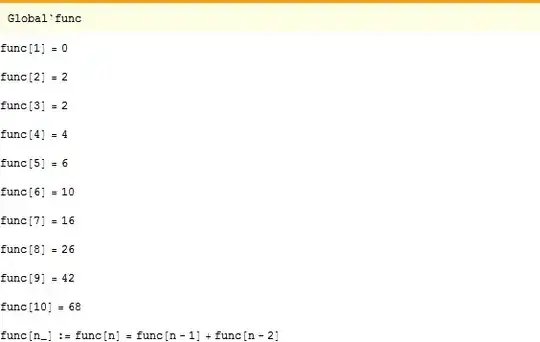
Now however, if you examine func you will see

?func

Mathematica graphics

All of the intermediate values have been assigned.

To create the desired list use Map.

Map[func, Range[10]]
(* {0, 2, 2, 4, 6, 10, 16, 26, 42, 68} *)
Jack LaVigne
  • 14,462
  • 2
  • 25
  • 37
3

Your sequence satisfies the following recursive formula

$a_{n+1} = a_n + a_{n-1}(n\geq 1) \quad a_0=0, a_1=2$

Trying this

First /@ NestList[{#2, #1 + #2} & @@ # &, {0, 2}, 9]
{0, 2, 2, 4, 6, 10, 16, 26, 42, 68}

For the general formula $a_{n+1}=$ func $(a_{n-1},a_n)$, you can use the a general solution

# & @@@NestList[{#2, func[#1,#2]} & @@ # &, {a1, a2}, n]

where $n$ is the $n$-th number

About the explonation, please the following post


For recursion formula $a_{n}=\alpha a_{n-1}+\beta a_{n-2}\quad (n \geq 2)$

we can use the following strtegy.ie. built-in MatrixPower[].

$$ \begin{pmatrix} a_{n-1}\\ a_{n} \end{pmatrix} = \begin{pmatrix} a_{n-1}\\ \alpha a_{n-1}+\beta a_{n-2} \end{pmatrix} = \begin{pmatrix} 0 & 1\\ \beta & \alpha \end{pmatrix} \begin{pmatrix} a_{n-2}\\ a_{n-1} \end{pmatrix} $$ $$ =\cdots = \begin{pmatrix} 0 & 1\\ \beta & \alpha \end{pmatrix}^{n-2} \begin{pmatrix} a_{1}\\ a_{2} \end{pmatrix} =A^{n-2}\begin{pmatrix} a_{1}\\ a_{2} \end{pmatrix} $$

where, $ A= \begin{pmatrix} 0 & 1\\ \beta & \alpha \end{pmatrix} $

xyz
  • 605
  • 4
  • 38
  • 117
1

I like everyone's answers, but it seems to me that your first approach is most appropriate for a 11-year-old kid new to MMA. Keep it simple and leave the pure functions and exotic syntax for another day. :)

Perhaps something like this:

next[list_] := Append[list, list[[-1]] + list[[-2]]]

So that

next[{0, 2, 2, 4}]

returns

{0,2,2,4,6}

Then

Nest[next, {0, 2, 2, 4}, 10]

returns

{0, 2, 2, 4, 6, 10, 16, 26, 42, 68, 110, 178, 288, 466}

After all, you're trying to show how simple and easy it is to check your homework with MMA :)

ConvexMartian
  • 1,641
  • 11
  • 18