18

Hi,

I asked some time ago the following question on math.stackexchange, but I ask it here too since it remains unanswered.

The question concerns a function I encountered during research :

$$f(k):= k K(k) \sinh \left(\frac{\pi}{2} \frac{K(\sqrt{1-k^2})}{K(k)}\right)$$ for $k \in (0,1)$.

Here $K$ is the Complete elliptic integral of the first kind, defined by $$K(k):= \int_{0}^{1} \frac{dt}{\sqrt{1-t^2} \sqrt{1-k^2t^2}}.$$

More specifically, my question is the following :

Is $f$ decreasing on $(0,1)$?

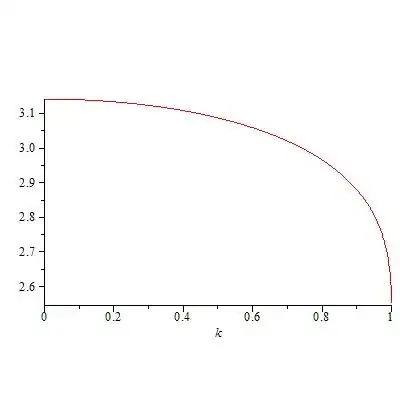
This seems to be true, as the graph below suggests (obtained with Maple) :

graph of $f$

In fact, as remarked by Henry Cohn, much more seems to be true : all the derivatives of $f$ seem to be negative. This can be seen by looking at the Taylor series expansion of $f$ (see the link to math.stackexchange). The Taylor series expansion seems to have all negative coefficients (except the constant term), and the coefficient of $k^{2j}$ seems to be $\pi$ times a rational number with denominator dividing $16^j$...

Any comment or relevant reference is welcome.

Thank you, Malik

EDIT (20-07-2012) It was remarked by J.M. on M.SE that $f$ can be written as $$f(k)=kK(k)\frac{1-q(k)}{2\sqrt{q(k)}},$$ where $q(k)$ is the Elliptic nome. Maybe this is useful...

Malik Younsi
  • 1,942
  • I have a feeling that looking at Laplace transforms and Bernstein's theorem on completely monotonic functions along with some inverse Laplace transforms might help...but translating this feeling into a proof might be non-trivial... – Suvrit Jul 19 '12 at 19:50
  • @Suvrit : Good idea, I'll check this out.. Thank you! – Malik Younsi Jul 20 '12 at 13:44
  • Are you sure you typed in the function all right? In Mathematica I get a very different plot. For example, at k=4/5 it tells me K(3/5)=1.94957, K(4/5)=2.25721, so f(4/5)=0.82.25721Sinh[(pi/2)*1.94957/2.25721]=3.27375, while your graph suggests a value below 3. – GH from MO Jul 20 '12 at 15:20
  • 2
    I clarified: K(k)=EllipticK[k^2] in Mathematica. – GH from MO Jul 20 '12 at 15:38
  • Yes, according to http://reference.wolfram.com/mathematica/ref/EllipticK.html. Weird... – Malik Younsi Jul 20 '12 at 15:47
  • For information, $K(k)=EllipticK(k)$ in Maple. – Malik Younsi Jul 20 '12 at 15:49

4 Answers4

16

First we put it in the notation of Mathematica $K(k)$ is $K(k^2)$. So our function will be $$f(k)= k K(k^2)\sinh\Bigl(\frac{\pi}{2}\frac{K(1-k^2)}{K(k^2)}\Bigr).$$ Now we change variables (W486, Whittaker, Watson p.~486) . $$k=\frac{\vartheta_2^2(q)}{\vartheta_3^2(q)} \quad (*)$$ Where$\newcommand\Z{\mathbb{Z}}$ $$\vartheta_2(q)=2q^{\frac14}(1+q^2+q^6+\cdots)= \sum_{n\in\Z}q^{(n-\frac12)^2}= 2q^{\frac14}\prod_{n=1}^\infty\{(1-q^{2n})(1+q^{2n})^2\}$$ $$\vartheta_3(q)=1+2q+2q^4+2q^9+\cdots=\sum_{n\in\Z}q^{n^2}= \prod_{n=1}^\infty\{(1-q^{2n})(1+q^{2n-1})^2\}$$ $$\vartheta_4(q)=1-2q+2q^4-2q^9+\cdots=\sum_{n\in\Z}(-1)^nq^{n^2}= \prod_{n=1}^\infty\{(1-q^{2n})(1-q^{2n-1})^2\}$$ The function of $q$ in (*) is differentiable and increasing on $(0,1)$ it is $0$ in $0$ and $1$ in $1$. (we shall write $\vartheta_j$ to denote $\vartheta_j(q)$). Since (W467) $$\vartheta_2^4+\vartheta_4^4=\vartheta_3^4$$ we have $$1-k^2=1-\frac{\vartheta_2^4}{\vartheta_3^4}=\frac{\vartheta_4^4}{\vartheta_3^4}$$ The interesting thing about this change of variables is that $$K(k^2)=K\Bigl(\frac{\vartheta_2^4}{\vartheta_3^4}\Bigr)=\frac{\pi}{2}\vartheta_3^2,\qquad K(1-k^2)=K\Bigl(\frac{\vartheta_4^4}{\vartheta_3^4}\Bigr)=\frac{\log(1/q)}{2}\vartheta_3^2.$$

Now our function is $$k K(k^2)\sinh\Bigl(\frac{\pi}{2}\frac{K(1-k^2)}{K(k^2)}\Bigr) =\frac{\pi}{4}\Bigl(\frac{1}{\sqrt{q}}-\sqrt{q}\Bigr) \vartheta_2^2$$ that must be decreasing in $q$.

We add to the above some comments:

We need to show that $f(q):=(1-q)\vartheta_2^2/4\sqrt{q}$ is decreasing for $0 < q < 1 $. But

$$f(q)=(1-q)\prod_{n=1}^\infty (1-q^{2n})^2(1+q^{2n})^4= (1-q)\prod_{n=1}^\infty (1-q^{4n})^2(1+q^{2n})^2$$ This is the same to prove that the logarithmic derivative is negative $$-\frac{1}{1-q}-\sum_{n=1}^\infty\frac{8nq^{4n-1}}{1-q^{4n}}+\sum_{n=1}^\infty \frac{4nq^{2n-1}}{1+q^{2n}}$$ multiply this by $q>0$ and expand in series $$-\sum_{m=1}^\infty q^m-\sum_{n=1}^\infty \sum_{k=1}^\infty 8nq^{4nk}+ \sum_{n=1}^\infty\sum_{k=1}^\infty (-1)^{k+1}4nq^{2nk}$$

To show that this is negative observe that the only positive terms are those in the third sum with $k=2j+1$ odd, we will pair this term with that in the first sum corresponding to the same $n$ and $k=j$, these two terms are $$-8nq^{4nj}+4nq^{2n(2j+1)}=-4nq^{4nj}(2-q^{2n})<0.$$ This leaves only the terms with $j=0$ without pair. The remaining positive terms adds to $$\sum_{n=1}^\infty 4nq^{2n}=\frac{4q^2}{(1-q^2)^2}.$$ These terms we compensate with the first sum $$-\frac{q}{1-q}+\frac{4q^2}{(1-q^2)^2}=-\frac{q(1+q)(1-q^2)-4q^2}{(1-q^2)^2}$$ This is negative for $ 0 < q < 0.295598 $.

There is an intrinsic difficulty to treat larger values of $q$.

I propose to use the modularity of the theta function:

We have the equality considering $\vartheta_j$ as functions of $q$ $$\vartheta_2(e^{-\frac{\pi}{x}})=\sqrt{x}\vartheta_4(e^{-\pi x})$$ It follows that putting $q=e^{-\frac{\pi}{x}}$ $$\frac{1}{4}\Bigl(\frac{1}{\sqrt{q}}-\sqrt{q}\Bigr)\vartheta_2^2(e^{-\pi/x})= \frac{x}{2}\sinh\frac{\pi}{2x}\, \vartheta_4^2(e^{-\pi x}).$$ We must show this function is decreasing Since $$\vartheta_4(e^{-\pi x}) = \prod_{n=1}^\infty (1-e^{-2\pi n x})(1-e^{-\pi(2n-1)x})^2$$ is almost $1$ for $x$ near infinite, we only have to show that for $x$ large $\frac{x}{2}\sinh\frac{\pi}{2x}$ is decreasing

In this way we are proving that our function decrease when the initial $q$ is near 1. This was the difficult part before.

This strategy must be sufficient.
GH from MO
  • 98,751
juan
  • 6,976
  • I have a little confusion with increasing decreasing, but this must be the solution – juan Jul 22 '12 at 17:31
  • 1
    I have changed the problem in other I think more tractable. But I see that still there is something missing. – juan Jul 22 '12 at 17:47
  • Why is the function of $q$ in (*) increasing on $(0,1)$? – GH from MO Jul 23 '12 at 01:07
  • 2
    I see: $\vartheta_3(q)/\vartheta_4(q)$ is increasing as it has positive Taylor coefficients, hence $\vartheta_2^2(q)/\vartheta_3^2(q)=(1-\vartheta_4^4(q)/\vartheta_3^4(q))^{1/2}$ is also increasing. – GH from MO Jul 23 '12 at 01:48
  • Rewriting the function in terms of theta functions is a good idea, even though it's not clear to me that the last function in your answer is a decreasing function of $q$...! – Malik Younsi Jul 23 '12 at 02:17
  • @Malik Younsi I have added some ideas to finish the argument. I have proved that the function decrease for 0<q< 0.29... I have some problems with the TeX. May somebody edit this? – juan Jul 23 '12 at 15:55
  • @juan +1, very nice! – Malik Younsi Jul 23 '12 at 20:29
  • @juan The function $g(x)=\frac{x}{2} \sinh{\frac{\pi}{2x}}$ is decreasing on $(0,\infty)$. However, I'm not sure I get why this implies that the function $f(e^{-\pi/x})$ is decreasing. Could you explain a little? – Malik Younsi Jul 24 '12 at 14:47
  • 1
    We have $f(e^{-\pi/x}) = g(x) \vartheta_4^2(e^{-\pi x})$. The factor $\vartheta_4^2(e^{-\pi x})$ is almost constant $=1$. Therefore the character of $f(e^{-\pi/x}) $ will be that of $g(x)$. Of course this need careful bounds. Those of $\vartheta_4^2(e^{-\pi x})$ are easily obtained from the expression given for the $\vartheta$ functions at the start of my answer. Those of $g(x)$ must be elementary.

    For example the error in $\vartheta_4^2(e^{-\pi x})\approx1$ is of the order of $C e^{-\pi x}$.

    This will work for $x\gg1$.

    – juan Jul 24 '12 at 15:48
  • @juan : I was confused, but I get it now. Thank you! – Malik Younsi Jul 24 '12 at 17:59
6

The following is a strengthening of juan's conclusion. We need to show that the logarithmic derivative of $$ f(q):=\left(\frac{1}{\sqrt{q}}-\sqrt{q}\right) \vartheta_2^2(q) $$ is negative. Multiplying the logarithmic derivative by $q$, this means that $$ -\frac{q}{1-q}-\sum_{n=1}^\infty\frac{8nq^{4n}}{1-q^{4n}}+\sum_{n=1}^\infty \frac{4nq^{2n}}{1+q^{2n}} < 0. $$ For $0 < q < 1$ we have $$ \sum_{n=1}^\infty\frac{8nq^{4n}}{1-q^{4n}} > \sum_{n=1}^\infty 8nq^{4n} = \frac{8q^4}{(1-q^4)^2} $$ and $$ \sum_{n=1}^\infty\frac{4nq^{2n}}{1+q^{2n}} < \sum_{n=1}^\infty 4nq^{2n} = \frac{4q^2}{(1-q^2)^2}, $$ hence it suffices to show that $$ -\frac{q}{1-q}-\frac{8q^4}{(1-q^4)^2}+\frac{4q^2}{(1-q^2)^2} < 0. $$ This holds for $0 < q < 0.37795$, hence in this range we are done.

Remark: One can generate larger ranges by keeping the first few terms in the sums, and estimating the tail similarly as above. The sums converge uniformly on any interval $[0,1-\epsilon]$, hence with a complementary argument as outlined by juan for $q\in[1-\epsilon,1]$, the above strategy should indeed work. All that is left now is numerical work, namely specifying the $\epsilon>0$ and the number of terms to be kept in the above sums.

GH from MO
  • 98,751
  • 1
    For $q$ near $1$ this type of reasoning fails, but then we may use the other form of the function. Adding the two arguments all the result may be proved. – juan Jul 23 '12 at 17:36
  • @juan: I agree, I was typing the same as you! See the "Remark" at the end of my post. Of course the credit is yours. – GH from MO Jul 23 '12 at 17:37
  • +1, I'm convinced..! For my needs, a proof like that suffices (that is, with some estimates and then a numerical argument as in GH's remark), but I still wonder if there's something more going on. More precisely, the following question remains : Is it true that the coefficients in the Taylor series of f are all negative? (this seems to be true, and in particular would imply that all the derivative of $f$ are negative). Anyway, thank you both for this nice argument! – Malik Younsi Jul 23 '12 at 20:43
  • @Malik: That is an interesting observation, and I have no idea how to explain it. Just to clarify: you talk about your $f(k)$, not juan's $f(q)$ which has positive coefficients as well. – GH from MO Jul 23 '12 at 20:56
  • @GH: Yes indeed, I'm talking about the function $f(k)$ in the question. – Malik Younsi Jul 23 '12 at 21:06
  • There exists a power series $q = a_2 k^2+\cdots$, after changing $k$ into $4k$ $a_n$ in this expansion is A005797 in the OEIS. Then your $f(k)$ is $(1-q)\vartheta_2^2/\sqrt{q}$. After substituting $q$ by this series. This may be a way to get your property. I do not say this is easy. Certainly in this way dissapear your terrible looking hyperbolic sin. – juan Jul 24 '12 at 10:24
  • @juan Yes, I tried that already, without much success unfortunately. Anyway, thank you for the suggestion. – Malik Younsi Jul 24 '12 at 14:48
4

Without the $\pi$, we have integer coefficients, paired $+$ and $-$ ... $$ \frac{1}{4}\Bigl(\frac{1}{\sqrt{q}}-\sqrt{q}\Bigr) \vartheta_2^2 = 1 - q + 2 q^{2} - 2 q^{3} + q^{4} - q^{5} + 2 q^{6} - 2 q^{7} + 2 q^{8} - 2 q^{9} + 3 q^{12} - 3 q^{13} + 2 q^{14} - 2 q^{15} + 2 q^{18} - 2 q^{19} + 2 q^{20} - 2 q^{21} + 2 q^{22} - 2 q^{23} + q^{24} - q^{25} + 2 q^{26} - 2 q^{27} + 2 q^{30} - 2 q^{31} + 4 q^{32} - 4 q^{33} + 2 q^{36} - 2 q^{37} + \operatorname{O} \bigl(q^{40}\bigr) $$

Gerald Edgar
  • 40,238
  • I think a better idea is to take log. But then the coefficients are also positive and negative, and interesting. – juan Jul 22 '12 at 19:55
0

This is more of a long comment to the remark in GH's answer. I did some calculations regarding the expression $$-\frac{q}{1-q} - \sum_{n=1}^{\infty} \frac{8nq^{4n}}{1-q^{4n}} + \sum_{n=1}^{\infty}\frac{4nq^{2n}}{1+q^{2n}}.$$

Keeping the first terms in the two series and estimating the remaining tail as in GH's answer, we obtain the following expression (if I didn't make any mistake..) :

$$-\frac{q}{1-q} - \sum_{n=1}^{k-1} \frac{8nq^{4n}}{1-q^{4n}} + \sum_{n=1}^{k-1}\frac{4nq^{2n}}{1+q^{2n}} + \frac{8(k-1)q^{4(k+1)}-8kq^{4k}}{(1-q^4)^2} + \frac{4kq^{2k}-4(k-1)q^{2(k+1)}}{(1-q^2)^2}.$$

Given small $\epsilon$, we want to find $k$ such that the above is negative on $(0,1-\epsilon)$.

With $k=1$, we get GH's result that the function is negative for $q \in (0,0.37795)$. With $k=8$, Maple gives that the above is negative for $q \in (0, 0.78177)$. Large values of $k$ take longer to solve explicitely, but plotting the function with $k=30$ gives a negative function for $q \in (0,\alpha)$ where $\alpha>0.9$.

Malik Younsi
  • 1,942
  • Solving $\exp(-\pi/x)=0.78177$ gives us x=12.7606.

    The remaining portion is $12.76 <x <+\infty$. In this range the other argument I think will be relatively easy to implement. For these large values of $x$ we have $1-\vartheta_4(e^{-\pi x})=8.48 \cdot 10^{-17}$.

    – juan Jul 24 '12 at 16:00
  • @juan Yes, this works! – Malik Younsi Jul 24 '12 at 18:15