41

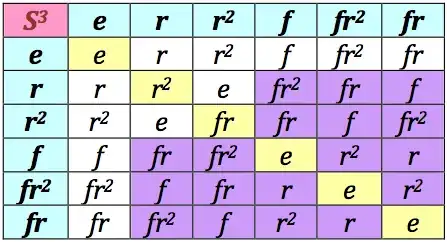
Let $G$ be a finite non-abelian group of $n$ elements. I would like a measure that intuitively captures the extent to which $G$ is non-commutative. One easy measure is a count of the non-commutative products. For example, for $S_3$, 9 products are non-commutative, or, 18 of the 36 entries in the multiplication table indicate non-commutivity (in the table, $r$=rotation; $f$=flip):
           S3Table
So one might say $S_3$ is 50% non-abelian.

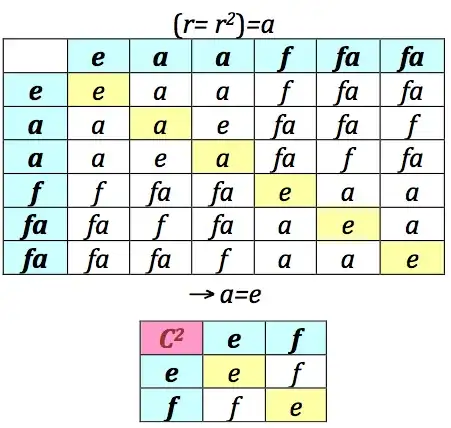
Another idea is to determine the fewest element identifications needed to make the group abelian. If one identifies the elements $r$ and $r^2$ above, and calls the resulting merged element $a$, then I believe $S_3$ is reduced to the abelian $C_2$:
           S3RedC2
So one might say $S_3$ is one element identification away from being abelian.

My question is:

Is there some standard, accepted measure of how far a group is from being abelian?

Ideally such a measure would not be restricted to finite groups. Thanks for pointers!

Joseph O'Rourke
  • 149,182
  • 34
  • 342
  • 933
  • 7
    A pair of standard notions in this general context is the commutator subgroup and the abelianization (see http://en.wikipedia.org/wiki/Commutator_subgroup ) On could then compare the respective cardinalities of the groups and these (or one of these suffices) derived groups. It am, however, not sure if this really goes in the direction you envision –  Mar 25 '13 at 00:34
  • 5
    The nilpotency class and the derived length are 'measures of non-abelianness' in a sense. You could also look at complex character degrees: a finite group is abelian if and only if all its irreducible characters are of degree 1. For finitely generated infinite groups, you could ask how far a Cayley graph is from having a 'Euclidean' metric, which takes you into distortion theory. I don't think there is one standard measure that suits all purposes. – Colin Reid Mar 25 '13 at 01:26
  • http://en.wikipedia.org/wiki/Commutator_subgroup#Derived_series – Martin Brandenburg Mar 25 '13 at 11:37
  • 2
    @Colin: In fact, the nilpotence class is not such a good measure for non-Abelianness in some senses. Consider a large dihedral $2$-group of order $2^{n+1}$. It has an Abelian (normal) subgroup of index $2,$ but has nilpotence class $n$. – Geoff Robinson Mar 26 '13 at 07:28
  • 2
    For general algebras, there is a notion of Abelian which corresponds to the usual notion in the case of groups and rings. For finite algebras, this has a directly calculable and measurable impact on the congruences of an algebra. The concept has also been used in decidability issues for certain classes of varieties. If you are interested, Joseph, I'll dig around in my notes and post a more detailed answer later. I doubt though that you will get some notion of probability out of it. Gerhard "Amazed About Remembering This Stuff" Paseman, 2013.03.25 – Gerhard Paseman Mar 26 '13 at 19:31
  • @JosephO'Rourke $E^\infty$-algebra are abelian. – Turbo Apr 11 '16 at 23:40

6 Answers6

68

Of course, one might say that both $Z(G)$ and $[G,G]$, in a sense, "measure" the non-commutativity of $G$. But they are not very good "quantitative" measures.

I think what you are aiming at is a notion introduced by Turán and Erdős (Some problems of a statistical group theory IV, Acta Math. Acad. of Sci. Hung. 19 (1968), 413-435), the "probability that two elements of $G$ commute": $$P(G) = \frac{\left|\{ (x,y)\in G\times G\mid xy=yx\}\right|}{|G|^2}.$$ In fact, $P(G) = k/|G|$, where $k$ is the number of conjugacy classes of $G$. Gustafson proved that if $G$ is nonabelian then $P(G)\leq 5/8$, and extended the notion to compact groups using Haar measure (W. Gustafson, What is the probability that two group elements commute? American Math. Monthly 80 (1973) 1031-1034). MacHale proved that certain values cannot occur: if $P(G)\gt \frac{1}{2}$, then $P(G) = \frac{1}{2} + \left(\frac{1}{2}\right)^{2s+1}$; and $P(G)$ cannot satisfy $\frac{7}{16} \lt P(G) \lt \frac{1}{2}$. Joseph proved that if $G$ is not commutative and $p$ is the smallest prime that divides $|G|$, then $P(G)\leq \frac{p^2+p-1}{p^3}$ (K.S. Joseph, Commutativity in non-abelian groups, PhD thesis, 1969, UCLA). There's been some other work on this.

In the case of $S_3$. $|G|=6$, and the set of pairs $(x,y)$ with $xy=yx$ is, as you note, $18$, so the probability that two elements commutes is precisely your "50% nonabelian".

Your second notion seems to be that of looking at $G/[G,G]$, which is the "largest" quotient of $G$ which is abelian.

Added: Since I edited to fix the accent on Erdős, I'll take the opportunity to add some references:

  • Desmond MacHale, How commutative can a non-commutative group be?, Math. Gazette 58 (1974), 299-202.
  • David J. Rusin, What is the probability that two elements of a finite group commute?, Pacific J. Math 82 (1979), no. 1, 237-247.
  • Robert Guralnick and Geoff Robinson, On the commuting probability in finite groups, J. Algebra 300 (2006), no. 2, 509-528, MR 2228209 (2007g:60011); Addendum, J. Algebra 319 (2008), no. 4, 1822.
  • 1
    @Arturo: TheTurán-Erdős model is perfect--Thanks so much! Fascinating that certain values of $P(G)$ cannot occur. – Joseph O'Rourke Mar 25 '13 at 10:48
  • Could you elaborate on the first sentence of this answer? Why are $Z(G)$ and $[G,G]$ not good quantitative measures? – MathematicsStudent1122 Jan 13 '19 at 05:58
  • @MathematicsStudent1122: The size of the groups doesn’t give you a good gauge of how likely two elements are to commute. You could have a very “nonabelian” group with very few commutators, quantitatively speaking, or a group with very small center but where lots and lots of things commute with one another. – Arturo Magidin Jan 13 '19 at 06:12
  • @ArturoMagidin With regard to the very last point you just made, is it true that for any small $\epsilon, \delta>0$ we can find a group $G$ with $P(G) > 1 - \epsilon$ but $\frac{|Z(G)|}{|G|} < \delta$? In other words, "small centre" but "lots and lots of things commute". Is there a concrete example of this? – MathematicsStudent1122 Jan 13 '19 at 06:19
  • @MathematicsStudent1122: $P(G)$ cannot exceed $\frac{5}{8}$ in a noncommutative group, as it says in the answer. So the answer is obviously “no”, because if you pick $\epsilon$ too small, then $Z(G)=G$. – Arturo Magidin Jan 13 '19 at 06:26
  • @MathematicsStudent1122: Look: if I tell you I have a group with trivial center, that doesn’t really tell you how likely two elements are to commute. If I tell you I have a group with $G=G’$, that also does not tell you much about how likely two elements are to commute; worse if I tell you “I have a group with commutator subgroup of order $1000$”. That’s why I said that neither the center nor the commutator subgroups are good quantitative measures of how “abelian” a group is. Six years ago... – Arturo Magidin Jan 13 '19 at 06:30
  • @ArturoMagidin My apologies. Overlooking what was mentioned in the answer was quite foolish of me. Thanks for the response. – MathematicsStudent1122 Jan 13 '19 at 06:59
14

You may want to look at the commutativity graph of a finite groups (vertices are elements, an edge connects $a$ and $b$ if $ab=ba$. This and similar graphs have been extensively studied. See, for example, this paper and the references there.

10

Yes, as Arturo says, you probably want what is known as the "commuting probability of $G$", cp(G). Bob Guralnick and I proved (among other things) in a Journal of Algebra paper (circa 2006) (without using the classification of finite simple groups) that $cp(G) \to 0$ as $[G:F(G)] \to \infty,$ where $F(G)$ is the largest nilpotent normal subgroup of a finite group $G,$ though sharper results are possible using the classification.

  • 2
    On the commutating probability in finite groups, J. Algebra 300 (2006), no. 2, 509-528, MR 2228209 (2007g:60011); Addendum, with sundry references, J. Algebra 319 (2008), no. 4, 1822. Sorry I omitted it from my (brief) list of references. – Arturo Magidin Mar 25 '13 at 02:05
  • That should be commuting probability, not "commutating probability". Sorry. – Arturo Magidin Mar 25 '13 at 02:05
  • @Arturo: Neither apology necessary! Not being able to edit comments is sometimes a pain. – Geoff Robinson Mar 25 '13 at 07:29
10

For certain applications, the abelian-ness of a group is inversely proportional to the quasirandom-ness of a group. The latter notion is more obscure, so this observation might not be a help at first. On the other hand quasirandom-ness can be measured quantitatively in a number of basically equivalent ways.

This is all laid out very beautifully in the paper Quasirandom groups by Tim Gowers. This is the first paper where the notion of a quasirandom group rears its head, and Gowers gives five equivalent definitions. Perhaps the most accessible is this: a group is $c$-quasirandom if the smallest dimension of a non-trivial irreducible representation is at least $c$. Obviously abelian groups are 1-quasirandom, but not 2-quasirandom; indeed, the same is true of all non-perfect groups.

On the other hand Gowers makes this remark about the family of groups $PSL_2(q)$:

...the order of $PSL_2(q)$ is $q(q^2 − 1)/2$, so the lowest dimension of a non-trivial representation is proportional to the cube root of the order of the group. This tells us that, in a certain sense, $PSL_2(q)$ is very far from being abelian.

Nick Gill
  • 11,161
  • 39
  • 70
3

I am not sure that the following will be useful, however...

Similarly to the answer of Mark Sapir let us consider the "anti-commutativity" graph (an edge connects $a$ and $b$ if $ab\ne ba$). Of course, it is not connected, and the number of its connected components can be taken as some measure of non-abelian-ness. E.g., this measure equals 2 (minimal value) for $S_n (n\ge 5)$.

Addendum: Morfeover, every simple group has the measure 2.

1

It seems that the same notions of "non-abelianness" also apply to semigroups. Should the notions somehow take into account the added structure a group has?

Newbie
  • 181
  • 2
    The above "answer" should probably be a comment elsewhere. In any case, it's worth noting that while $Pr(G) \leq 5/8$ when $G$ is a group (and there are various other values below $5/8$ that are not the commuting probability for any group $G$) the commuting probability of a semigroup can be anything. This is proved here. – Robert Heffernan Mar 26 '13 at 19:56
  • The link is broken due to the HTML content; should be www-rohan.sdsu.edu/~vadim/ps.pdf – Arturo Magidin Mar 26 '13 at 20:14