9

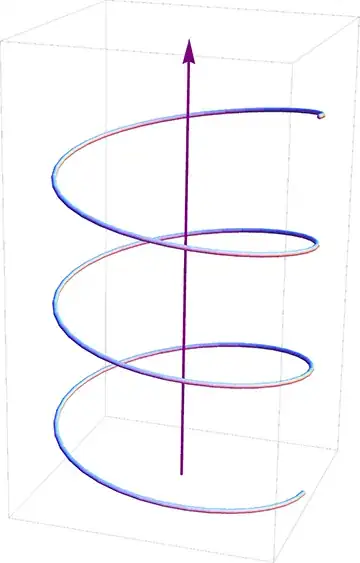
Is it the case that every unit-radius circular spiral, $$x = \cos(t)$$ $$y = \sin(t)$$ $$z = c \cdot t$$ for $c \in \mathbb{R}^+$ is dense in rational-coordinate points (i.e., all three coordinates rational)? Perhaps not? In which case: For which $c>0$ is the spiral dense in rational points?
         Spiral


Related MO question: Rational points on a sphere in $\mathbb{R}^d$.
Answered (by Noam Elkies, Mark Sapir, Will Jagy, Robert Israel). Remarkably to me, for no $c \neq 0$ is the spiral dense in rational points, but for $c=0$, the unit circle, it is dense in rational points.
Joseph O'Rourke
  • 149,182
  • 34
  • 342
  • 933
  • 1
    Clearly can't be true for all $c$, for cardinality reasons; indeed for all but countably many $c$ there's only the obvious point $(t,x,y,z) = (0,1,0,0)$. [If $t \neq 0$ then $c = (\cos^{-1}x) / z$ with countably many $(x,z)$ pairs each of which has countably many choices of $\cos^{-1} x$.] If we get to choose $c$ then there can be infinitely many rational points, but still not a dense set, only a discrete subgroup. – Noam D. Elkies Sep 08 '13 at 01:08
  • 2
    Suppose $c=1$. Then you want $t$ to be rational. But then $\sin(t)$ is transcendental for most rational $t$. You need $c$ to be something like $1/\pi$. –  Sep 08 '13 at 01:08
  • 2
    But if $c=1/\pi$, then for most rational numbers $ct$, $\sin(t)$ will be algebraic but not rational. I think the answer to your question is "no" for any $c$. –  Sep 08 '13 at 01:11
  • What software did you use to create this picture? – Michael Hardy Sep 08 '13 at 20:40
  • @MichaelHardy: Mathematica. – Joseph O'Rourke Sep 08 '13 at 20:44

2 Answers2

6

Suppose $\cos(t) $ and $\sin(t) $ are rational but not in $\{-1,0,1\}$. Since the Gaussian integers are a UFD, we can write $z = \exp(it) = \cos(t) + i \sin(t) = \prod_j p_j^{d_j}$ where $p_j$ are Gaussian primes and $d_j$ are integers, with finitely many (and at least one) $d_j$ nonzero. Similarly, if $s = mt/n$ for coprime integers $m,n$ and $\cos(s)$ and $\sin(s)$ are rational, write $w = \exp(is) = u\prod_j p_j^{e_j}$ where $u \in \{\pm 1, \pm i\}$. Now $w^n = z^m$, so $d_j m = e_j n$ for all $j$. In particular, $m/n = e_j/d_j \in {\mathbb Z}/d_j$. We conclude that for all nonzero $c$, there is at most a discrete set of rational points on the spiral.

EDIT: In fact, we don't need the $y$ component: for all nonzero $c$, $\{(ct, \cos(t)): t \in {\mathbb R}\}$ has only a discrete set of rational points. Note that $\cos(nt) = T_n(\cos(t))$ where $T_n$ is the $n$'th Chebyshev polynomial of the first kind. These satisfy the recursion $T_n(x) = 2 x T_{n-1}(x) - T_{n-2}(x)$ with $T_0(x) = 1$ and $T_1(x) = x$.

It's easy to prove by induction that for any odd prime $p$, if the $p$-adic norm $|x|_p = q > 1$, then $|T_n(x)|_p = q^n$, while if $q \le 1$, $|T_n(x)|_p \le 1$. On the other hand, for $p=2$, if $|x|_2 = q > 2$ then $|T_n(x)|_2 = 2 (q/2)^n$ while if $|x|_2 \le 2$ then $|T_n(x)|_2 \le 2$.

Now suppose $\cos(t) = x$ and $\cos(s) = w$ are nonzero and rational and $s/t = m/n$ is rational, where $m$ and $n$ are positive integers. We have $T_n(w) = \cos(ns) = \cos(mt) = T_m(x)$. Fix $t$ and take $0 < |m/n-1| < \epsilon$ where $\epsilon$ is small. If $\epsilon$ is sufficiently small, there is some prime $p$ such that $|w|_p \ge \max(p,|x|_p^2)$ (if $p \ne 2$) or $\max(4, |x|_2^2)$ (if $p = 2$). But then (in the case $p > 2$) $|T_n(w)|_p = |w|_p^n \ge \max(p^n,|x|_p^{2n}) > |T_m(x)|_p$
or (in the case $p=2$) $|T_n(w)|_2 = 2 (|w|_2/2)^n \ge \max(2^{n+1}, 2 (|x|_2^2/2)^n) > |T_m(x)|_2$. The contradiction shows that $s$ can't be taken too close to $t$.
Robert Israel
  • 53,594
4

From Niven's little book, if $c$ is rational there are no rational points for $t \neq 0.$ Corollary 2.7 on page 21, the trig functions are irrational at nonzero rational values of the arguments.

Niven Irrational Numbers. MAA, Carus Mathematical Monographs.

Here we go, same for $c$ a real irrational algebraic number by Gelfond-Schneider, because $$ (-1)^x = \cos (\pi x) + i \sin(\pi x), $$ take $x=ct.$

Corollary 3.12 on page 41, for rational $r,$ the only rational values of $\cos (\pi r)$ or $\sin (\pi r)$ are the ones you know, $0, \pm 1, \pm 1/2.$ Discrete. So, $c$ cannot be a rational multiple of $\pi$ either.

Nuts, you put the $c$ outside, so the first two stay the same but the third goes to $1/\pi$ which is what Mark has been saying.

Will Jagy
  • 25,349