60

Edit (June 2015): Addressing this problem is a brief project report from the Illinois Geometry Lab (University of Illinois at Urbana-Champaign), dated May 2015, that appears here along with a foot-note saying: An expanded version of this report is being prepared for possible publication.

Below is an excerpt (though, to be clear, this question on MO is about finding a closed-form solution; moreover, (a) the main finding in part i agrees with an earlier MSE response, and (b) I have relayed the typographical error of "math.overflow.net" to the write-up's corresponding faculty mentor).
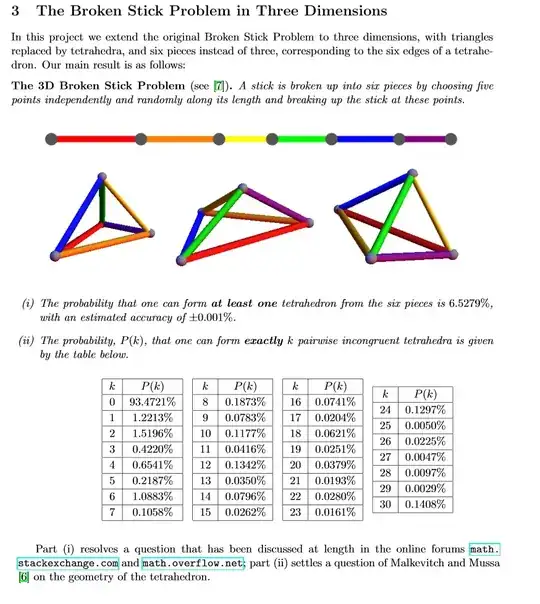
enter image description here


The following problem was brought to my attention by a doctoral dissertation on Mathematics Education, but - as far as I know - the solution remains unknown.

I have already asked this question on MSE, where the post has garnered over 90 votes, but still no canonical answer in the more-than-a-year since it has been there.

Please add or suggest different tags if it seems warranted.


Randomly break a stick in five places.

Question: What is the probability that the resulting six pieces can form a tetrahedron?

Clearly satisfying the triangle inequality on each face is a necessary but not sufficient condition.

Furthermore, the question of when six numbers can be edges of a tetrahedron is related to a certain $5 \times 5$ determinant, namely, the Cayley-Menger determinant. (See, e.g., Wirth, K., & Dreiding, A. S. (2009). Edge lengths determining tetrahedrons. Elemente der Mathematik, 64(4), 160-170. A more recent article by these authors is cited in the comments below: Wirth, K., & Dreiding, A. S. (2013). Tetrahedron classes based on edge lengths. Elemente der Mathematik, 68(2), 56-64.)

Obviously, this problem is far harder than the classic $2D$ "form a triangle" one. I would welcome any progress on finding a solution or a reference to one if it already exists in the literature.

  • 2
    I assume that for the tetrahedron there is a difference between the marked (where you say which piece is which edge) and unmarked (where you don't) versions of the question. Which one do you mean? – Igor Rivin Sep 23 '13 at 19:54
  • 5
    Perhaps this phrasing is clearer: If you randomly choose five different points on the unit interval and cut at each of them, then you will end up with six pieces. What is the probability that such a process will yield six pieces that can somehow be assembled so that they are the edges of a tetrahedron? – Benjamin Dickman Sep 23 '13 at 20:02
  • Does "randomly" mean that the points should be equidistributed? – Stefan Kohl Sep 23 '13 at 20:09
  • 2
    I believe the problem in its original statement was meant only as a higher-dimension analogue of the 2D triangle one. Rephrasing from the linked MO post: "Pick five points uniformly at random on the stick, and break the stick at those points. What is the probability that the six segments obtained in this way form a tetrahedron?" – Benjamin Dickman Sep 23 '13 at 20:19
  • There are results going back much farther than the 2009 paper you mention. The edge lengths are basically an N=4 Euclidean Distance Matrix. Schoenberg gave sufficient results here, and you can see a good summary of the additional "fifth Euclidean property" or "relative angle inequality" (expressed in matrix terms) in any good summary like (https://ccrma.stanford.edu/~dattorro/EDM.pdf‎ ). The volume of the inequality tetrahedron over the entire space of reachable distances (integrated over the probability at each point) should start an answer. – ex0du5 Sep 23 '13 at 20:40
  • perhaps it is exponentially small, as the following answer (on distance matrices) suggests: http://mathoverflow.net/questions/123528/probability-that-a-random-distance-function-is-metric – Suvrit Sep 23 '13 at 21:27
  • 5
    The unmarked problem looks much messier than the marked problem. Why not do the case where you specify where each piece goes first? – Douglas Zare Sep 23 '13 at 22:28
  • @DouglasZare Perhaps that would fall under "I would welcome any progress on finding a solution"; in any event, yes, I would be quite pleased if there is someone who knows how to tackle the "unmarked" version as well. (Anyone should feel free to edit this into the problem statement.) – Benjamin Dickman Sep 23 '13 at 22:44
  • Have you done either the marked or unmarked problem where you ignore the nonlinear condition? – Douglas Zare Sep 24 '13 at 01:46
  • @DouglasZare The only "progress" I know of on this problem, marked or unmarked, is in the statement here and some of the responses from the MSE link. – Benjamin Dickman Sep 24 '13 at 04:28
  • Not quite an answer, but an improvement over the naive Monte-Carlo method is importance sampling. If one picks a Dirichlet distribution with concentration parameter (2.2,2.2,2.2,2.2,2.2,2.2), the speed of convergence is roughly quadrupled. Only a small improvement. – Arthur B Sep 24 '13 at 17:31
  • 2
    There is more recent article by Wirth and Dreiding; Tetrahedron classes based on edge lengths, Elem Math 68 (2013), no. 2, 56–64. I haven't seen it, so I don't know for sure that it is relevant. – Gerry Myerson Sep 26 '13 at 00:38
  • The alternative to Monte Carlo method as a way of numerically estimating the probability is discretization. In general, instead of a continuous uniform distribution we can assume a discrete uniform distribution. Of course, the more points in the support of this discrete distribution, the more precise the estimates. It seems that in this way we can obtain strict lower and upper bounds and not just probabilistic ones. – Waldemar Sep 27 '13 at 12:50
  • 12
    When I tried to solve the marked problem with a Monte Carlo method with $10^{11}$ samples, I got the answer $\frac1{79}$ with relative error of about $4\times10^{-5}$. The marginal expected length of any piece seems to be $\frac16$ (rel.err. $\pm10^{-4}$) with variance of about $\frac1{284}$ (rel.err. $\pm2\times10^{-4}$). Perhaps this might be helpful, especially if someone else checks this too. – Kirill Sep 30 '13 at 04:23
  • @Waldemar We can find P(n): The probability of forming a tetrahedron where stick is broken at n equidistant points ( n ≥5 )and then hopefully extrapolate the results for very large 'n' or even take the asymptotic value as n tends to infinity.P(5) =1; P(10)= ? – ARi Oct 02 '13 at 09:29
  • @ARi The problem is if we can get the exact value by discretization. Do you know how to do it in this simple case (http://mathoverflow.net/questions/2014/if-you-break-a-stick-at-two-points-chosen-uniformly-the-probability-the-three-r?rq=1)? I think that strict bounds are possible. – Waldemar Oct 02 '13 at 09:40
  • @Waldemar Created a post for the case referred to here – ARi Oct 02 '13 at 16:30
  • What does it mean "randomly" ? The breaking points are independent uniformly distributed? Or what? – Alexandre Eremenko Jan 07 '14 at 06:35
  • @AlexandreEremenko I'd hoped this was clarified by an earlier comment, which I re-paste here: I believe the problem in its original statement was meant only as a higher-dimension analogue of the 2D triangle one. Rephrasing from the linked MO post: "Pick five points uniformly at random on the stick, and break the stick at those points. What is the probability that the six segments obtained in this way form a tetrahedron?" If you see a more tractable problem under another reasonable interpretation, then I would be interested to see it! – Benjamin Dickman Jan 07 '14 at 07:45
  • 1
    The Illinois students have put up a video, https://www.youtube.com/watch?v=qFeyBCGviNQ – Gerry Myerson Jun 18 '15 at 02:48
  • 1
    @GerryMyerson Thanks for the link. And a "(Dickman, 2013)" attribution around 3:53! Very nice. – Benjamin Dickman Jun 18 '15 at 03:43
  • 2
    A content-free comment: the answer, whatever it is, ought to be a period. https://en.wikipedia.org/wiki/Ring_of_periods – Ian Agol Jun 18 '15 at 10:17
  • The conditions equal to inequalities given by existence of quadrilateral (4 sides and 2 diagonal). – Takahiro Waki Mar 14 '18 at 13:22
  • 1
    @TakahiroWaki If you have an answer, then please post it! – Benjamin Dickman Mar 14 '18 at 18:19

1 Answers1

14

This is far from a complete answer, but it may be helpful progress.

The marked problem, where the numbers are labeled, looks much simpler than the unmarked version. The region of lengths which can be assembled into tetrahedron in some order can be viewed as a union of $6!$ copies of the region for marked lengths, although this can be reduced by the symmetries of the tetrahedron. So, let's look at the simpler case of marked lengths.

There are linear conditions from the triangle inequality on each face of the tetrahedron, plus one quadratic condition from the positivity of the square of the volume. Ignoring the quadratic condition gives us an upper bound on the probability the edges form a tetrahedron.

The collection of $12$ triangle inequalities and one equation, that the sum of the lengths is $1$, produces a $5$-dimensional polytope $P$ which I analyzed with the help of qhull. Given the simplicity of the result, perhaps there is a way to read off the structure more directly. There are $7$ vertices. Four of these vertices give $1/3$ length to the $3$ edges meeting at a vertex, and $0$ length to the other three edges forming a triangle. Three of the vertices give $1/4$ length to a cycle of length $4$, and $0$ length to two opposite edges. If the tetrahedron includes faces with lengths $\lbrace a, b, c \rbrace$ and $\lbrace a, d, e \rbrace$ then the vertices include $(0, 0, 0, 1/3, 1/3, 1/3)$ and $(0, 1/4, 1/4, 1/4, 1/4, 0).$ With only $2$ more vertices than the dimension, the combinatorial structure of $P$ is relatively simple, and is determined by the fact that the convex combination (in fact average) of $4$ vertices equals a convex combination of the other $3$ vertices. Much as the bipyramid in $3$ dimensions can be triangulated with either $2$ or $3$ tetrahedra, $P$ can be triangulated with either $3$ or $4$ symmetric simplices. $P$ is related to the normal disks in a tetrahedron.

The volume of $P$ is $1/54$ of the volume of the simplex of edge lengths summing to $1$. This gives an upper bound on the probability that breaking a stick into marked lengths produces the edge lengths of a tetrahedron, although this is far from the $1/79$ observed numerically by Kirill. It is interesting that the quadratic condition rules out a large fraction of the lengths which satisfy the triangle inequalities.

I think the quadratic condition can be added by considering how the surface intersects the tetrahedra of one of the triangulations of $P$. This is much simpler than taking the intersection of a quadratic inequality with an arbitrary polytope.

Douglas Zare
  • 27,806