Can we have positive reals $x,y,z$ with $$ x^{\left( y^z \right)} = y^{\left( z^x \right)} = z^{\left( x^y \right)} $$ in cyclic permutation, other than the line $x=y=z$?
I put this at https://math.stackexchange.com/questions/493739/this-is-stupid-but-i-have-a-bad-cold-with-cough and one poor guy has been hacking away at it. I still have no idea.
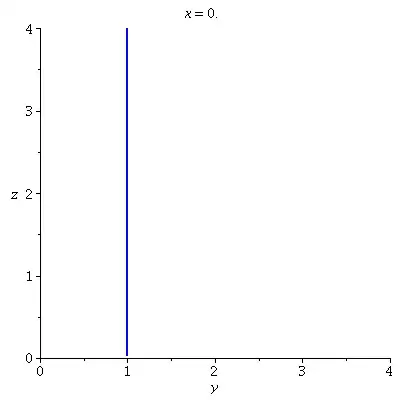
I would love to see some representation of the supposed surface $$ x^{\left( y^z \right)} = y^{\left( z^x \right)}, $$ which I feel really ought to be some ugly variant of the helicoid around the line $x=y=z$.
EDIT, Thursday: Is it true that the gradient of $$ \color{magenta}{ h(x,y,z) = x^{\left( y^z \right)} - y^{\left( z^x \right)}}, $$ is defined and a nonzero vector along the line, say, at the point $x=y=z=t$ for positive real $t?$ If so, the surface is orthogonal to that at the line...Further, if you switch to one of the other pairs as a difference, I expect the gradient vector to be rotated by $120^\circ;$ this gives a pretty good reason for there being no other points on all three such surfaces near the known line.




-(t^(t + t^t + 1)*log(t)^2 - t^(t + t^t))/t , (t^(t + t^t + 1)*log(t) - t^(t + t^t))/t , t^(t + t^t)*log(t)^2 - t^(t + t^t)*log(t)– joro Oct 04 '13 at 06:03y = exp(-LambertW(-z^(1-x)*ln(x))/z)– joro Oct 04 '13 at 10:46