3

Let $C(r)$ be the origin-centered circle of radius $r$, and let $\beta(r)$ be the exterior buffer around $C(r)$: the distance from $C(r)$ to the closest lattice point exterior to $C(r)$:
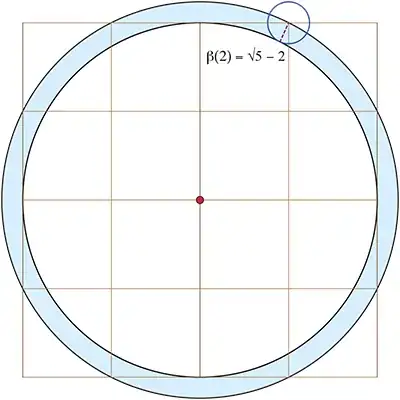
     BetaBuffer
For example, $\beta(2) = \sqrt{5}-2 \approx 0.24$ because there are no lattice points strictly between $C(2)$ and $C(\sqrt{5})$, and this is the largest buffer around $C(2)$.

I am interested in the behavior of $\beta(r)$ for large $r \in \mathbb{R}$, as I believe understanding that behavior will answer my question concerning ratchet spirals, Lattice radial-step (ratchet) spirals.

I'll pose a specific question before formulating the general question.

Q1. Is there an $R$ such that, for all $r > R$, $\beta(r) < \frac{1}{2}$ ?

If so, then, for example, the spiral $S(3,\frac{1}{2})$ depicted in that question is unbounded.

Q2. Is there an $R(\epsilon)$ such that, for all $r > R(\epsilon)$, $\beta(r) < \epsilon$, where $0 < \epsilon < 1$ ?

Joseph O'Rourke
  • 149,182
  • 34
  • 342
  • 933

2 Answers2

5

Bambah and Chowla ("On numbers which can be expressed as a sum of two squares") proved that there is a constant $C$ such that for any $x > 0$, there is an integer between $x$ and $x+ Cx^{1/4}$ which is the sum of two squares. From this it easily follows that the answer to the more general Q2 is in the affirmative. (in fact $x + Cx^{1/2 - \epsilon}$ would do for any $\epsilon$).

1

This is really just a comment, not a complete answer.

Suppose $r$ is integral. The distance from the point $[1,r]$ to $C(r)$ is $$\sqrt{1+r^2}-r$$ which has asymptotics $\frac{1}{2r}$ and hence for integral diameters the answers are affirmative.

If $r$ is nonintegral, then the point $[0,\lceil r \rceil]$ is closer to $C(r)$ than $[0,r]$ and its distance to $C(r)$ $$ \lceil r \rceil - r $$ gets arbitrarily close to 1 (as Abhinav Kumar pointed out in the comments). So for nonintegral diameters one really has to pick a good lattice point inside the first quadrant.

Vít Tuček
  • 8,159