Pólya proved that a random walk on $\mathbb{Z}^2$ almost surely returns to the origin, or, equivalently, returns to the origin infinitely often. It was subsequently established that in $\mathbb{Z}^3$, a random walk returns to the origin with probability about 34%.
My question is:
Q. What is the probability that a random walk on the edges of a Penrose tiling returns to its starting point?
Each step from a vertex of the tiling follows one of the incident edges chosen randomly.
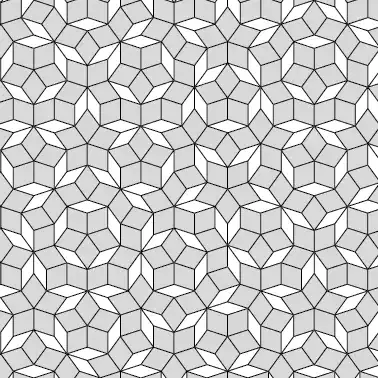
(Image from this link)
I am wondering to what extent this aperiodic but "quasiregular" tiling mimics the $\mathbb{Z}^d$ lattice from the viewpoint of random walks.
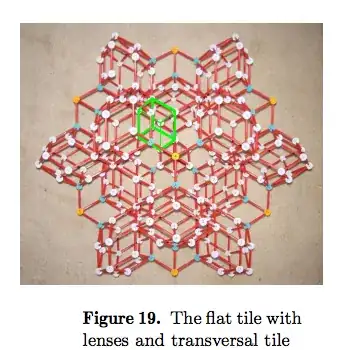
One could ask the same question of a notion of 3D Penrose tiles, e.g.,
Dietl, Ruth Maria Katharina, and Jost-Hinrich Eschenburg. "Three-Dimensional Penrose Tilings and Self-Similarity." (PDF download link)