9

A piecewise linear flat torus embedded in $\mathbb{R}^3$ is shown at http://www.mathcurve.com/polyedres/toreplat/toreplat.shtml. It is flat in the sense that the angle defect at the vertices is zero.

Here is a 3D printed hinged version:
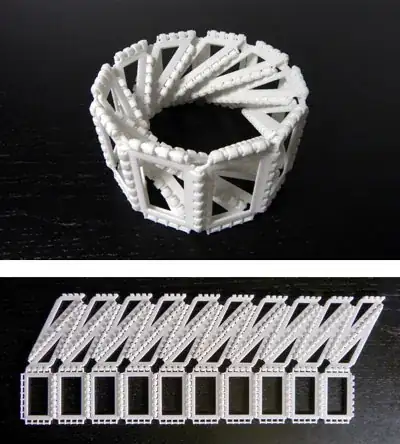
enter image description here

Who came up with this construction?

I asked Robert Ferréol who maintains the mathcurve.com site. He heard of it from Guy Valette, who remembers seeing a torus like this at Oberwolfach over 30 years ago.

Henry Segerman
  • 1,886
  • 20
  • 25
  • 1
    related answer: http://mathoverflow.net/a/34370/1345 – Ian Agol Jun 11 '15 at 14:47
  • 1
    One gets 1-parameter families of embedded flat tori by taking the middle level (which consists of a regular $n$-gon and a $2n$-star), and inserting a product region. – Ian Agol Jun 12 '15 at 08:54

1 Answers1

3

I believe the originator is Victor A. Zalgaller.

Permit me to quote myself from an earlier answer:


In the paper by V. A. Zalgaller, "Some bendings of a long cylinder," Journal of Mathematical Sciences, 100(3):2228--2238, 2000 (translated from a 1997 article in the Russian journal Zapiski Nauchnykh Seminarov POMI), he proves this theorem:

"Theorem 1. A direct flat torus can be isometrically embedded in $\mathbb{R}^3$ 'in the origami style' if its development is a rectangle sufficiently large compared to its altitude."

He defines a direct flat torus as the result of identifying the opposite sides of a rectangle.

Joseph O'Rourke
  • 149,182
  • 34
  • 342
  • 933