6

Stalling`s end Theorem (a group has more than one end iff it splits over a finite subgroup) and the Seifert-van Kampen Theorem (the fundamental group of a 'decomposable' space is a free amalgamated free product w.r.t the 'pieces' of the space) are well-known theorems. However I often read that they are kind of analogues or that Stalling's Theorem is the 'combinatorial' version or something like that.

I was wondering if this could be made a bit more precise?

I know that there are some major differences. Indeed Stalling's Theorem deals with amalgamated free products and HNN-Extensions over finite subgroups, where the Seifert-van Kampen Theorem 'just' deals with amalgamated free products.

In this sense I was also wondering if there is some sort of 'Seifert-van Kampen Theorem' for HNN-Extensions?

M.U.
  • 701
  • I know Bass-Serre theory and Serre's book (and the proof of Dunwoody & Krön for Stalling's Theorem using Bass-Serre trees). However I don't think that this answers my question or I may haven't understood your comment correctly. – M.U. Aug 17 '15 at 11:50
  • 1
    I never read that Stallings' and Seifert-van Kampen's theorems were analogous. Have you an example where you read this idea? – Seirios Aug 18 '15 at 04:31
  • 1
    Krön, B., Teufl E., Ends, group theoretical and topological aspects or Krön, B., Cutting up graphs revisited - A short proof of Stalling's structure theorem – M.U. Aug 18 '15 at 10:47
  • Could you be more specific? I don't currently have the first paper in front of me, but the second does not mention van Kampen's theorem at all. – HJRW Dec 18 '17 at 22:31
  • @HJRW The arxiv version of the second paper has the sentence "The counter part of the Seifert-van-Kampen Theorem in geometric group theory is Stallings’ structure theorem". (The arXiv version is 3 pages longer than the journal version and seems to contain more background.) [For completeness: The first paper has the sentence "Stalling’s [sic] Theorem...is the analogue of Seifert-van-Kampen’s Theorem in geometric group theory." ] – user1729 Dec 19 '17 at 11:35
  • 1
    It's probably not a coincidence that that sentence didn't make it into the published version. I think the real answer to your question is that these two theorems are not usually regarded as analogous. In fifteen years of working in geometric group, I had never heard them described as analogues. Perhaps an e-mail to Kroen would be a better way of finding out what he means. – HJRW Dec 20 '17 at 15:26

1 Answers1

2

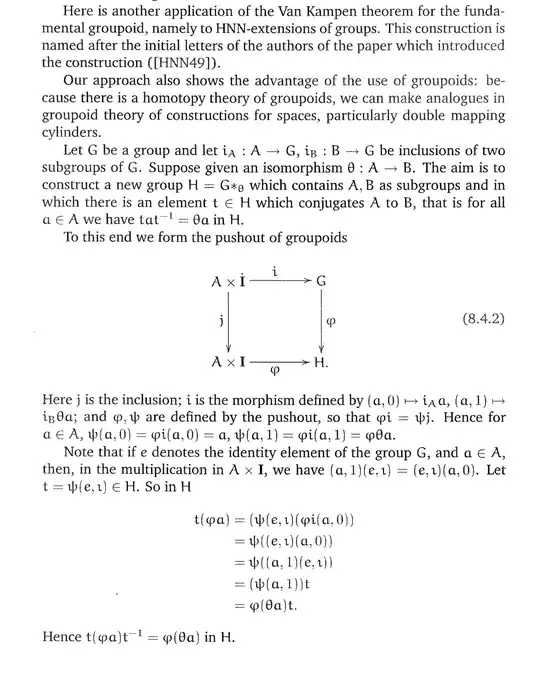
Here is an extract from p.335 of Topology and Groupoids (T&G):

(source)

In this $\mathbf I$ is the groupoid with 2 objects $0,1$ and one arrow $\iota:0 \to 1$, and $\dot{\mathbf I}$ is the discrete groupoid on the set consisting of $0,1$. Thus $\mathbf I$ is a "interval object" in the category of groupoids and can be used to model in the category of groupoids topological objects such as double mapping cylinders, as stated in the text. To mirror the topology you need of course a Seifert-van Kampen Theorem for the fundamental groupoid on a set of base points. Compare for example this mathoverflow discussion.

I do not know about applications to the theory of ends! Perhaps old papers of Chris Houghton (see the bibliography of T&G) are relevant.

jeq
  • 1,228
  • 5
  • 16
  • 21
Ronnie Brown
  • 12,184
  • Thanks. I actually heard a lot about your book but it seems that I really have to take a closer look at it :) – M.U. Aug 17 '15 at 11:31