26

I have been asked sometimes, and I ask myself, to what extent the dimension $1+3$ is important for our real world, say compared to an hypothetical $(1+d)$-dimensional world. I have two answers in mind.

  • The Huygens principle. If you switch off a point source of light, then a point situated at distance $L$ will be in dark after time $\delta t=L/c$ ($c$ the speed of light). This would be false in dimension $1+2$ for instance, even if the energy would be very low after $\delta t$.
  • Chemistry is a consequence of quantum mechanics. Mathematically it involves the linear representations of the rotation group. In $1+2$ dimensions, the group is $SO_2$, which is abelian and isomorphic to a circle ; its representations are one-dimensional, associated with linear characters. In our world, the groups $SO_3$ is not abelian and the situation is way richer. In particular, we have a notion of spin.

What are other manifestations of the dimension $1+3$ in our real world ?

In order to limit this discussion to a reasonable extent, I assume that the Physics of a hypothetical world would be based on equations similar to those we already know. In particular, second-order differential operators would be at stake, because of their nice mathematical properties (maximum principle, ...)

Glorfindel
  • 2,743
Denis Serre
  • 51,599
  • 3
    I'm sure you already know this, but the (general) Huygens principle for the wave equation testifies as to the importance of having odd number of spatial dimensions rather than that odd number being exactly $3$. For completeness sake, it also applies to sound. – M.G. Nov 17 '17 at 09:31
  • 3
    With more spatial dimensions we wouldn't be able to tie our shoe laces. Moreover, $3$- and $4$-manifolds are rather mysterious both in their exceptional behavior and the difficulties they present (as opposed to their higher-dimensional counterparts). I always had a feeling that this should be somehow physically significant as to why $1+3$. – M.G. Nov 17 '17 at 09:38
  • @July. I do know that Huyghens principle prefers odd space dimension. However, it fails also in space dimension $1$. – Denis Serre Nov 17 '17 at 09:55
  • Fair enough. So, you are making a point that $3$ is the smallest number of dimensions that realizes Huygens principle, so there is no need for nature to go higher, so to speak? – M.G. Nov 17 '17 at 10:16
  • It seems that some physics equations are related to the quaternionic version of Cauchy-Riemann equations characterizing holomorphy (precisely, continuity equation and wave equation) in a minkowskian metric. See my question whose title is something like "Riemann Zeta function, quaternions and physics" on MSE. – Sylvain JULIEN Nov 17 '17 at 10:28
  • 2
    Also see the physics.SE discussion https://physics.stackexchange.com/q/10651/99268 – Martin Nicholson Nov 17 '17 at 12:58
  • 2
    Martin Rees explores this question a little bit in chapter 10 of Just Six Numbers (written for non-professionals). Glancing through it, I think his strongest point concerning why 1+3 is special is the one mentioned in Nemo's answer: orbits are stable under a force obeying an inverse square law, but not under one obeying an inverse cube law. – Will Brian Nov 17 '17 at 14:38
  • 3
    Related: https://mathoverflow.net/q/47569/13917 – Qmechanic Nov 17 '17 at 16:17

3 Answers3

21

It was shown by Paul Ehrenfest in 1917 that Coulomb interaction is unstable at spatial dimensions higher than three,

  • P. Ehrenfest, In what way does it become manifest in the fundamental laws of physics that space has three dimensions?, Proc. Netherlands Acad. Arts Sci., 20 (1917), 200 - 209 (pdf).

To quote:

In $R_n$ for $n>3$ the planet falls on the attracting centre or flies away infinitely. In $R_n$ for $n>3$ there do not exist motions comparable with the elliptic motion in $R_3$,- all trajectories have the character of spirals.

This analysis has been extended to quantum mechanics in

David Roberts
  • 33,851
12

Hawking has an extensive discussion in “A Brief History of Time”. Excerpt:

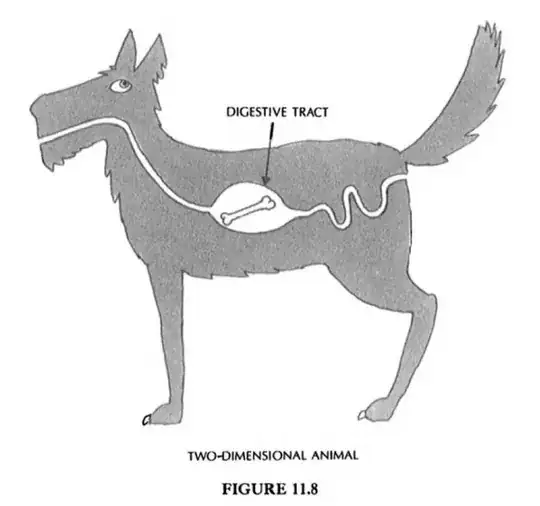
Two space dimensions do not seem to be enough to allow for the development of complicated beings like us (...) If a two-dimensional creature ate something it could not digest completely (...) because if there were a passage right through its body, it would divide the creature into two separate halves: our two-dimensional being would fall apart (Fig. 11.8).

  • 4
    Well, conceivably we could be once-punctured tori living on a high-genus surface, and have a non-separating digestive trait. (But motion would be a bit weird.) – Marco Golla Nov 17 '17 at 14:54
  • 12
    It is also conceivable (though unpleasant to think of) that we could eject unwanted matter by the same "opening" by just reversing the direction. – tst Nov 17 '17 at 16:28
  • 3
    but what is the problem with being disconnected? many of us are, in a sense – Pietro Majer Aug 25 '21 at 08:57
  • Creatures made of molecules in any number of dimensions are highly disconnected. (I am not sure if that is what Pietro Majer meant in his comment.) – Ben McKay Aug 25 '21 at 09:46
  • 1
    You might look at Dewdney's Planiverse to see how these restrictions on two-dimensional animals can be circumvented. – rimu Aug 25 '21 at 10:09
  • 1
    We are not solid beings; our cells do move around, and molecules in them break up and combined. Such a 2D animal could process food like our cells do: let it in through a membrane; close the membrane behind it; absorb it; and expel through the membrane. – Michael Aug 25 '21 at 16:18
2

One answer in the form of a paper is Tegmark’s “On the dimensionality of spacetime” at https://arxiv.org/abs/gr-qc/9702052