1

I am asking this question to know more about this problem that I find very interesting.

The problem is that suppose you have the unit 2-sphere $S^2$ in $\mathbb{R}^3$ and a measurable subset $A \subset S^2$ such that $\mu(A)=0.9\mu(S^2)$. Then prove that you can find a cube whose vertices will fit inside the set $A$.

This question has been asked and answered before:

https://math.stackexchange.com/questions/573926/surface-of-a-sphere-and-cube

https://math.stackexchange.com/questions/499854/problem-regarding-the-fitting-cube-into-sphere

I want to know where this question originates from. Is this question part of some general type of questions that are encountered in a more general setting (for example coding theory)? What are the known developments?

1 Answers1

3

I asked a more general version of this question in an earlier question, Regions on a sphere that avoid a fixed point set.


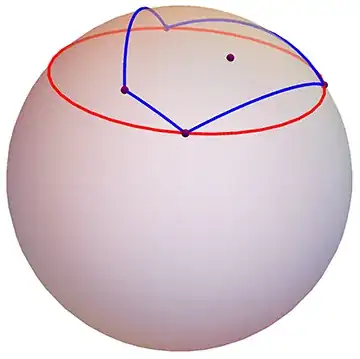
          A $5$-point set, its convex hull (blue) and smallest enclosing circle (red).
The OP's version is an $8$-point set. An upperbound was proved: "for an $n$-point set $P$, the area of an avoiding set cannot be larger than $\frac{n-1}{n} A$, where $A$ is the area of the sphere." For $n=8$, this gives an upper bound of $\frac{7}{8}=0.875$ which is smaller than the OP's $0.9$.

To address the OP's specific questions:

I want to know where this question originates from.

My version was original, but ...

Is this question part of some general type of questions that are encountered in a more general setting?

Yes, avoiding sets. For example, there is quite a bit of literature on mutually avoiding sets, going back to Erdős. There is also considerable literature on sets avoiding integral (or rational) distances. See, e.g., the question Integer-distance sets. Or: Kurz, Sascha, and Valery Mishkin. "Open sets avoiding integral distances." Discrete & Computational Geometry 50.1 (2013): 99-123.

Joseph O'Rourke
  • 149,182
  • 34
  • 342
  • 933