I think you will find this discussion of the napkin folding problem instructive: Chapter 5 of Lectures on piecewise distance preserving maps. The problem involves "Origami moves", meaning folding and unfolding of a thin sheet of paper, and asking whether the perimeter of the flattened folded sheet can increase.
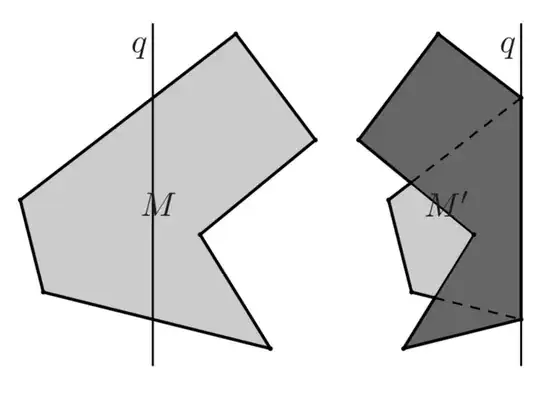
The answer is no if all layers of the folded sheet are always folded simultaneously, as in this figure:
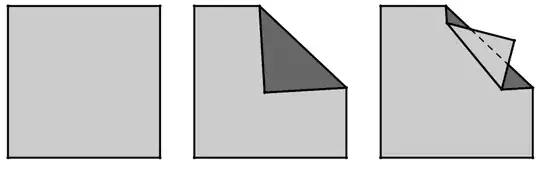
You have to allow for unfolding of a folded layer, as in the figure below, which actually does increase the perimeter, however, not yet beyond the perimeter of the original square.
18th century origami masters already discovered, before this problem was posed by mathematicians in the 20th century, that you can in fact increase the final perimeter beyond the initial perimeter, for example in this crane figure:
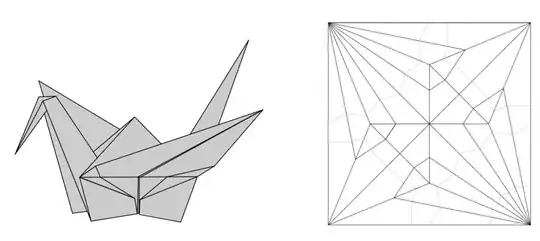
The perimeter of the flattened crane is about 0.5% larger than the perimeter of the initial square. The crane has 80 layers of folded paper. By increasing the number of folds it is possible to make the final perimeter as large as one wants, without mathematical limit. There is of course a physical limit, due to the nonzero thickness of the paper.


