46

Some math riddles tend to be spoiled for mathematicians before they get a chance to solve them. Three examples:

  1. What is $1+2+\cdots+100$?

  2. Is it possible to tile a mutilated chess board with dominoes?

  3. Given a line $\ell$ in the plane and two points $p$ and $q$ on the same side of $\ell$, what is the shortest path from $p$ to $\ell$ to $q$?

I would like to give my children the opportunity to solve these riddles before the spoilers inevitably arrive.

Question: What are other examples of kid-friendly math riddles that are frequently spoiled for mathematicians?

Notes:

  • There is no shortage of kid-friendly math riddles. I am specifically asking for riddles that are frequently spoiled for mathematicians because they capture a bigger idea that is useful in math, especially research-level math. As such, the types of riddles I am asking for are most readily supplied by research mathematicians.

  • In case it is not clear whether MO is an appropriate forum for this question, see the following noteworthy precedent: Mathematical games interesting to both you and a 5+-year-old child

  • 14
    I'm not sure if being aware of the bigger mathematical perspective counts as having it 'spoiled' …. Do you include the famous von Neumann "what is easier than summing the series?"? – LSpice Feb 23 '21 at 15:13
  • 16
    You are asking in the wrong forum, I think. – Gerald Edgar Feb 23 '21 at 15:19
  • 8
    This is an interesting question, and I'm really curious to see the answers proposed, but it might be better received in math.stackexchange. – JoshuaZ Feb 23 '21 at 15:38
  • 1
    @LSpice - I think you're referring to this riddle?: http://math.bme.hu/~petz/vnsumming.html This is news to me. Yes, this would be an example. – Dustin G. Mixon Feb 23 '21 at 15:46
  • 2
    Regarding the forum, I was inspired by this successful MO question: https://mathoverflow.net/questions/281447/mathematical-games-interesting-to-both-you-and-a-5-year-old-child/ – Dustin G. Mixon Feb 23 '21 at 15:47
  • 4
    I agree with Joshua that this question would be much better suited for Mathematics SE - this question bears little to no relation to research mathematics as far as I can see. It is honestly beyond me how the question about games you linked was so well-received to be honest, especially given it's relatively recent. – Wojowu Feb 23 '21 at 17:34
  • 5
    "What did the acorn say when it grew up?" "Geometry!" (Because a mathematician would explain that, since the acorn changed shape, it should have said "Topology!" Which would make no sense whatsoever.) ("Gee, I'm a tree!" Get it now?) – davidbak Feb 24 '21 at 01:21
  • 7
    Try Martin Gardner's book My Best Mathematical and Logic Puzzles. Not all of these are suitable for kids but some are. Sometimes he also prefaces the statement of a puzzle with an easier "too often spoiled" puzzle (is there more water in the wine or more wine in the water?) so it's also a good source for those. – Timothy Chow Feb 24 '21 at 01:26
  • 1
    @JoshuaZ: On the whole, I agree it’s better suited for Math.SE. But one clear benefit of being here: participants are not spoiling the riddles under discussion. At Math.SE, with less consistently mature participants, I’m fairly sure the ratio of spoilers to riddles would be much higher. – Peter LeFanu Lumsdaine Feb 24 '21 at 10:27
  • 15
    Suppose that $\lambda$ is a singular limit of supercompact cardinals, how many cardinals lie between $\lambda$ and $2^\lambda$? – Asaf Karagila Feb 24 '21 at 13:24
  • 4
    What's the meaning of "spoiled for mathematicians", exactly? I'm not sure I understand. – Pietro Majer Feb 24 '21 at 19:07
  • 4
    @PietroMajer I had to reread it too a few times before it made sense to me, but I suppose what is meant is this: problems that would be fun/interesting to solve from first principles, but that are unrewarding to mathematicians because they can immediately recognize the underlying theory with which they are already familiar. – Will Feb 25 '21 at 00:55
  • I don't think this is suitable for MO, plus the phrasing of the question is too cryptic. – Hollis Williams Feb 25 '21 at 18:45
  • Kid-friendly? Too bad this rules out https://en.wikipedia.org/wiki/Condom_problem ... – Federico Poloni Feb 25 '21 at 21:17
  • @AsafKaragila not sure it's a math riddle suitable for kids. We discussed and argued a lot about it, back in kindergarten days, with no relevant conclusions – Pietro Majer Feb 25 '21 at 21:23
  • @Pietro: Solovay proved that the Singular Cardinal Hypothesis holds above a strongly compact cardinal, and since $\lambda$ is the limit of supercompact cardinals it is a strong limit itself, so $2^\lambda=\lambda^+$ (so the answer is "none"). But I understand why you didn't reach a conclusion about this in kindergarten, Solovay's theorem is usually a 2nd grade topic... – Asaf Karagila Feb 25 '21 at 21:39

10 Answers10

33

Here's a few, two I got to solve myself as a kid and one (a trickier one, in my opinion) that was spoiled for me.

  1. There are $1000$ lights all in a line and turned on. At time $n$, person $n$ comes by and toggles the switch on every $n$th light, starting with the $n$th. How many lights are on after person $1000$ has finished?
  2. There are four ants standing at the corners of a square of side length $1$. At time $t=0$, they begin walking with speed $1$, each toward the ant to their right. How long does it take them to all meet in the center?
  3. There are $20$ soldiers standing distance $1$ apart on a bridge of length $19$. At time $t=0$, the soldiers immediately begin walking left or right with speed $1$. When two soldiers collide, they immediately turn around and begin walking in the opposite direction. What is longest possible time it takes all the soldiers to leave the bridge?
  • 10
    Is the kid friendly way to solve 2 without calculations to talk about infinitesimals (after the symmetry discussion), or is there some "trick" to seeing it that I'm missing? – Ville Salo Feb 24 '21 at 05:23
  • I think I heard this as a kid in the spoiled form that they will spiral forever, and I agreed was obvious. I only thought about this now... – Ville Salo Feb 24 '21 at 05:27
  • 12
    @VilleSalo By symmetry the ants are going to always stay arranged in a square. For any given ant in a square arrangement, the ant it's moving towards will always be moving directly sideways, and sideways movement doesn't affect separation distance. The only thing affecting distance between the two ants is the first ant's walking speed, so the distance between them shrinks at constant speed 1. The distance starts at 1, so at speed 1 it drops to 0 at t = 1. – Douglas Feb 24 '21 at 08:39
  • 9
    Yes, and I was wondering if there's a way to make the "moving sideways" argument more "rigorous"/convincing: maybe a kid will find it obvious, but if they don't, what do you do? The issue is, if you think in terms of discrete moves, it may not be so clear, and as mentioned in my comment above, I think I once managed to convince myself (I was not really given this as a puzzle, I was just told the wrong solution) that actually the ants do not get closer even though at any given moment it looks like they do. – Ville Salo Feb 24 '21 at 09:23
  • 7
    My understanding is that it took humankind thousands of years to sort these infinitesimal issues out, but sometimes there is a convincing geometric trick, and I was wondering if for example there's something like that here. – Ville Salo Feb 24 '21 at 09:25
  • 4
    Are the lights on or off before the 1st person comes? – Emil Jeřábek Feb 24 '21 at 10:26
  • For #1, is the solution to count the number of perfect squares less than 1000, or is there a slicker way? – Alex Kruckman Feb 24 '21 at 13:54
  • @EmilJeřábek Yes, up to reflection around 500. – Yakk Feb 24 '21 at 16:33
  • 2
    @AlexKruckman Well, the number of positive perfect squares less than or equal to $1000$ is the number of positive integers less than or equal to $\sqrt{1000}$. The general answer for $n$ doors is the floor of $\sqrt{n}$, so I don't see how the solution could be made any slicker. – Tanner Swett Feb 24 '21 at 17:26
  • @VilleSalo Maybe compare it to standing still while someone walks in a circle around you. If they ever deviate from the circle, then at that moment they are not walking directly sideways from the direction you're looking at them, but if they stay on the circle then the distance never changes. – Douglas Feb 24 '21 at 19:16
  • @Douglas: Ok, that sounds convincing enough. – Ville Salo Feb 25 '21 at 05:21
  • @VilleSalo Incidentally, the ants spiraling "forever" isn't actually completely wrong. Ignoring realism and just following the math, the ants do in fact circle around the center infinitely many times. They just do it in finite time and distance by dint of most of the spiral's revolutions being infinitesimally small. – Douglas Feb 25 '21 at 07:54
  • True, I'm sure that was my subconscious thinking. – Ville Salo Feb 25 '21 at 08:08
  • @TannerSwett It should actually be the ceiling of $\sqrt{n}$ in this case as the lights are stated to initialise in the on state. – Supernovah Feb 25 '21 at 10:45
  • 3
    @Supernovah Note that this was only specified by an anonymous edit 3 hours ago, long after Tanner Swett’s comment. But anyway, it’s still floor, not ceiling: when the lights start on, the answer is $n-\lfloor\sqrt n\rfloor$. – Emil Jeřábek Feb 25 '21 at 10:49
  • @villesalo: polar coordinates and trig are arguably more intuitive to a kid than calculus (they were for me). I solved it noticing that the radial component of the ant's velocity was constant (because symmetry) and equal to $cos(\alpha)$ between the center and ant's direction, which is 45 degrees. Total time is the radial speed times the distance to the center. – Quassnoi Feb 28 '21 at 00:10
  • @Quassnoi: right, close to what Douglas said. Maybe "tilt your head at the same rate as the ants move" is a kid-friendly way to phrase it. – Ville Salo Feb 28 '21 at 05:50
  • I wasn't really thinking about calculus when I mentioned infinitesimals, I think infinitesimals are a much more intuitive concept than multivariate calculus, which (to understand, even if not to apply) requires quite a bit of training. – Ville Salo Feb 28 '21 at 05:54
27

To make this suitable for MO rather than math.SE, perhaps we can define a "too often spoiled" puzzle to be one that can be recognized instantly by a mathematician even with what looks like far too little description. So for example, the following "words to the wise" should be sufficient in each case (some of these have already been mentioned by others):

  1. It's dark and you have ten white socks and ten black socks in your drawer.

  2. Is there more water in the wine or more wine in the water?

  3. A fox, a rabbit, and a cabbage.

  4. How do you measure out exactly 5 gallons?

  5. Four people are crossing a bridge.

  6. You come upon a fork in the road.

  7. A checkerboard is missing two squares.

  8. Von Neumann said, "I summed the series."

  9. There's a rope around the equator of the Earth.

  10. There are three doors.

  11. What is the probability that my other child is a girl?

  12. There are 12 coins, one of which is lighter or heavier than the others.

  13. You arrive on an island where some people have blue eyes.

  14. "I don't know the numbers." "I don't know the numbers." "Now I know the numbers." "So do I."

Greg Martin
  • 12,685
Timothy Chow
  • 78,129
11

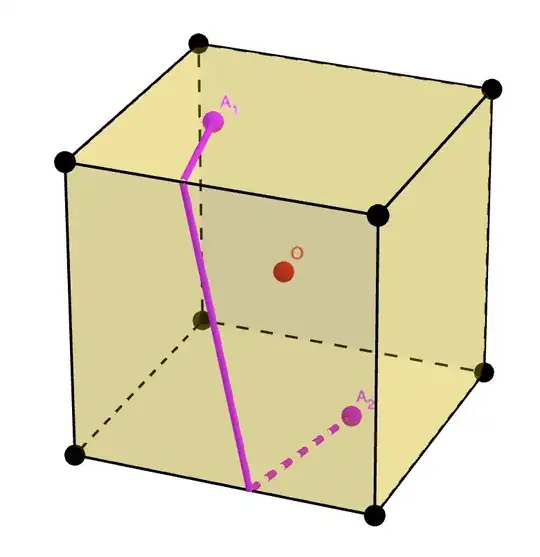
The shortest path of a fly walking on the interior surface of a cubic room:


      Image credit


Joseph O'Rourke
  • 149,182
  • 34
  • 342
  • 933
  • 15
    Upon reflection [sic] this isn't very different from the OP's third examples (shortest path from point $p$ to line $\ell$ to point $q$ on the same side). – Noam D. Elkies Feb 24 '21 at 00:57
  • 6
    Quanta recently published a very nice article about this kind of thing recently: https://www.quantamagazine.org/the-crooked-geometry-of-round-trips-20210113/ The question is: does every shortest round trip from a vertex to itself passes through another vertex? It's true for any platonic solid (try to prove it for the tetrahedron, it's pretty fun)... except the dodecahedron! (Not affiliated with quanta, I just found it rather interesting!) – Najib Idrissi Feb 24 '21 at 08:22
  • 2
    @NajibIdrissi - I think there may be special uses of shortest and round trip involved there. For example there are trips on a tetrahedron which visit every face and return to the original vertex shorter than any trips which visit another vertex and return. And on a dodecahedron, even restricted to a straight line on a plane from unfolding/tumbling, I would guess that the shortest round trip actually visits five other vertices. – Henry Feb 25 '21 at 00:13
  • @Henry Perhaps try reading the article. – Najib Idrissi Feb 25 '21 at 06:37
  • 1
    @NajibIdrissi I did - both the Quanta article and the two papers on arXiv. Which is why I know shortest is not used in its conventional sense. – Henry Feb 25 '21 at 09:53
  • @Henry I have trouble determining if you are trying to make a point or are being genuine. Shortest means geodesic here. One just needs to make sense of what it means when one crosses an edge of the cube. – Najib Idrissi Feb 25 '21 at 10:00
  • 1
    @NajibIdrissi I am aware of that (and what happens crossing a vertex is even more complicated as there are choices involved) but one of my points is that a child could understand shortest as minimum total distance, and that minimum trip for a dodecahedron passes through other vertices. – Henry Feb 25 '21 at 10:06
  • @Henry It's a good thing that we are all professional mathematicians and that we know that words have precise definitions then, so that when writing here we may get away with using a short description knowing that people will look up unknown definitions before evaluating a statement, even though we would need to give a slightly longer explanation to a child who is not versed in math. The word "geodesic" is written explicitly in the first paragraph of the quanta article. – Najib Idrissi Feb 25 '21 at 10:10
  • 1
    I was given a variant of this with a room in the form of a parallelopiped with corner coordinates $(0,0,0)$ and $(10,30,10)$ (if I remember well, if not take 20 instead of 30). A spider at $(5,0,1)$ wants to catch an immobile fly at $(5,30,9)$. The shortest path is a bit counterintuitive. – Abdelmalek Abdesselam Feb 25 '21 at 17:05
8

The book "1000 Play Thinks" by Ivan Moscovich contains up to 1000 of these, depending on your background. It is an absolute delight - large pages, full-coloured and playfully illustrated by Tim Robinson. Puzzles are grouped by mathematical categories (Geometry, Graphs and Networks, Numbers, Probability, Topology...), show essential examples, structures and ideas from those fields, and each has a difficulty rating and solution. Between puzzles are short introductions to subjects and historical notes of the mathematicians involved in their development. It also includes 89 references to other mathematical puzzle books.

Flipping through various sections, here are a few examples:

  • 38: Will a $70$ cm sword fit into a $30\times 40 \times 50$ cm chest?
  • 179: Euler's Problem: "to trace a pattern without picking up your pencil or backtracking over sections." Along with $11$ images and the question "which ones do you find impossible to solve?"
  • 186: Utilities I: Can you connect three house to three utilities without allowing any of the lines to intersect? Followed up by three Play Thinks on multipartite graphs (including the terminology, and phrased as connecting animals of various colours).
  • 528: A description of perfect numbers, the example of 6, and the question: what is the second perfect number? Also notes that 38 perfect numbers are known, so the book is dated between 1999 and 2001.
  • 687: You need to roll a double 6 in at least one of twenty-four throws. Are the odds in your favor?
  • 703: Mars Colony (Gerhard Ringel's "Empire-Colony puzzle" of colouring two maps with 11 numbered regions so that both regions with the same number have the same colour.)
  • 715: Topology of the Alphabet. Can you find the letters that are topologically equivalent to E in the given font?
  • 859: A steel washer is heated until the metal expands by 1%. Will the hole get larger or smaller or remain unchanged?
  • 995: Seven birds live in a nest, and send out three each day in search of food. After 7 days, every pair of birds has been one one foraging mission together. Can you work out how?
Zack Wolske
  • 1,852
6

A new family moved into your neighborhood. You heard that they have two children, but don't know if boys or girls. You look out the window, and see a girl playing outside that you never saw before. So one of the new children is a girl. What is the probability that the other one is a girl?

Edited, to address the comments:

A new family moved into your neighborhood. You heard that they have two children, but don't know if boys or girls. You meet the parents and ask if both children are boys. They answer no, so you know that at least one of them is a girl. What is the probability that the other one is a girl too?

I used it once in a talk to an undergraduate math club. After arguing with the audience we ran a simulation, with coins instead of children. Demonstrated that math was right and common sense was wrong.

Gregory Arone
  • 10,698
  • 5
    The Monty Hall puzzle is a famous variant of the same idea. – Gregory Arone Feb 24 '21 at 07:45
  • 14
    I think the way you phrased the problem with the children actually does have 1/2 as the answer. You didn't learn "one of the children is a girl". You learned "The child outside is a girl". Normally you'd have 4 options (2 times boy/girl) and eliminate the boy+boy one to get 1/3. But here you have 8 options (2 times boy/girl and what child did I see). And by seeing a girl you eliminate 4 out of 8. – Jorik Feb 24 '21 at 10:54
  • 3
    I agree with Jorik. A different way of phrasing without extraneous details could be: "someone tosses two coins at the other side of the room, so that you don't see the result. The person names, at random, one of his two results. What is the probability that his other result is different then the named one?" Its not so clear which formulation better describes the situation, and they have different answers. I dont think its fair to use this to illustrate how common sense is wrong, but merely how subtle probability is to formulation of the problem. – Amueller Feb 24 '21 at 11:13
  • To add to @Jorik's point: if we are dealing with 2 attributes instead of one (say girl with prob $x$, tall with prob $y$) then seeing a girl would imply prob $x/(2-x)$ for the unseen kid (to be a girl), seeing tall $\implies$ prob of $y/(2-y)$ for the unseen, and seeing a tall girl $\implies$ prob of $xy/(2-xy)\ne x/(2-x)\cdot y/(2-y)$. Seems wrong... but I may well be missing some subtleties of conditional probabilities here. – Yaakov Baruch Feb 24 '21 at 11:16
  • Wait... I don't follow the "two coins" example. Am I being stupid or does the result of one coin have no bearing on the result of the other? I understand the Monty Hall problem, but that works because "there are 2 goats and 1 car, so you have a 2/3 chance of picking a goat on your first guess" But in your example, I see no room for that type of reasoning... Each flip of the coin was completely separate from the other, and one coin's result should not affect the other coin's result. If I flip a coin 50 times and it lands on heads every time there's still a 50% chance that the next flip is tails – OOPS Studio Feb 24 '21 at 11:39
  • You are probably right. If one of the children chosen at random went out to play, and it turns out to be a girl, that excludes the boy-girl family with probability 1/2. I have to think of a scenario that excludes the possibility of two boys, without introducing a bias among the remaining possibilities. Say, you meet the parents and ask "Are they both boys?" "No". Then the probability that they are both girls is 1/3. But maybe this kind of gives the game away. – Gregory Arone Feb 24 '21 at 11:40
  • @OOPSStudio Imagine the person tossed the coins in succession, so there is a fist and a second coin. If the person says "The first coin came up heads", then the probability that the second one came up heads in 1/2. But if the person says "At least one of the coins came up heads", then the probability that both coins came up heads is 1/3. It is not so easy to formulate a scenario that reveals that at least one of the coins came up heads, without introducing a bias between the remaining possibilities, and without giving the game away. Looks like I have been hoisted by my own petard. – Gregory Arone Feb 24 '21 at 11:49
  • @GregoryArone Wait so you're basically saying "if you flip two coins, the odds that they'll both come up heads is 1/3", and so if you say that the first one landed on heads then the second one has a lower chance of landing on heads, since it's <50% chance of them both being heads then I could see that making more sense... But still, I am having a hard time believing that the odds are at all changed by the words spoken by the person flipping the coins... – OOPS Studio Feb 24 '21 at 11:55
  • For example, if you're asked "what are the odds that the next two coins I flip will land on heads?" then it's reasonable to reply "one out of three", but if someone were to say "okay, I just flipped a coin and it landed on heads, what are the odds that this next one will also be heads?" then the correct answer is "50%" ... Right? I hope I'm not missing something that's very obvious... – OOPS Studio Feb 24 '21 at 11:56
  • @GregoryArone You say that playing the game where you ask "Are they both boys?" and hear "no" gives the game away. Maybe this goes some way to explaining why the answer is unintuitive. I think our brains just intuitively conflate the "at least one is a girl" and "I can see one, and it's a girl" scenarios. – Jorik Feb 24 '21 at 12:10
  • 2
    @GregoryArone The issue with someone spontaneously saying "At least one of the coins came up heads" is that you can only calculate the probability if you assume they are equally likely to say that regardless of if one or two came up heads. It's easy to come up with potential reasons why that wouldn't be so. So you really want a scenario where someone asks the question. I don't think this gives the game away - someone who understands how to get the solution in this scenario understands the key idea. For the riddle, I think the best approach is to justify it. – Will Sawin Feb 24 '21 at 13:36
  • @WillSawin I agree with you. I hope the current version is OK :-) – Gregory Arone Feb 24 '21 at 13:38
  • 2
    e.g. Perhaps you have boy's clothes that your son grew out of and want to know if one of the children is a boy in case they want hand-me-downs (this isn't ideal because there is overlap in clothes that children of different genders may want to wear, but it's the best I could come up with.) – Will Sawin Feb 24 '21 at 13:43
  • 1
    A similar problem occurs in the Monty Hall problem, where people often explain the problem without specifying the rules Monty Hall follows (always opening a door with a goat behind it), and just saying what he does (opens a ghost on a particular instance.) People - even people who know the solution - seem to have a cognitive bias that only the sequence of events matters, and not the counterfactuals. It could also be because when the problem was originally asked, most people were familiar with the game show and didn't need its rules explained... – Will Sawin Feb 24 '21 at 13:44
  • 1
    The problem with the current formulation is that, if you only know that there is at least one girl, "the other one" is not well-defined because you could have 2 possibilities for the child that is a girl and no way to distinguish them. – Antoine Labelle Feb 24 '21 at 15:01
  • 1
    The correct way to formulate it would be "What is the probability that both are girls" instead of "What is the probability that the other one is a girl" (but once formulated correctly it suddenly becomes less counterintuitive) – Antoine Labelle Feb 24 '21 at 15:03
  • The new formulation resolves my contradiction: now with two attributes the words "the other one" are meaningless. If one kid is a girl and one is tall, there are two other ones: a boy and a short kid, possibly but not necessarily the same. In the original formulation the same kid that could be observed to be a girl could also be seen to be tall, wearing a red shirt etc. and there was then one well defined other kid with a probability of having one or more of those attributes, and that probability could not follow the suggested formula. – Yaakov Baruch Feb 24 '21 at 15:28
  • @OOPSStudio "I am having a hard time believing that the odds are at all changed by the words spoken by the person flipping the coins" this seems one of the paradoxes coming from probability as intrinsically linked to an event. According to a more healthy subjective point of view, à la Bayes and De Finetti, probability is a measure of certainty you give to an unknown event according to your information; thus it may change and does, if new information is added – Pietro Majer Feb 24 '21 at 19:46
  • @OOPSStudio Suppose we initially only know they are a randomly chosen family with two children. Your guess is: there is at least a girl, mine is: they are a couple of boys. What condition would you accept as fair to bet? Will you change it as soon as you know there is actually at least a boy? – Pietro Majer Feb 24 '21 at 19:47
  • @PietroMajer No, I would leave my guess at "there is at least a girl", because the first child being a boy doesn't make the second child any more likely to be a boy. I would have no reason to switch my guess, since I wasn't told anything about their situation other than the gender of one of their children. (I wasn't told how many of each gender there was in total, and nothing to base my guess on other than "well, there's approximately a 50% chance that each child is a boy, and 50% that each is a girl") – OOPS Studio Feb 24 '21 at 23:54
6

Given an equilateral triangle with side length 1 and five points within that triangle's interior, some pair of those points is at a distance less than $\frac{1}{2}$. (Or other similar problems using

the pigeonhole principle

.)

Not sure if this following one is one that's commonly seen, but it's possibly a bit more kid friendly: Out of any list of ten integers, there is some nonempty subset whose sum is divisible by 10. (And then, you see you can in fact make it some consecutive nonempty subset of the integers, assuming some ordering to the initial list.)

2

Very similar to the shortest path ones already mentioned: A person is on the shore at a perpendicular distance $d_1$ from the shore and wants to rescue a person drowning at a perpendicular distance $d_2$ from the shore and a distance $\ell$ from the first person's position on the shore (usually that's sketched); they can run at speed $v_1$ and swim at speed $v_2$. What path should they take to the drowning person in order to rescue them as quickly as possible?

gmvh
  • 2,758
2

The Monty Hall Problem is a famous one, which goes against most people's intuitions.

Suppose you're on a game show, and you're given the choice of three doors: Behind one door is a car; behind the others, goats. You pick a door, say No. 1, and the host, who knows what's behind the doors, opens another door, say No. 3, which has a goat. He then says to you, "Do you want to pick door No. 2?" Is it to your advantage to switch your choice?

KingLogic
  • 101
  • 5
  • 2
    It's crucial to understanding the problem to know that the host always reveals what's behind another door and offers the chance to switch (which I didn't know the first time I read the problem, never having seen the show). If the host has a choice instead to just give you what's behind your chosen door immediately, the answer could be different depending on host's strategy. For example, if the host's strategy is: if the person chose correctly show and give choice to switch, if the person chose incorrectly open chosen door - then you never want to switch. – Daniel Schepler Feb 26 '21 at 00:48
  • 1
    One also needs to know whether the host is allowed to open the door with the car behind it and show you that you lost! – Dan Ramras Feb 26 '21 at 02:14
  • 1
    I am hopelessly math avoidant. I never really understood it in high school, and that was many decades ago... This problem was discussed in the movie 21, and I didn't understand it there, nor can I figure it out now. Sometimes I hate how illiterate I am with any form of higher math, beyond the basics (add, sub, mult, div). – CGCampbell Feb 26 '21 at 18:08
-3
  • Can you find two different (real) numbers with nothing in between them?
  • If you're at the beach, and the coastline's wobbly, how can you find the shortest distance to the water?
  • If you connect up the midpoints of the sides of a triangle, how much smaller is the triangle you get? (What about a square, or a pentagon?)
wizzwizz4
  • 101
  • 5
    How is that a kid-friendly riddle? – gmvh Feb 24 '21 at 13:19
  • @gmvh It might not be, but it's usually spoiled in childhood. It's certainly fun to mess around with – though you probably wouldn't say “real” to the child. If they come back with 1 and 2, give them 1½, and that should be enough. – wizzwizz4 Feb 24 '21 at 13:21
-6

I) The game of the little pîglet is a French game for 3 players. The first player takes the ball and throws it. The second player takes the throw and balls it. What does the third player do?

Used to illustrate first order logic, as it is NOT a guessing game, the correct answer is the only answer which can be logically deduced from the riddle.


II) Ann goes out with some hard boiled eggs in her basket (If you forget "hard-boiled", the child will point out to you that it is impossible). She meets her sister and gives her half the eggs in her basket plus half an egg. She meets her cousin and gives her half the eggs in her basket plus half an egg. She meets her sister-in-law and gives her half the eggs in her basket plus half an egg. She then goes home with no more eggs. How many eggs did she have to start with?

Spoiled if solved via algebra.


III) There are 100 red buttons and 99 black buttons in a large jar. A kid takes them out two by two, and he has some to spare (enough for the whole game). He cannot see which buttons he takes out, the jar is opaque. When he draws two buttons of the same colour, he puts a red button back in the jar. When he draws two buttons of different colours, he puts a black button back in the jar. When only one buttons is left in the jar, which colour is it?

Spoiled by probabilities - and that's overkill. You have to ask why.


IV) For kids only starting geometry, ask them to prove the Pythagorean Theorem on the special case where you start with half a square, to prove it the ancient way, using only a straight stick, a pen and a compass. For older kids, ask them the same starting with half a rectangle.

Spoiled by the modern mathematical proof

  • 13
    (2)–(4) are very nice examples, but (1) seems incomprehensible (and searching, I can’t find an answer anywhere else). Can you give a ROT13’d hint, or a link to an answer, or some other non-spoiling form of help? – Peter LeFanu Lumsdaine Feb 24 '21 at 10:23
  • I don't know what a ROT13'd hint is... The wording of (I) is puzzling, this is deliberate. AFAIK, there are no answers online. In France, a friend of mine took 5 years to find the answer. Use first order logic, KISS, and once you find it please don't post it. The right answer is the only logically deductible one, once you find it you will think "of course!". – Alain Reve Feb 24 '21 at 12:39
  • 4
    In what sense is the third one spoiled by probabilities? First, red herrings and overkill are different things, and second, having seen a different problem where the solution is a similar trick before is not really the same as having the problem spoiled. Also, rot13 is a simple form of "encryption" that is sufficient to prevent someone from accidentally seeing the answer if they don't want to but is easy to decrypt if you do want to see. https://en.wikipedia.org/wiki/ROT13 https://rot13.com/ – Will Sawin Feb 24 '21 at 13:30
  • @AlainReve ROT13 is just shifting the text 13 characters forward in the alphabet. For example, alphabet becomes nycunorg. It's a common way for hide spoilers in comment on the puzzle stack. – Nzall Feb 24 '21 at 14:27
  • 7
    For (I), a few webpages (all written in French) suggest that rot13(guvf evqqyr vf haqrefcrpvsvrq, naq gung'f gur cbvag). Considering this riddle isn't well known to the MO community, I'm not sure this qualifies as "too often spoiled for mathematicians." – Dustin G. Mixon Feb 24 '21 at 14:47
  • 8
    @DustinG.Mixon If that’s right, then I fail to see what it has to do with first-order logic. Anyway, the usual meaning of the word “illustrate” is to “clarify with a helpful example”. Here, it seems to be just the opposite. – Emil Jeřábek Feb 24 '21 at 14:55
  • is the solution to 1: rot13(Gur guveq cynlre onyyf gur guebj naq gnxrf vg.) – Ricky Feb 24 '21 at 20:34
  • 1
    @Ricky And how in the world is someone supposed to guess that? What prevents the answer from being "gur guveq cynlre onyyf gur gnxr naq guebjf vg" or "gur guveq cynlre guebjf gur gnxr naq onyyf vg" or even "gur guveq cynlre guebjf gur onyy naq gnxrf vg" Like.... If they're all nonsense, then what makes that one the "correct" answer? This makes no sense to me. – OOPS Studio Feb 25 '21 at 00:20
  • The third person rot13(vf gur bayl erznvavat cvt va n oynaxrg)? – Yonatan N Feb 25 '21 at 03:03
  • 1
    @Ricky: Only if you want to get mocked for a really bad riddle. I'd prefer Gur guveq cynlre vf gur onyy. Although I think it didn't translate well into English because while "takes the throw" isn't literally insane without more rule definitions it doesn't have a meaning yet. – Joshua Feb 25 '21 at 03:49
  • 1
    If it is true that 1 illustrates first-order logic (as opposed to some other logic), would be interesting to hear how. Although, maybe the point was that this guessing game was spoiled for mathematicians by claiming the answer makes sense. – Ville Salo Feb 25 '21 at 05:34
  • 1
    I think 1 would be considerably better if it was a game with six players (and you just give the first two). Of course it's still a guessing game, but at least somehow it has a canonical answer. (I guess I'm missing some French pun, and in Finnish this works even worse than in English.) – Ville Salo Feb 25 '21 at 05:35
  • A 'throw' is a light cover for furniture. You could take and 'ball' (squeeze or form into a rounded shape) a throw. – user3153372 Feb 25 '21 at 08:04
  • 3
    The French versions of the first riddle I find online are based around the fact that "le jeu se joue à trois" can mean both "is a game for three players" and "the game starts on the count of three". I don't see the link with first order logic, so this must be a different riddle. – Tassle Feb 25 '21 at 12:10
  • 2
    Is the answer simply that rot13(Gur guveq cynlre cynlf gur tnzr)? – Tassle Feb 25 '21 at 12:22