10

Let $P\subset \Bbb R^n$ be an inscribed convex polytope, that is, all its vertices are on a common sphere of radius $r$. Let $G$ be the edge-graph of $P$. For convenience, assume $V(G)=\{1,\dotsc,s\}$. Let $\ell_{ij}$ denote the length of the edge of $P$ corresponding to $ij\in E(G)$.

Question. Let $p_1,\dotsc,p_s\in\Bbb R^{m}$ be points so that

  • the points are on a common sphere $S$,
  • $\lVert p_i-p_j\rVert\le\ell_{ij}$ for all $ij\in E(G)$,
  • the center of $S$ lies in the convex hull $\operatorname{conv}\{p_1,\dotsc,p_s\}$.

Is it then true that the radius of $S$ is at most $r$? If no, does this change if $n=m$?

In other words, are the skeleta of inscribed polytopes "as expanded as possible" for the given edge-lengths?

Note that the condition on the convex hull is necessary. Without this we could choose an arbitrarily large sphere $S$, and place all the $p_1,\dotsc,p_s$ in an arbitrarily small patch of $S$, so that $S$ is their circumsphere.


The case $n=m=2$

I will demonstrate my general ideal on the case $n=m=2$, which I hope to somehow generalize to all cases with $n=m$. I do not yet have an idea for $m>n$.

Let $P\subset\Bbb R^2$ be an inscribed polygon with circumradius $r$ and vertices $v_1,...,v_s$ in circular order. Let $\alpha_i$ be the angle between $v_i$ and $v_{i+1}$ (indices mod $s$) as seen from the circumcenter. Then $\alpha_1+\dots+\alpha_s=2\pi$.

Suppose now that we have such a set of points $p_1,...,p_s$ with circumradius $r'>r$. Let $\beta_i$ be the angle between $p_i$ and $p_{i+1}$ as seen from the circumcenter. Since $\|p_i-p_{i+1}\|\le \|v_i-v_{i+1}\|$ but also $\|p_i\|>\|v_i\|$ it is easy to see that $\beta_i<\alpha_i$. In particular, $\beta_1+\cdots+\beta_s<2\pi$, and the closed polyline with vertices $p_1,...,p_s$ must have zero winding number around the circumcenter. But since the convex hull of the $p_i$ contains the origin, there are three points $p_{i_1},p_{i_2},p_{i_3}$ with $i_1<i_2<i_3$ so that already the convex hull of these contains the circumcenter. It is then easy to see that $$\beta_{i_1}+\cdots+\beta_{i_2}+\cdots+\beta_{i_3}\ge \pi$$ and $$\beta_{i_3+1}+\beta_{i_3+2}+\cdots+\beta_{i_1-1}\ge \pi,$$ in contradiction to $\beta_1+\cdots+\beta_s<2\pi$. $\;\square$

To generalize this, one would need to find a suitable notion of "winding number" (mapping degree) for point arrangements with $n>3$, somehow using the face structure provided by the polytope. One might then be able to construct a similar argument using space angles (aka fractions of the sphere, as described by Matt F. in the comments).

M. Winter
  • 12,574
  • 1
    @Matt I am not sure that I can follow your argument. What follows from the larger fractions? I can imagine an argument going the other way: if the radius of the sphere were larger, then the fractions would be smaller and can no longer sum up to 1. But it seems hard to show that "summing over faces yields at least 1" is a necessary criterion, as the subsets of points that form faces have special meaning only in the polytope, but not in the point arrangement $p_1,...,p_s$ (at least not obviously). – M. Winter Dec 12 '21 at 23:49
  • The final question at least can be answered: it does not change if $n=m$, and you can reduce to that case without loss of generality. This is because you can embed the smaller-dimension point set into a sphere of the larger dimension, and perturb the points by epsilon until they strictly contain the center - then one of the point sets, viewed in a large-dimension sphere, will have strictly greater edge lengths than the other. (This also shows that if the conjecture holds in dimension $n$, it does so in all lower dimensions as well.) – RavenclawPrefect Dec 13 '21 at 00:10
  • @Ravenclaw Since I do not require the circumcenter to be in the interior of the convex hull, I agree with your argument if $m<n$, even without the perturbation. However, if $m>n$, then, as far as I understand, you try to perturb the vertices of the polytope. This might create a polytope with new edges, the lengths of which might have not been respected by the initial higher-dimensional point arrangement. Have I misunderstood something? – M. Winter Dec 13 '21 at 00:36
  • @Matt Surely the convex hull of the $p_i$ has some faces (if it is not of a lower dimension, but I believe we can ignore this). But why should these faces be in one-to-one correspondence with the faces of the polytope? Or are we not talking about the polytop's faces? I agree that summing over the fractions of the faces of the convex hull of the $p_i$ will give 1. – M. Winter Dec 13 '21 at 16:35
  • @Matt How about a pentagon and a pentagram, the faces are defined by different sets of vertices? But in general, just let the $p_i$ be the vertices of an arbitrary inscribed polytope (in any dimension if you want) that you scaled down sufficiently, so that the edge length constraints are satisfied. – M. Winter Dec 13 '21 at 21:17
  • @Matt If there is a way to make the question clearer, I would love to know. But I do not understand your objection. What is wrong/misleading about my phrasing? In the example of my last comment, $P$ is the pentagon (a convex polytope), and the pentagram is formed by the $p_i$ (in the sense that if you draw the lines between $p_i$ and $p_j$ for all $ij\in E(G)$, then you will see a pentagram). – M. Winter Dec 13 '21 at 21:40
  • For $n=m=2$, the lengths of the edges of $P$ uniquely determine the circumscribed circle. See Cyclic polygons generalized to higher dimensions. – Joseph O'Rourke Dec 13 '21 at 23:25
  • Perhaps you could exploit the special conditions that must hold for a polytope to be inscribable? Arnau Padrol, Günter M. Ziegler: Six Topics on Inscribable Polytopes. E.g., maybe restrict attention to simple 3-polytopes, where a graph theoretic characterization is available. – Joseph O'Rourke Dec 13 '21 at 23:33
  • 1
    @JosephO'Rourke Thank you for your comments. To your first comment: do you think this fact gives a shorter proof for $n=m=2$? I would be happy to see this as an asnwer. To your second comment: I explicitly want this to hold as general as possible. In general, I would say "simple" is too much of a restriction, but of course, seeing a proof for simple 3-polytopes might be a start. I skimmed throught the paper and couldn't find anything specific that seems to help here. I might be wrong of course. – M. Winter Dec 14 '21 at 00:24
  • It is no doubt a matter of taste, but to me the uniqueness for the 2D case is simple, as illustrated in the figure I just posted. – Joseph O'Rourke Dec 14 '21 at 01:31

3 Answers3

3

The answer to the question is unfortunately no, in the case of $n=m=3$. There is a simple example to illustrate this.

Let $P$ be the cube with vertices $(\pm \frac{1}{2},\pm \frac{1}{2},\pm \frac{1}{2})$. Very obviously, every edge is of length $1$, and a quick calculation shows this is inscribed upon a sphere of radius $\frac{\sqrt{3}}{2}$.

We now describe the locations of 8 vertices, one for each sign-string of length 3. Vertex $V_{sign}$ with $s=\#$positive entries of $sign$ is at the point $(sin(\frac{s\pi}{3}),cos(\frac{s\pi}{3}),0)$. It is easy to check that the lengths of the edges is exactly preserved. However, these vertices lie on a sphere of radius $1 > \frac{\sqrt{3}}{2}$.

There are three things wrong with this example, two of which are immediately fixable. First, $\vec{0}$ is not interior. A small reduction of the radius can fix this. Secondly, the convex hull of these points is not full dimensional. Again a small reduction of the radius combined with some small perturbation in the third coordinate fixes this.

Finally, the images of the faces of $P$ form a complex which does not contain the origin. This is both what allows the example to exist, and makes it a not satisfying example. Perhaps an additional condition which could contribute to a winding number argument could be: the cone generated by all edges incident to a vertex contains the origin. This could replace that the origin is in the convex hull of the points.

  • I want to mention the following modification of the problem which might still have an affirmative answer: for each $p_i$ require that the cone $p_i+\mathrm{cone}{p_j-p_i\mid ij\in E}$ contains the origin. This version is also due to Joseph. – M. Winter May 14 '22 at 15:02
0

This addresses only the $n=m=2$ case.

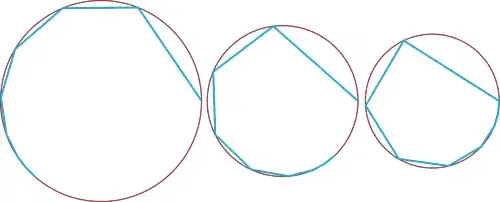
Break the polygon $P$ into an open polygonal chain with the same lengths as $P$. Place the chain in a large-radius circle, and shrink the radius until the chain closes. The result is the unique circumcircle for the inscribed $P$:

To reach closure, each $\ell_k$ must be less than the sum of the other lengths.

(This figure is from an MSE question of mine.)

Joseph O'Rourke
  • 149,182
  • 34
  • 342
  • 933
  • Thanks for your answer. Can you explain a bit more how this relates to the proof for the case $n=m=2$? – M. Winter Dec 14 '21 at 13:51
  • @M.Winter: Let the radius for the original $P$ be $r$. If you shorten any link, the polygonal chain will not close at $r$, but instead will have to shrink to a smaller radius to reach closure. – Joseph O'Rourke Dec 14 '21 at 14:27
  • 1
    I definitely see the intuition behind your argument, but I also believe that it leaves room for a lot of subtleties. For example, I would need to show, that starting at $P$, I can reach any closed chain by a continuous transition that is non-increasing on all edge-lengths. This is not true if the target chain has winding number $\le 0$. You can argue this away of course (but you somewhere need to use that the circumcenter is inside the convex hull). – M. Winter Dec 14 '21 at 15:52
0

"Yes" for the case $m=n=3$. I will assume that center of sphere lies in the first polyhedron, say $Q$, but it is straigthforward to remove this assumption.

Assume contrary. By rescaling the second polyhedron, say $P$, we can assume that the radius of the sphere stays the same as for the original polyhedron $Q$, but all edges get shorter.

Consider the central projection of the edges of $Q$ to the sphere. Note that they cut the sphere into cyclic polygons. Choose an edge $e$ of $Q$, consider two of its adjacent spherical cyclic polygons $F$ and $G$. The vertices of $F$ and $G$ lie on two arcs with endpoints of $e$. Since $Q$ is convex the arcs bound a nonconvex region from the sphere with $F$ and $G$ inside. The last statement (with some work) implies the following: if one decreases the edge $e$ while keeping $F$ and $G$ cyclic, then the total area of $F$ and $G$ decreases.

Now, for each edge of $Q$ draw a line segment between the corresponding vertices of $P$. Project the obtained line segments to the sphere. Since the center of sphere is inside of $P$ the spherical polygons that correspond to facets of $Q$ will cover the whole sphere. Note that cyclic polygon maximize the area among all polygons with the same sides. From above it follows that the total sum of their areas get smaller, but they cover the same sphere --- a contradiction.

  • This is definitely a very promising approach! I was not aware of the Kirszbraun Theorem. But I cannot yet see (and I put some thought into this) why $q_i\mapsto p_i$ is non-expanding. This is clear if we consider distances between $p_i,p_j$ with $ij\in E(G)$, but there are other pairs that do not correspond to edges in $G$. I believe this is true, but I do not yet know how to use the polytope structure to conclude this (but I will think a lot more in this direction). – M. Winter Dec 14 '21 at 13:49
  • @M.Winter Now it is a complete solution for $m=n=3$. – Anton Petrunin Dec 18 '21 at 09:42
  • Thank you very much for the update :). I have some questions: (1) "if one decreases the edge $e$ while keeping $F$ and $G$ cyclic, then the total area of $F$ and $G$ decreases", this seems plausible (I believe there should be many ways to see this), but I do not understand how this follows from the discussion prior to this sentence. By the way, I already know that this fails in higher dimensions: there is a polytope, if I shorten all of its edges, the volume can still increase. – M. Winter Dec 18 '21 at 13:59
  • (2) "Since the center of sphere is inside of $P$ the spherical polygons that correspond to facets of $Q$ will cover the whole sphere". This is not completely obvious to me. Consider the case $m=n=2$ in my post: it is possible that an inscribed polygonal chain whose convex hull contains the circumcenter still has winding number zero and does not cover the full circle. Of course, the edge length contractions should prevent this for $m=n=2$, but elaborating this for $m=n=3$ might need some work. Still, I believe this should be possible. – M. Winter Dec 18 '21 at 14:04
  • (3) "Now, for each edge of $Q$ draw a line segment between the corresponding vertices of $P$". Where is this part of the argument used? – M. Winter Dec 18 '21 at 14:05
  • But in general, the structure of the argument seems plausible to me: (1) the projections of the 2-faces of $Q$ cover the full sphere. (2) the projections of the $P$-equivalents of the 2-faces of $Q$ cover the same sphere. (3) but these $P$-equivalents have smaller volume. Contradiction. – M. Winter Dec 18 '21 at 14:10
  • @M.Winter (1) if a polygon does not contain its circumcenter then decreasing its longest side we increase its area. If we take two of such polygons that share the longest side then their total area increases, BUT this picture cannot come from the central projection of a convex polyhedron --- so you have to use the property discusses in the previous sentence. – Anton Petrunin Dec 18 '21 at 17:22
  • @M.Winter I did not get (3), for (2) --- I do not see a nice argument at the moment, but it must be true. – Anton Petrunin Dec 18 '21 at 17:24