A current project uses bijections from a set to itself. (The set is the integer compositions of $n$, i.e., "ordered partitions of $n$," but that doesn't seem pertinent to the question.) Is there a more specific name for such maps? These do not have order two, so involution is not correct. There is not an algebraic structure being considered, so automorphism doesn't sound right...
Asked
Active
Viewed 633 times
1

-
19"permutation"? I need to add length. – Ville Salo Dec 30 '22 at 09:33
-
@VilleSalo Hmm, maybe. I think of permutations in a very specific algebraic combinatorics sense, e.g., pattern avoiding permutations. – Brian Hopkins Dec 30 '22 at 09:37
-
6I agree with "permutation". – Gerald Edgar Dec 30 '22 at 09:37
-
6An example of a post on this site where permutation is used for an infinite set: Cardinality of the permutations of an infinite set. And a related question on [math.se]: Is it correct to say that every bijection of a set onto itself is a permutation? – Martin Sleziak Dec 30 '22 at 11:26
-
4The word is "permutation". Mathematicians have been reluctant for some time to accept the existence of infinite sets, and some of them are still reluctant to use the terminology "permutations" in the context of infinite sets. – YCor Dec 30 '22 at 16:35
-
1Historical note: the 1st appearance of permutations of infinite sets (explicitly) is maybe Vitali's 1915 note, where is was called (in Italian) "substitution" — "substitution" was indeed common for permutations of finite sets, notably in C. Jordan's famous Traité des substitutions. Vitali wrote (my translation) "We'll call *substitution* the transition from the permutation $1,2,3\dots,N,N+1,\dots$ to an arbitrary permutation". Of course "substitution" is now an obsolete terminology and I've never seen it in any modern text. – YCor Dec 30 '22 at 16:45
2 Answers
15
Permutation is the term I would use (indeed, when I teach, I define a "permutation" of a set $X$ as a bijection from $X$ to itself).


-
3Thanks for all the responses. As an aside, I found an MSE question that used "autojection" to the consternation of many. – Brian Hopkins Dec 30 '22 at 10:02
-
2@BrianHopkins, I originally read that as "autobijection", which is literally the first thing that occurred to me (before reading all the comments and answers proposing "permutation", which is of course the right answer), and which seems to me to be technically correct, if jarring. But, however much or litte traction I can imagine "autobijection" getting, "autojection" (trying to follow the "homomorphism" → "automorphism" model, I guess) would surely get less. – LSpice Dec 30 '22 at 16:20
-
2And furthermore, $X!$ is a standard notaton for the set of permutations of a set $X$, meaning the set of bijections of $X$ with itself. – Joel David Hamkins Dec 30 '22 at 19:43
-
2For the group of permutations of $X$, I have seldom seen the notation "$X!$" (choices of notation are sensitive to math communities, so I'm not saying it doesn't exist. Actually the use of "!" is confusing when the sentence/phrase is ending, but this is already a problem with the factorial notation $n!$. Calling it "set of permutations" rather than "group of permutations" would be strange in group theory :) but may be natural in combinatorics. The notation I've mostly seen: $S(X)$, $S_X$ $\mathrm{Sym}(X)$, $\mathrm{Sym}_X$, $\mathfrak{S}(X)$, $\mathfrak{S}_X$ ($\mathfrak{S}$ is \mathfrak{S}). – YCor Dec 31 '22 at 15:03
-
1I concur with YCor, and would add that I've also seen $\Sigma_X$ and $\Sigma(X)$. – Max Horn Dec 31 '22 at 16:23
2
Wikipedia has this nice graphics about about different mappings:
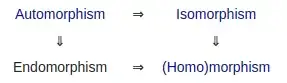
I believe you looking for either Automorphism or Endomorphism.

-
Thanks, Max. My discomfort with -morphism is that there's no underlying structure being preserved. – Brian Hopkins Dec 30 '22 at 09:39
-
12
-
@VilleSalo So in a combinatorics article (where the word category never arises), would you call these maps permutations or automorphisms? – Brian Hopkins Dec 30 '22 at 09:54
-
12